The story of Brewed From Within starts long ago.
Prismatic
There are endless early moves to help avoid pushing your idea toward someday. For instance, creative wireframing requires only a pencil. With a little visualized clarity in place, a couple exploratory conversations can also help.
First, meet with a mentor. This should feel like a supportive space but avoid rainbows and butterflies. Be realistic with exciting aspects of the idea, but also the challenges. As we learned in YDNTB, an early no is much better than a long, wrong yes. That said, playing it safe is easier than activating initiative, so don’t let early doubt slow you down. Instead, welcome it. Let curiosity uncover new understandings. Pivots are inevitable, and this exploration adds confidence as the original idea is tweaked toward product-market fit.
After transparently talking with that trusted mentor, the next meeting is with a potential customer. This will feel too early, but it’s not. You’re actually protecting your personal bandwidth by not swinging at a bad pitch too many times.
To optimize early innings, arrive prepared to ask good questions. Take notes and speak less so you can actively listen to how this potential early adopter is responding.
Are you building a pain killer or vitamin? Remember, feedback is data, and this is only one data point, but let this conversation infuse reality into the idea. Show up, stand out, follow up, stay connected, find a thoughtful way to accelerate their work, and then keep building.
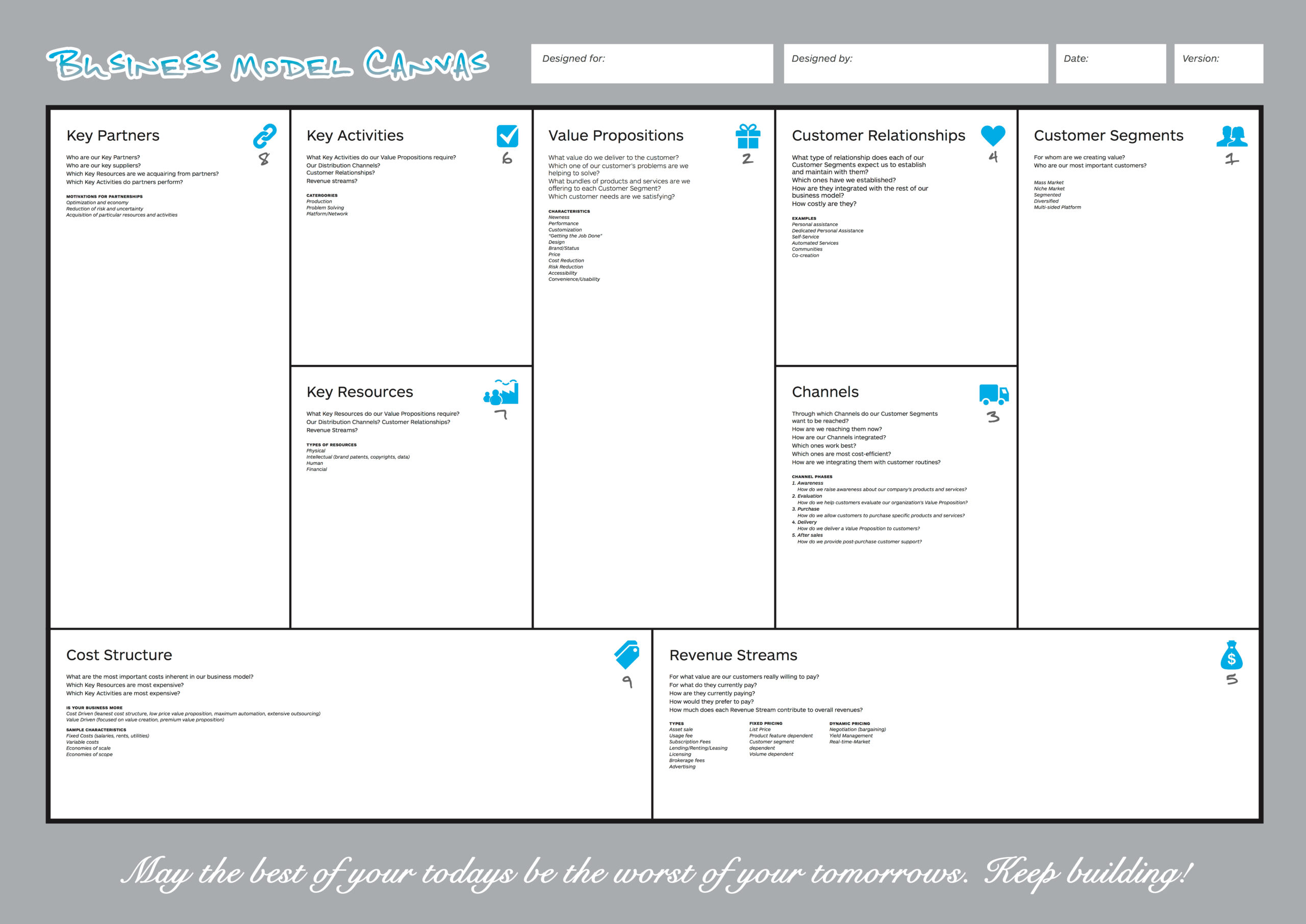

The business model canvas is a tool to do so. While it’s impossible to predict the future, business model canvases help us continue to explore while curating a story that sells.
Most early business ideas don’t have a clear story. This can make it hard to know where to start within the business model canvas. While you can use this tool in endless ways, consider an approach that is less about the entire business and more about one story at a time. Instead of trying to boil the ocean, organizing a complete story for each customer segment creates a combination of more actionable insights.

To give it a try, use this special business model canvas. The areas are numbered to curate canvases that each highlight a customer story:
- Customer Segments – Start with the details of a particular type of customer. The goal isn’t to complete the Customer Segments box. It’s starting a story to follow through the rest of the canvas. Now lean into the pain as you move from box to box and watch as your solution transforms into a story.
- Value Propositions – What benefit(s) can you deliver?
- Channels – Where can you connect with this customer?
- Customer Relationships – Who are you working with and how will you make this customer feel?
- Revenue Streams – Will financial income flow? How?
- Key Activities – What actions make the customer care?
- Key Resources – What is needed to keep building, and how might needs change to maintain momentum?
- Key Partners – Who helps to make this sustainable?
- Cost Structure – What costs go into activating this customer segment? How is pricing organized to support realistic profit margins that align with a financial model?
By telling the story of created value for one customer segment, hypotheses can be connected with context. Next, using a separate business model canvas, visualize more stories based on different customer segments.
With separate business model canvases for each customer segment, merge everything into one business model canvas. To stay organized, select different colors to use for each customer segment. As everything blends together, the prismatic rainbow maps roads to reality.
ArtOfficial
Art for art’s sake is vital to humanity and innovation.
We need fine artists and creatives who do not conform—who lead even when no one else follows. The calculated confusion we experience in contemporary, experimental, and abstract art pushes boundaries so new ideas, styles, and ways of thinking can emerge later. Immersing ourselves in these misunderstood realms trains us to trust strangeness. What feels unfamiliar today often becomes inevitable tomorrow.
EXTRA SHOT
This contribution was written by Siobhan Spain. Siobhan developed a new financially self-sustaining nonprofit model providing affordable creative workspace to over 200 artists of all disciplines in downtown Des Moines, Iowa. She now consults, podcasts about nonprofit ecosystems, and owns an arts licensing agency.
Practicing artists see potential before there’s proof. They have a high tolerance for risk and are willing to invest years of invisible labor while operating with restricted resources.
Artists and founders both shape how people think, feel, or behave. The divergence comes in their relationship to the market. Founders must satisfy a market need; ignoring users is fatal. Artists, meanwhile, can deliberately resist or ignore market signals altogether. This alienation can become the feature, not a flaw.
Then there’s the question of success and perceived impact. Founders are validated externally—users, revenue, growth. Artists often answer to internal measures: mastery of a medium, conceptual rigor, or the necessity of making work that holds personal meaning.
In the contemporary art world, a purist code of practice is common. “Selling out” is to be avoided at all costs, lest the merit of both artist and artwork be compromised. Selling out can mean creating work primarily for aesthetic beauty or mainstream appeal—heaven forbid it be mass-produced.
The commercialization of fine art often inverts traditional capitalist values, where financial success is viewed as a betrayal of artistic integrity. However, communities that prioritize building robust creative ecosystems recognize artists and creatives as powerful drivers for economic development, cultural identity, innovation, and social cohesion.
They foster diverse economic and social opportunities where titles, race, career, and socio-economic status dissolve into a culture of curiosity and inspiration that spark cross-disciplinary collaborations that benefit artists, companies, and civic entities alike.
As these sectors blend a financially sustainable infrastructure is now possible – motivating artists to lean into their creative visions with a sense of purpose.
Artists are critical thinkers who imagine what does not yet exist. They collaborate to form solutions before markets know to ask for them. They rehearse cultural shifts, test new narratives, and expand our collective tolerance for the unknown. Artists show us how to use emerging tools—AI included—with intention rather than conformity.
When artists stop being an afterthought and start being recognized as founders with foresight, more viable economic pathways emerge, cultural relevance deepens, and irreplaceable talents can be engaged by all.
Voices
the streets are restless
voices low,
rumbling of those
who feel forgotten
who feel the die was cast
before they were even born.
they hunger for the chance
to make something their own
to etch their mark in the wall of the world.
and in the shadows,
small fires are being lit
not by kings or queens
but by ordinary hands
with ordinary dreams.
it begins like a forest rising
out of swamp and tangle
messy, alive, unpredictable—
where strangers meet
where trust grows in broken soil
where one seed
can seed a thousand.
it says:
no one will save us
except us.
it says:
the right to begin
is the right to belong.
and if enough of us answer,
if enough of us care,
then out of the discontent
out of the silence of the left behind
will rise
a chorus of builders
a rainforest of possibility
a people remaking the world
with extraordinary love.
Extra Shot
This poem is from Victor W. Hwang.
Down Under
It’s easy to think the perfect investor pitch exists.
The inspired business idea, sharp slide deck design, magical lines within a concise pitch, and formulas to make everything click. Study fundraising all you want, but the art form can be seen when understanding adds space for storytelling that shows instincts.
EXTRA SHOT
This contribution was written by Saba Karim. This Australian technologist is a perpetual builder who has heard more business pitches than anyone you know.
During my time at Techstars, we listened to hundreds of founder pitches. Different industries, backgrounds, and levels of experience. On paper, many of the companies looked nearly identical. Similar markets, similar traction, similar slides. Yet the outcomes were rarely the same. Some conversations created momentum immediately. Others stalled, even when the numbers looked better.
The difference was almost never the product. It lived in the story. The strongest founders were not reciting information. They were explaining how they saw the world. Their judgment was heard in the way they framed problems and talked through decisions. Their pitch was not something memorized. It was something the founder(s) understood. That distinction matters, because investors are not betting on slides. They are betting on decision makers. A deck can show intelligence. A story reveals instinct.
Many founders treat pitching like a checklist. Hit these slides. Answer these questions. Say the right words. But when either side approaches an early interaction that way, the conversation usually falls flat. No deck is ever complete enough to replace connection.
When founders realize alignment matters more than perfection, the dynamic changes. The meeting stops feeling like a performance and starts feeling like a conversation. That shift alone creates momentum.
Momentum is not mysterious. It is human. Founders who walk into meetings with clarity tend to leave with more doors open. Not because everything is perfect, but because belief compounds quickly. You can feel when someone has their right foot forward.
They are not rushing.
They are not over-explaining.
They speak in present tense.
This is what exists today.
This is what we’ve learned.
This is what we are doing next.
Reality builds more trust than ambition ever will.
Another common mistake is trying to sell the product instead of the opportunity. Features matter, but they rarely carry the conversation. What resonates is why the problem matters, why the timing makes sense, and why this founder cannot walk away from it.
The best meetings barely felt like pitches at all. They are calm, low pressure conversations. Sometimes there was a deck. Sometimes there was just a demo. The tone shifted from here is what I want to build to here is what I have already built. That shift changes everything.
As founders, we tend to overthink the wrong details. Being slightly late. A noisy background. A moment of nerves. Those things rarely matter. What does matter is presence. Listening instead of talking. Answering the question that was asked. Slowing down enough to think clearly.
Extra Shot
Confidence is not volume. It is calm.
Over time, storytelling stops being a fundraising skill and becomes a life skill. Entrepreneurship demands it constantly. With investors, teammates, customers, and yourself. Every difficult decision needs a narrative strong enough to carry uncertainty.
Early on, those stories are mostly aspiration. Later, experience reshapes them. Obsession sharpens them. Failure humbles them. You stop trying to sound impressive and start trying to sound honest.
Eventually, you care less about winning every room and more about finding rooms where you belong. Fundraising becomes relational. You are no longer trying to convince someone to believe in you. You are discovering whether you already believe the same things.
People do not want to feel processed, optimized, or pitched. Success, whether in business or in life, is rarely about winning someone over. It is about how people feel when they leave your presence. The energy you bring into a room. The care you show when no outcome is attached.
In the end, the perfect pitch never existed. What existed was clarity, presence, and the courage to speak from experience instead of expectation. There is no finish line. Only better questions, deeper alignment, and the quiet understanding that the best relationships are all built the same. With intention, kindness, and a genuine desire to be remembered for how you made people feel.