Wayfinders

Startups that pay in love are a blank
canvas that comes to life through us.

By nature, parents want to provide the means for children to go beyond their potential. Family requires immeasurable resources, but the love from our kids unlocks more hours in the day. The added productivity comes from seeing the best of ourselves in someone we care so much about. Purpose is renewed, and the heart we put into our creative work can make our presence as parents even more interesting.

Summon Stories

Children grow up fast, so we stay in the moment. Everyone tells us to cherish the simple joys of life, but it may be worth getting a little extra creative. One way to enhance your family’s ability to relive memorable moments is to use multimedia marketing skills to summon family stories.

Every moment is special. As creation becomes an acquired behavior, we can stitch together memories for our children to revisit interactively, any time, with or without us. We all have an endless collection of photos and videos on our smartphones, but scrolling around on a digital device does not translate into something a group can enjoy together. It’s easy for anything to get lost in so much noise. Spoken storytelling is always appreciated, but why not paint our most treasured stories with a few added brushes?

You can create quiet relics like photo slideshows, something that sits on the shelf, a mix of audio recordings, art on the wall, or a cinematic feature film that highlights your adventures. You’re the creator with endless ways to create.

We all do a form of this because family is our favorite, but the time required is real. A rigid cadence is not required, since any day is a good day to ship this type of art. In the early days of photos and video, recording family time was reserved for birthdays and Christmas; now, every day is a holiday. You don’t need to rush but keep producing new surprises. Everyone will love the end result, and as more come together, the growing playlist becomes a sequence of stories that follow kids growing up. With our constant collection of content, a good story is always ready to tell, but at a minimum, why not share an annual gift with your kids, partner, and other loved ones?

Along the way, attentive organization will make a growing collection of relics easier to craft. This takes an ongoing commitment, but file management is easy and helps bring life to life with shared memories.

Your future self will then thank you for organizing and producing such heartfelt content. Share this beauty in public if you want, but that can alter the art if it becomes performative. Do this for yourself and your favorite people first. Organize the massive library offline, then, if you want to play with the transitory channels of social media, that’s a personal choice.

Tracking neural activity patterns and electronic brain scans may retrieve memories without physically capturing content in the future. For now, it’s up to us to coordinate personal storytelling. Fortunately, compiling your own heritage is amusing and assembles positive emotions along the way.

This special interest becomes second nature as we enhance our own real skills to commemorate those we love. Technology can make editing content productive, but this is not your average task. This is the type of sincere storytelling you enjoy spending time with.

As kids grow up, these projects will have a low view counts but will always be your favorite. Looking ahead, imagine being a child right now, then receiving such a thoughtful collection from your parents someday!

You’ve Got Mail

Consider setting up an email for your little one. This inbox can be used as a communication channel to write to your child as they grow up. Whether you start writing before they are born or later in their life, imagine the gift this inbox will be in the future! This email address can be shared and used for online accounts, but at a minimum, this tailored inbox curates a personalized time machine full of thoughtful updates.

Along with sentimental content, your kids will appreciate an email address that can be used after childhood. First and last name with your preferred email provider should stand the test of time. This is also a good chance to register a URL using their first and last name. Your gift can personalize an email address or support a personal website someday.

Avoid Routine

“Time flies” and “They grow up so fast” are accurate, but avoiding routine may slow down time.

The freedom to be spontaneous is a privilege, and everyone will define such flexibility differently, but a proven path to explore such a reality is entrepreneurship. Boundless hard work, dedication, and resiliency are what this lifestyle takes, but suffering provides a stronger sense of purpose.

Extra Shot
What’s your favorite parenting tip?

As this purpose is layered in later stages of life, experiential wisdom can be channeled into more treasured time doing things that make us happy. While hardship is part of the deal, children make their parents happy. Perhaps a reward for parents who lead by example is the opportunity to share everything with those who matter most.

Brewed From Within
#118 📖 Life & Happiness
By Ben McDougal, ago

Prismatic

There are endless early moves to help avoid pushing your idea toward someday. For instance, creative wireframing requires only a pencil. With a little visualized clarity in place, a couple exploratory conversations can also help.

First, meet with a mentor. This should feel like a supportive space but avoid rainbows and butterflies. Be realistic with exciting aspects of the idea, but also the challenges. As we learned in YDNTB, an early no is much better than a long, wrong yes. That said, playing it safe is easier than activating initiative, so don’t let early doubt slow you down. Instead, welcome it. Let curiosity uncover new understandings. Pivots are inevitable, and this exploration adds confidence as the original idea is tweaked toward product-market fit.

After transparently talking with that trusted mentor, the next meeting is with a potential customer. This will feel too early, but it’s not. You’re actually protecting your personal bandwidth by not swinging at a bad pitch too many times.

To optimize early innings, arrive prepared to ask good questions. Take notes and speak less so you can actively listen to how this potential early adopter is responding.

Are you building a pain killer or vitamin? Remember, feedback is data, and this is only one data point, but let this conversation infuse reality into the idea. Show up, stand out, follow up, stay connected, find a thoughtful way to accelerate their work, and then keep building.

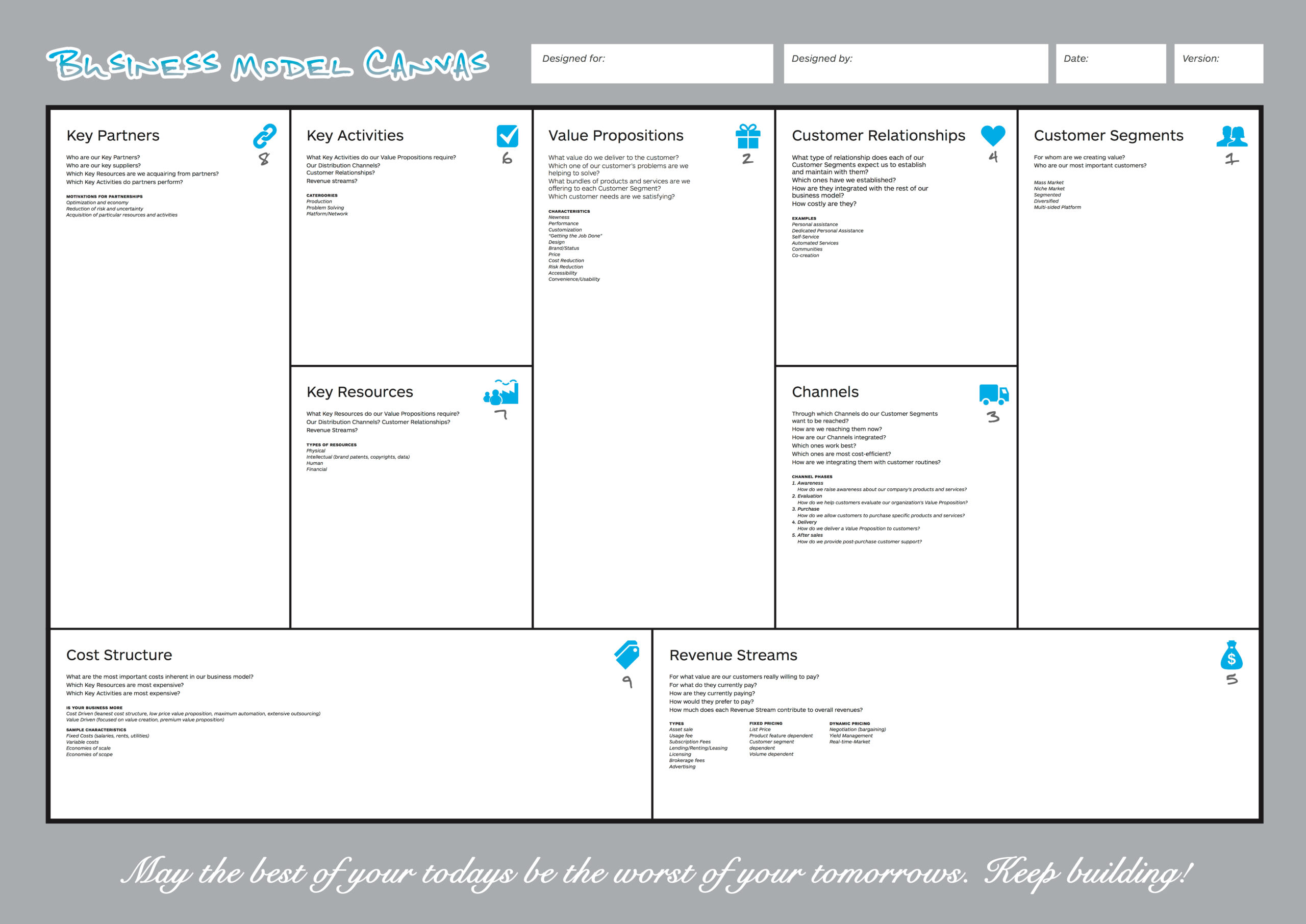
The business model canvas is a tool to do so. While it’s impossible to predict the future, business model canvases help us continue to explore while curating a story that sells.

Most early business ideas don’t have a clear story. This can make it hard to know where to start within the business model canvas. While you can use this tool in endless ways, consider an approach that is less about the entire business and more about one story at a time. Instead of trying to boil the ocean, organizing a complete story for each customer segment creates a combination of more actionable insights.

To give it a try, use this special business model canvas. The areas are numbered to curate canvases that each highlight a customer story:

  1. Customer Segments – Start with the details of a particular type of customer. The goal isn’t to complete the Customer Segments box. It’s starting a story to follow through the rest of the canvas. Now lean into the pain as you move from box to box and watch as your solution transforms into a story.
  2. Value Propositions – What benefit(s) can you deliver?
  3. Channels – Where can you connect with this customer?
  4. Customer Relationships – Who are you working with and how will you make this customer feel?
  5. Revenue Streams – Will financial income flow? How?
  6. Key Activities – What actions make the customer care?
  7. Key Resources – What is needed to keep building, and how might needs change to maintain momentum?
  8. Key Partners – Who helps to make this sustainable?
  9. Cost Structure – What costs go into activating this customer segment? How is pricing organized to support realistic profit margins that align with a financial model?

                By telling the story of created value for one customer segment, hypotheses can be connected with context. Next, using a separate business model canvas, visualize more stories based on different customer segments.

                With separate business model canvases for each customer segment, merge everything into one business model canvas. To stay organized, select different colors to use for each customer segment. As everything blends together, the prismatic rainbow maps roads to reality.

                Brewed From Within
                #8 📖 Entrepreneurship

                By Ben McDougal, ago

                Down Under

                It’s easy to think the perfect investor pitch exists.

                The inspired business idea, sharp slide deck design, magical lines within a concise pitch, and formulas to make everything click. Study fundraising all you want, but the art form can be seen when understanding adds space for storytelling that shows instincts.

                EXTRA SHOT

                This contribution was written by Saba Karim. This Australian technologist is a perpetual builder who has heard more business pitches than anyone you know.

                During my time at Techstars, we listened to hundreds of founder pitches. Different industries, backgrounds, and levels of experience. On paper, many of the companies looked nearly identical. Similar markets, similar traction, similar slides. Yet the outcomes were rarely the same. Some conversations created momentum immediately. Others stalled, even when the numbers looked better.

                The difference was almost never the product. It lived in the story. The strongest founders were not reciting information. They were explaining how they saw the world. Their judgment was heard in the way they framed problems and talked through decisions. Their pitch was not something memorized. It was something the founder(s) understood. That distinction matters, because investors are not betting on slides. They are betting on decision makers. A deck can show intelligence. A story reveals instinct.

                Many founders treat pitching like a checklist. Hit these slides. Answer these questions. Say the right words. But when either side approaches an early interaction that way, the conversation usually falls flat. No deck is ever complete enough to replace connection.

                When founders realize alignment matters more than perfection, the dynamic changes. The meeting stops feeling like a performance and starts feeling like a conversation. That shift alone creates momentum.

                Momentum is not mysterious. It is human. Founders who walk into meetings with clarity tend to leave with more doors open. Not because everything is perfect, but because belief compounds quickly. You can feel when someone has their right foot forward. 

                They are not rushing.
                They are not over-explaining.
                They speak in present tense.
                This is what exists today.
                This is what we’ve learned.
                This is what we are doing next.

                Reality builds more trust than ambition ever will.

                Another common mistake is trying to sell the product instead of the opportunity. Features matter, but they rarely carry the conversation. What resonates is why the problem matters, why the timing makes sense, and why this founder cannot walk away from it.

                The best meetings barely felt like pitches at all. They are calm, low pressure conversations. Sometimes there was a deck. Sometimes there was just a demo. The tone shifted from here is what I want to build to here is what I have already built. That shift changes everything.

                As founders, we tend to overthink the wrong details. Being slightly late. A noisy background. A moment of nerves. Those things rarely matter. What does matter is presence. Listening instead of talking. Answering the question that was asked. Slowing down enough to think clearly.

                Extra Shot

                Confidence is not volume. It is calm.

                Over time, storytelling stops being a fundraising skill and becomes a life skill. Entrepreneurship demands it constantly. With investors, teammates, customers, and yourself. Every difficult decision needs a narrative strong enough to carry uncertainty.

                Early on, those stories are mostly aspiration. Later, experience reshapes them. Obsession sharpens them. Failure humbles them. You stop trying to sound impressive and start trying to sound honest.

                Eventually, you care less about winning every room and more about finding rooms where you belong. Fundraising becomes relational. You are no longer trying to convince someone to believe in you. You are discovering whether you already believe the same things.

                People do not want to feel processed, optimized, or pitched. Success, whether in business or in life, is rarely about winning someone over. It is about how people feel when they leave your presence. The energy you bring into a room. The care you show when no outcome is attached.

                In the end, the perfect pitch never existed. What existed was clarity, presence, and the courage to speak from experience instead of expectation. There is no finish line. Only better questions, deeper alignment, and the quiet understanding that the best relationships are all built the same. With intention, kindness, and a genuine desire to be remembered for how you made people feel.

                Brewed From Within
                #20 📖 Entrepreneurship

                By Ben McDougal, ago

                Fashion Activism

                A movement doesn’t start with noise. It starts with intention.

                Let’s cook up the ingredients for a fashion activism movement.

                1. Clear Why
                  Before the fabric, before the fit—know the purpose. What injustice are we confronting? What truth are we amplifying? If the “why” isn’t rooted in lived experience or deep listening, the clothes will speak, but they won’t say anything real.
                2. Story Over Trend
                  Trends fade. Stories stay. Fashion activism is about garments carrying memory, struggle, joy, resistance. Every stitch should answer the question: who is this for and what are we protecting or pushing forward?
                3. Accessibility
                  Movements don’t live on pedestals. They live in neighborhoods, classrooms, kitchens, sidewalks. If people can’t see themselves wearing it, touching it, or participating in it—then it’s not a movement, it’s a moment.
                4. Co-Creators
                  You don’t build a movement alone. Invite youth, elders, artists, skeptics, organizers. Let people shape the message. Fashion becomes activism when the community helps design the uniform.
                5. Consistency
                  One hoodie doesn’t change the world. Repetition does. Show up again. And again. Workshops. Conversations. Pop-ups. Education. Fashion activism is practice, not performance.
                6. Courage in Discomfort
                  If nobody’s uneasy, you’re probably not pushing hard enough. Clothing should sometimes interrupt the room. Make people pause. Make them ask questions they’ve been avoiding.
                7. Joy as Resistance
                  Activism doesn’t have to be heavy to be powerful. Joy, beauty, pride—these are radical tools. Celebration keeps people engaged longer than anger alone ever will.
                8. Paths Forward
                  A movement must offer direction. Awareness is step one—but what’s step two? Where does the energy go after the outfit is seen? Give people somewhere to walk next.

                EXTRA SHOT
                This contribution was written by Andrè Wright. Andrè is a world traveler who uses design, fashion, and art to inspire students and community-driven movements.

                Fashion activism isn’t about what we wear.
                It’s about what we refuse to ignore.

                When clothing becomes language—and community becomes the author—that’s when a movement is born.

                By Ben McDougal, ago

                Perpetuity

                There are infinite ways in which perpetuity could be good or bad, but proficient happiness, trust, love, hard work, fun, generosity, learning, wonder, and action seem like safe bets.

                As we traverse the entrepreneurial lifestyle, setbacks are inevitable, but each conquered setback makes us more resilient. As resiliency bonds with wisdom, focused determination makes setbacks less distracting. Eventually, setbacks become more like interesting obstacles for trained problem-solvers. This seasoned mindset welcomes suffering and unlocks the wild cards of consistency and persistence.

                Passion is overused as a motivating factor, and enthusiastic storytelling is easier for extroverts to fake. The key to lasting success is more like an energizing obsession that makes us build when others don’t. We savor the quests we were called to pursue and push through the dips that make others quit. We don’t need a map and find comfort in the unknowns, as we all continue making a ruckus every step of the way. Ω

                Brewed From Within
                #125 📖 Life & Happiness

                By Ben McDougal, ago