Prismatic

There are endless early moves to help avoid pushing your idea toward someday. For instance, creative wireframing requires only a pencil. With a little visualized clarity in place, a couple exploratory conversations can also help.

First, meet with a mentor. This should feel like a supportive space but avoid rainbows and butterflies. Be realistic with exciting aspects of the idea, but also the challenges. As we learned in YDNTB, an early no is much better than a long, wrong yes. That said, playing it safe is easier than activating initiative, so don’t let early doubt slow you down. Instead, welcome it. Let curiosity uncover new understandings. Pivots are inevitable, and this exploration adds confidence as the original idea is tweaked toward product-market fit.

After transparently talking with that trusted mentor, the next meeting is with a potential customer. This will feel too early, but it’s not. You’re actually protecting your personal bandwidth by not swinging at a bad pitch too many times.

To optimize early interactions, arrive prepared to ask good questions. Take notes and speak less so you can actively listen to how this potential early adopter is responding.

Are you building a pain killer or vitamin? Remember, feedback is data, and this is only one data point, but let this conversation infuse reality into the idea. Show up, stand out, follow up, stay connected, find a thoughtful way to accelerate their work, and then keep building.

The business model canvas is a tool to do so. While it’s impossible to predict the future, business model canvases help us continue to explore while curating a story that sells.

Most early business ideas don’t have a clear story. This can make it hard to know where to start within the business model canvas. While you can use this tool in endless ways, consider an approach that is less about the entire business and more about one story at a time. Instead of trying to boil the ocean, organizing a complete story for each customer segment creates a combination of more actionable insights.
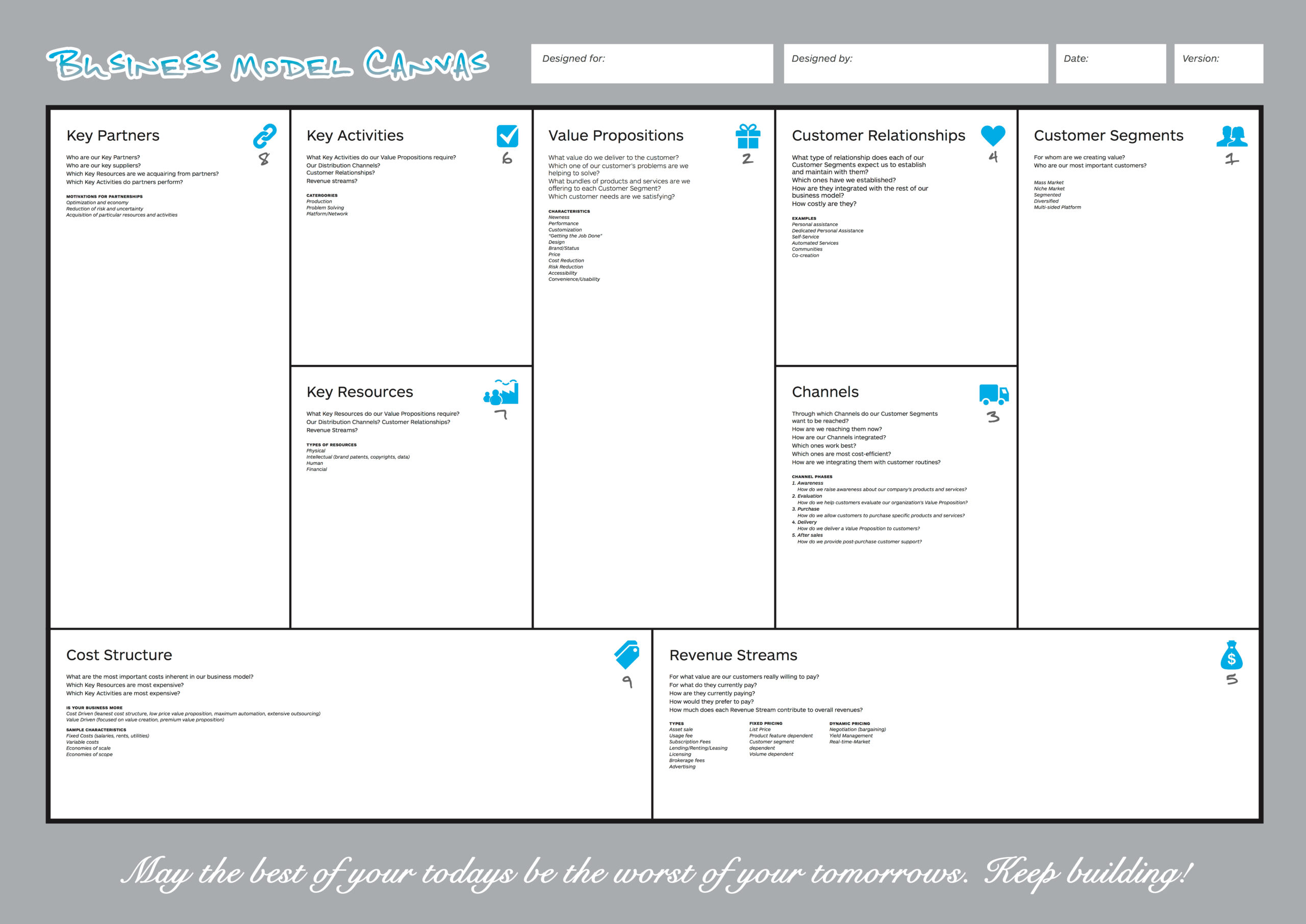

To give it a try, use this riff’s QR code to find our special business model canvas. The areas are numbered to curate multiple canvases that each highlight one customer story:

  1. Customer Segments – Start with the details of a particular type of customer. The goal isn’t to complete the Customer Segments box. It’s starting a story to follow through the rest of the canvas. Now lean into the pain as you move from box to box and watch as your solution transforms into a story.
  1. Value Propositions – What value do you plan to deliver?
  1. Channels – Where can you connect with this customer?
  1. Customer Relationships – Who are you working with and how can you make this customer feel appreciated?
  1. Revenue Streams – What are all the ways to earn income?
  1. Key Activities – What actions ensure this customer cares?
  1. Key Resources – What is needed to keep building, and how might needs change to maintain momentum over time?
  1. Key Partners – Who can help to make this story sustainable?
  1. Cost Structure – What costs go into activating this customer segment, and how is pricing organized to support realistic profit margins that align with a healthy financial model?

By telling the story of how you’re creating value for one customer segment, hypotheses are connected with context.

Next, using a separate business model canvas, visualize more stories based on different customer segments.

With separate business model canvases for each customer segment, merge everything into one business model canvas. To stay organized, select different colors to use for each customer segment. As everything blends together, the prismatic rainbow maps roads to reality.


 

ORIGINAL POST

The New Year is already starting to feel like old news, eh. Let’s shake off that early temptation to push your new idea toward someday. Look, I get it. There was intoxicating enthusiasm when you first thought through everything over the holidays. As you’ve returned to routine, the idea that felt like it was the one & only thing that mattered, now seems to be falling down your priority list.

Extra Shot

This is normal, but we’re not normal!
We are the weird who make a ruckus.

After some creative wireframing, I challenge you to setup (at least) two meeting to breath life into this budding idea. First, meet with a #givefirst mentor. This should feel like a supportive space, but avoid rainbows and butterflies. Be realistic by sharing the exciting aspects of the idea, but also the challenges. As discussed in YDNTB, a fast no is much better than a long, wrong yes. That said, playing it safe is easier than activating initiative, so don’t let early doubt slow you down. Instead, welcome it. Let this energizing form of curiosity uncover new understandings. Pivots are inevitable and this exploration adds confidence as the original ideal is tweaked toward product-market fit.

After transparently talking with that trusted mentor, the next meeting is with a potential customer. This will feel too early, but it’s not. Your actually protecting your personal bandwidth by not swinging at a bad pitch too many times. Be smart to optimize these early interactions. Arrive prepared to ask good questions. Take notes and speak less so you can actively listen to how this potential early adopter is responding. Are you building a pain killer or vitamin? Remember, feedback is data and this is only one data point, but let this conversation absorb reality into the idea. Show up, stand out, follow up, stay connected by accelerating their work, and let’s keep building.

To do so, let’s continue brewing into this month’s theme of early moves. The business model canvas is a tool for crafting a story that sells. Here is a business model canvas that includes a little extra encouragement.

As we dive in, I’d like to share a suggested cadence from a friend of mine. Based in Sacramento, JDM is a fellow founder, entrepreneurial ecosystem builder, and tenacious content creator. He will be sharing a caffeinated contribution soon, but the way he moves through the business model canvas caught my attention. In short, most business models can’t be told in one story so it’s not one box at a time, but one story at a time. Instead of trying to boil the ocean, organize different stories for each customer segment. I’ve numbered each box in this downloadable business model canvas as a friendly guide.

  1. Customer Segments – Start with the details of a particular type of customer. The goal isn’t to complete the Customer Segments box. It’s starting a story to follow through the rest of the canvas. Now lean into the pain as you move from box to box and watch as your solution transforms into a story.
  2. Value Propositions – Based on this single customer, outline the value you’ll deliver.
  3. Channels – Where will your business connect with this specific customer?
  4. Customer Relationships – Who are you working with and how will collaboration feel?
  5. Revenue Streams – Based on the first four boxes, what’s the exchange the value?
  6. Key Activities – To deliver on the promise, you must execute with action(s).
  7. Key Resources – Using all seven capitals, here’s what’s needed to keep building.
  8. Key Partners – We can do more with less in the connected era. Who helps you get where?
  9. Cost Structure – The financial capital needed to go from problem to solution.

By telling the story of how you’re creating value for one customer segment, hypotheses connect through all nine boxes and are properly contextualized. Now add more stories, one at a time. To stay organized, use a clean business model canvas for each customer. With different stories told for each customer, color code each story as they are merged into one business model canvas. As everything blends together, the rainbow of color creates a roadmap to reality.

By Ben McDougal, ago

Everyday Activism

Power from the past keeps us moving, but effectiveness dwindles when fewer voices are heard. Fewer voices help those in power grow quickly, but history reminds us how a lack of diversity is not only dangerous, it’s boring. This invites the leader inside us all, to design action for change by empowering diverse populations.

EXTRA SHOT
This contribution was written by Andrè Wright. Andrè is a world traveler who uses design, fashion, and art to inspire students and community-driven movements.

To thread a topic for discussion, let’s stick a few bars on the global language of fashion. Our voices can be heard, but sometimes the volume makes a message miss. The art we share online is material, but can be lost in the sea of content. Efforts add up, but community requires sacrifice. Activate as much energy as possible, but clothing can also speak. What we wear tells a story. This story has many characters, each playing a role in how we feel, think, and act. What we wear hides or magnifies your mode for that moment. Fashion makes each outfit a creative act. We dress to impress, to feel the chill, to stand out, to fit in, to perform, to relax, or just to call it good enough. No matter the story of what we wear, our creative expressions can be enhanced with education and experiences that foster engagement, adaptability, and collaborative partnerships. For any genre, when stories stack alongside real progress, community-driven activism can grow a movement.

The right audience in the moment (timely) and over time (timeless) sets a direction for a movement. This form of group action may involve individuals, organizations, or both. Together, a vision is understood thanks to a compelling narrative. Planning keeps the vision clear and supports small, but consistent moves that all rhyme over time. The movements we all talk about are those that provide opportunities to build our skills in leadership, teamwork, and citizenship through creative expression.

We each have our own gifts and people we love. This makes the style of how we interact with the world all your own. You are your own sustainable accouterment for change.

Everyday activism adds up and the diversity it inspires can keep things interesting. Designed with an open mind and a positive-sum mindset, everyday activists form communities that create conditions to help us all thrive. We develop more conscious people who can then contribute positively to their families, schools, communities, and the world.

By Ben McDougal, ago

Base Camp

Join us at base camp as Jon Kallen builds a mountain for us to climb. We lean into the pain and carry our own gear with stories from AconcaguaDenali, Kilimanjaro, and more high altitudes worldwide. When he’s not craving gummy worms on snow capped peaks above the clouds, this impactful leader mentors founders commercializing business strategies. We reflect on this leadership alongside our closing message to the mountains.

LISTEN on APPLE PODCASTS
LISTEN on SPOTIFY

https://JenningsKallen.com

https://AlgaeBiomass.org

http://Base-Camp.YouDontNeedThisPodcast.com

Roasted Reflections Break: Landing

EP18 – Fourteeners 🎙️ Jeff Reed

EP58 – Always Growing 🎙️ Clayton Mooney

http://YouDontNeedThisPodcast.com

https://BenMcDougal.com/anticipation

44 Harsh Truths About Human Nature

https://films.NationalGeographic.com/free-solo

https://Alpinist.com/podcast

Snowboarding Utah

By Ben McDougal, ago

Rubik’s Cube

Curt Nelson and Beth Meyer help entrepreneurs spin the Rubik’s cube that is starting (and scaling) a business. The Entrepreneurial Development Center is celebrating 20 years of really getting involved to make an impact. Curt also leads the Iowa Venture Capital Association.

Together, we chat through the origin story of the EDC, then shift gears to chat about tracking milestones with mentors, giving advice, raising financial capital, managing startup boards, and the investor landscape throughout Iowa.

Enjoy this Episode
YDNTP on APPLE PODCASTS
YDNTP on SPOTIFY

By Ben McDougal, ago