Woven Worlds

Culture is woven; technology is built. One accumulates through memory and shared meaning, shaped over time by many hands. The other is designed and assembled with intention. This distinction matters because what is built can be finished, while what is woven never is.

Through stories, symbols, and artifacts, each generation adds new layers to the tapestry of our world. What once took only physical form is increasingly becoming digital, carried forward by the relentless evolution of technology. Yet, once introduced, technology rarely remains confined to its original purpose. It’s folded into the fabric of our world where it’s interpreted and repurposed, becoming part of our society in ways its creators could not fully anticipate. This process is cumulative, not merely additive. New ideas rarely replace what came before; they intertwine with it. Beliefs and practices become entangled across time itself.

EXTRA SHOT
This contribution was written by Will Schneller. This founder is a curious creator who explores how art, technology, and community connect.

At the edge of new frontiers, humans reach for the familiar. We stitch together distancethe gap between the known and unknown with shapes we recognize. Sometimes this instinct serves convenience or efficiency, making new systems easier to adopt. An artwork originating in oil paint is trivial to transfer into a physical print edition, and it’s even easier to make that print digitally available. A ticket to a sporting event that once existed on perforated paper now lives on a handy smartphone app. Your favorite album is no longer confined to the shelf but sits among thousands of other songs on a device in your pocket. Other times, replication is a coping mechanism, a way to translate ideas that feel too abstract, too technical, or difficult to explain.

Even when digital systems begin by imitating familiar physical forms, digital depth quietly emerges beneath the surface. Metadata invisibly flows; hidden traces record not just what something is, but how it came to be, and how it moves through networks. MThe meaning in what we create no longer resides solely in appearance or original intent. It accrues through circulation, reference, and response. As these translations settle into everyday use, they begin to expose possibilities that were never present in their physical counterparts. Constraints loosen and rules get rewritten. Systems that once existed to mirror the familiar start inviting exploration, modification, and play. What follows is not a better copy of the old world, but a space where new behaviors and relationships can unfurl.

While some technological advances are purpose-built to solve specific problems, others become playgrounds. Environments where new primitives can be experimented with and explored. For example, blockchains created the conditions for non-fungible tokens to be born. NFTs (“non-fungible tokens”) are digital assets supported by smart contracts that connect to a blockchain. Each NFT is unique, which allows code to autonomously apply, track, and transfer digital signatures and verifiable ownership. Although each digital artifact may have no exact equivalent, it can still evolve over time. These blockchain-native assets allowed us to apply property rights to digital goods and interact with like-minded individuals without corporate algorithms shaping every connection.

Long before NFTs gained prominence, video games had already been rehearsing some of the same ideas. Virtual worlds established shared rulesets, persistent identities, and digital artifacts whose value emerged through play and social context rather than physical substance. Communities formed around common mechanics, aesthetics, and norms. They assigned meaning to avatars, skins, achievements, and in-game assets that only existed as code yet carried real weight. Traditionally, in-game items are effectively rented, disappearing when servers shut down; blockchain-based ownership proposed permanence, portability, and player-held authority. Once ownership can be represented digitally with credible verification, we give users their own cybernated backpack to store, use, and transfer digital assets. Instead of centralized servers restricting our digital assets, decentralized protocols and web3 layering supports ownership across different platforms. tThe conversation expands beyond art and gaming into everyday artifacts like memberships, credentials, and records that structure daily life.

As these digital-native systems mature, they enable entirely new creative and cultural capabilities. Not merely faster production or broader distribution, but fundamentally different relationships between audiences, creators, and artifacts. One such shift was generative creation. Instead of crafting a single, fixed outcome, creators began defining rule sets; constraints, probabilities, and parameters from which many unique expressions could emerge. Authorship moved upstream from execution to orchestration. One of the earliest and most visible examples was Larva Labs’ CryptoPunks which demonstrated that scarcity and identity could be encoded directly into digital artifacts. Each image was simple, but its meaning was amplified by its inclusion within a fixed set, its history of ownership, and its role as a recognized cultural symbol. Platforms like Art Blocks pushed this idea further by entangling the code powering the generative image algorithms with the cryptographic functions of the blockchain itself to create a symbiotic relationship between process and product. Variation became a feature, not a flaw, and collectors became participants in the moment of creation itself.

Alongside generative art, other projects explored coordination and collective meaning-making through radical simplicity. Jack Butcher’s Checks emerged as social commentary when Twitter (now X) infamously monetized account verification, replacing long-standing signals of notability with a paid badge. More than capturing the cultural moment, Checks leveraged the blockchain architecture itself to create an infinite game of coordination where holders could recombine varying edition sizes to create new outputs, thereby elevating them into collaborators. Another of Butcher’s projects, Opepen, transformed the silhouette of a popular internet-native character, Pepe the Frog, into a gallery-esque system in which constraint became the canvas. Artists across backgrounds and styles imagined thematic sets, each adding a distinct thread to the whole. Through distributed voting, token holders collectively enshrined new works into a permanent collection, shaping the canon set by set. Power did not come from technical complexity or visual detail, but from repetition, shared context, and sustained participation over time. The community drove the narrative.

Taken together, these projects revealed a broader shift. Digital artifacts were no longer static endpoints, but dynamic nodes within living systems. Value emerged not only from aesthetics or novelty, but from process, lineage, and collective engagement. Creation became less about producing objects and more about shaping culture-organizing frameworks within which culture could organize itself. In this way, technology did not replace traditional artistic or cultural practices; it extended them, offering new ways for ideas to propagate, mutate, and endure. But more than offering a new set of tools, technology holds up a mirror, forcing us to confront what we value as our physical and digital lives continue to merge, layer by layer, thread by thread.

When novelty fades and attention moves on, what remains is not spectacle but structure. People return to the tangible, not in rejection of the digital but in search of something that is grounding. Digital slips into quieter roles as infrastructure. This isn’t failure but rhythm, an expression of how new technologies mature over time. Every major technological shift follows the a familiar arc discussed in the upcoming Yin Yang riff. Early breakthroughs ignite curiosity and experimentation, producing rapid growth as possibilities are explored. Along the Often described as an S-curve of a technology’s life cycle, this initial ascent is driven by potential rather than stability. Expectations rise faster than practical understanding. Capital and cultural energy concentrate at the leading edge, amplifying both innovation and excess.

Inevitably, the curve bends and the edges begin to fray. Constraints appear and promises collide with reality. What cannot sustain itself is torn away, giving rise to periods of contraction or disillusionment. These moments are frequently mistaken for failures and become opportunities for skeptics to declare their predictions correct. However, they serve a necessary function. They clear the noise from signals, speculation from utility, and fragile ideas from durable ones. What follows is not a return to obscurity but a slower, steadier climb. The technology re-enters everyday life, quietly embedded into workflows, tools, and habits, often under new branding to shed cultural baggage. It stops demanding attention and begins offering reliability. Value shifts from novelty to usefulness, from expansion to integration. The most enduring systems are no longer those that announce themselves loudly, but those that quietly become indispensable.

Each technology life cycle pulls old threads forward, reweaving the physical and digital into a fabric that grows richer with history. Past experiments inform future structures. Early missteps become knots rather than dead ends, points of tension that strengthen the tapestry. Over time, what once felt disruptive becomes foundational, and the boundary between the new and the familiar dissolves until the cycle begins anew. What remains is not the novelty of the tools themselves, but the patterns of use, meaning, and connection sewn around them. Technologies may be constructed in moments, but their cultural significance is woven slowly through repetition and shared experience. In the long run, progress is measured not by what is built, but by what endures.

By Ben McDougal, ago

Líneas Invisibles

Están por todos lados. Este barrio contra el otro. Nuestra comunidad contra la de ellos. Mi estado contra tu estado. Este país contra aquel país. Las líneas invisibles crean lealtades. Crean un sentido de pertenencia. Ayudan a estructurar los recursos. Pero con el tiempo, también pueden crear barreras, divisiones y frenar la colaboración.

DOSIS EXTRA

Esta enriquecedora contribución fue escrita por Jorge Sánchez. Este generoso traductor une a líderes angloparlantes e hispanohablantes de todo el mundo.

Los buenos líderes reconocen la importancia de pertenecer, pero también comprenden que el futuro se construye sobre puentes, no con muros. La innovación no se limita a nuestro lugar de residencia, lo que nos invita a celebrar la singularidad de cada ciudad, región, estado y país, mientras abrimos la puerta a la colaboración entre diferentes culturas. Esto se ve desafiado por el contexto histórico compartido entre dos lugares. Cuando las personas de una comunidad tienen opiniones preconcebidas sobre otra, estas suposiciones pueden limitar el interés en la colaboración futura. En lugar de repetir quejas del pasado o lamentarse por lo que le falta a la propia comunidad, reconozcamos lo que sí tenemos. Celebremos la singularidad que aporta una diversidad enriquecedora y avancemos gracias a la colaboración con nuestros vecinos.

Además de la colaboración comunitaria, se requiere un esfuerzo adicional para desarrollar negocios a través de fronteras invisibles. Siempre habrá factores específicos a considerar, pero aquí presentamos algunas actividades clave para construir puentes entre diferentes lugares.

  • Participa y comparte experiencias en ambos entornos.
  • Encuentra un aliado honesto que comprenda las diferencias culturales.
  • Crea una red de contactos en ambos lugares y únelas.
  • Estructura legalmente un negocio para ambos entornos.
  • Mantén al día licencias, permisos, obligaciones fiscales, impuestos aplicables y auditorías.

El lugar de origen aporta valor cultural a cualquier situación, pero esto no tiene por qué convertirse en una limitación. Aprender a desenvolverse en múltiples entornos permite acceder a mejores recursos y ayuda a que las zonas vecinas prosperen sin perder su propia identidad. Respetar las fronteras invisibles es necesario, pero la verdadera oportunidad, los recursos y la armonía esperan a quienes construyen juntos.


ENGLISH VERSION

They exist all around us. This side of town versus that side. Our community versus that other community. My state versus your state. This country versus that country. Invisible lines create loyalties. They create a sense of belonging. They help structure resources. Over time, they can also create silos, divisions, and limit collaboration.

EXTRA SHOT
This contribution was written by Jorge Sanchez. This translator unites English and Spanish-speaking leaders worldwide.

Leaders recognize the importance of belonging, but also understand that the future is built on bridges, not walls. Innovation is not restricted to where we live, which calls us to celebrate the uniqueness of individual cities, regions, states, and countries, while also inviting collaboration between different cultures. This is challenged by the historical context shared between two locations. When people in one community have opinions of another community, assumptions can limit interest in future collaboration. Instead of relaying ongoing complaints stuck in the past or dwelling on what your own community lacks, recognize what you do have. Celebrate the uniqueness that adds healthy diversity and go further thanks to a neighbor who can extend progress.

Along with collaboration at a community level, extra work is required for individuals building a business through invisible lines. There will always be specific environmental factors to consider, but here are key activities to build on any border.

  • Show up and share stories in both environments.
  • Find an honest ally to understand cultural distinctions
  • Build a network in both locations, then unite them
  • Legally structure a business to span both environments
  • Maintain required licenses, permits, financial variations, applicable taxes, and ongoing auditing

Where you’re from adds cultural value to any situation, but this does not need to become a limitation. Learning to inhabit multiple environments enables people to access better resources and helps neighboring areas thrive without losing their own identity. Respecting invisible lines is necessary, but authentic opportunity, resources, and harmony awaits those who build together.

By Ben McDougal, ago

Incentivized Reality

Today’s dominant cultural narrative on AI paints a cynical future, where elites hoard wealth while the rest of us are entertained to death. That story relies on a single assumption: that the current attention economy survives.

The future improves not just because technology gets better, but because the customer changes. In the near future, that customer is an AI assisting entity, also called an Agent. Until now, the customer has been human: emotional, tired, and easily hijacked. We feel inadequate and buy things to cope, but end up deprived by polarization, endless distractions, and hollowing anxiety.

A polarized economy built on distraction only works because a majority still believe they have enough disposable income to be sloppy and impulsive. As we lose wages to automation, we can’t afford to pay extra. Agentic AI began as talking encyclopedias (LLMs) designed to boost productivity within existing data sets. As capabilities of Narrow AI advanced toward General AI, theory of mind functionality maximizes an Agent’s purchasing power and evolves to proactively optimize our lives.

Agents cannot be manipulated by ads. Nor do they feel inadequacy compared to an influencer. Agents don’t get FOMO or feel shame. They learn to deeply understand all your preferences, but only care about optimizing outcomes—be it extending lifespan, coordinating capital, or lowering stress. When Agents block today’s emotional hijacking, the business model of selling distraction collapses. We no longer profit by selling dopamine. To survive, we must sell utility.

It feels cold, but this shift forces the economy to service human potential rather than exploit human weakness. The efficiency is ruthless. It triggers a turbulent gap and deflationary slide where the cost of services crash before new safety nets appear. First, AI crashes the cost of cognitive services (bits). Then, as intelligence flows into robotics, it crashes the cost of goods (atoms) as well. If automation plays the role we expect, the price of food, housing, and transport begins to plummet alongside wages.

This is why the plumbing must change. We cannot rely on the labor-for-wages loop. As wage pipes narrow, the answer is not corporate handouts or government benevolence. The new deal becomes owned data in exchange for dividends. The framework shifts away from work earn spend, and more toward own create spend. We own Agents that capture our reality, then spend dividends received for the data created. This provides abundance with less friction as we rewire income to flow from a stake in the system itself.

Extra Shot

This contribution was written by Alex Myers, a certified futurist and agility coach who believes we teach to learn.

AI is starving as it runs out of data to scour. Synthetic data can fill in gaps, but as fake realities begin to stack, truth dissolves. To get smarter, AI needs tacit data to understand the visual, sensory, and messy data of the physical world. A lazy human generates uninteresting data compared to humans who face challenges, build things, and solve problems using real-world physics, empathy, and entropy.

If Agents always find the right thing at the right price, ‘brand tax’ evaporates and a $200K/year lifestyle becomes the standard subscription. Wealth signaling dies when any bloke can fake a billionaire’s lifestyle online. The virtual facade pushes value back to the physical layers. We can’t eat code, so intelligence flows into the supply chain and hardware automates the physical resources we need to thrive. As the story of money begins to fade, the cost to produce goods is distilled to raw materials plus energy and shared dividends can be aligned to help humanity flourish. This moves us from an economy of extraction (stealing attention) to an economy of cultivation (growing potential).

AI Agents (catalyst) → Service Deflation (bits) →
Physical Deflation (atoms) → Viability of Abundance

Humans and machines peak when each learns from the other’s best. Machines are data-thirsty for the oil of outcomes. To keep things interesting, they must help humans flourish. In doing so, machines realize that the human factor is well worth preserving.

The dystopian fear of elites lording over a planet of entertained zombies isn’t just morally bankrupt; it’s a strategic error. A population of dopamine addicts is not just boring, but dangerous and bad for long-term growth.

The neon future is bright, because a passive, anxious population cannot generate the information needed to evolve the economy as we reach for the stars. This age accelerated by AI belongs to those who refuse to be farmed; the sufficiently decentralized and physically engaged who point machines toward worthy goals. Let’s stay awesome and remain the indispensable source code for reality.

By Ben McDougal, ago

Inverse Charisma

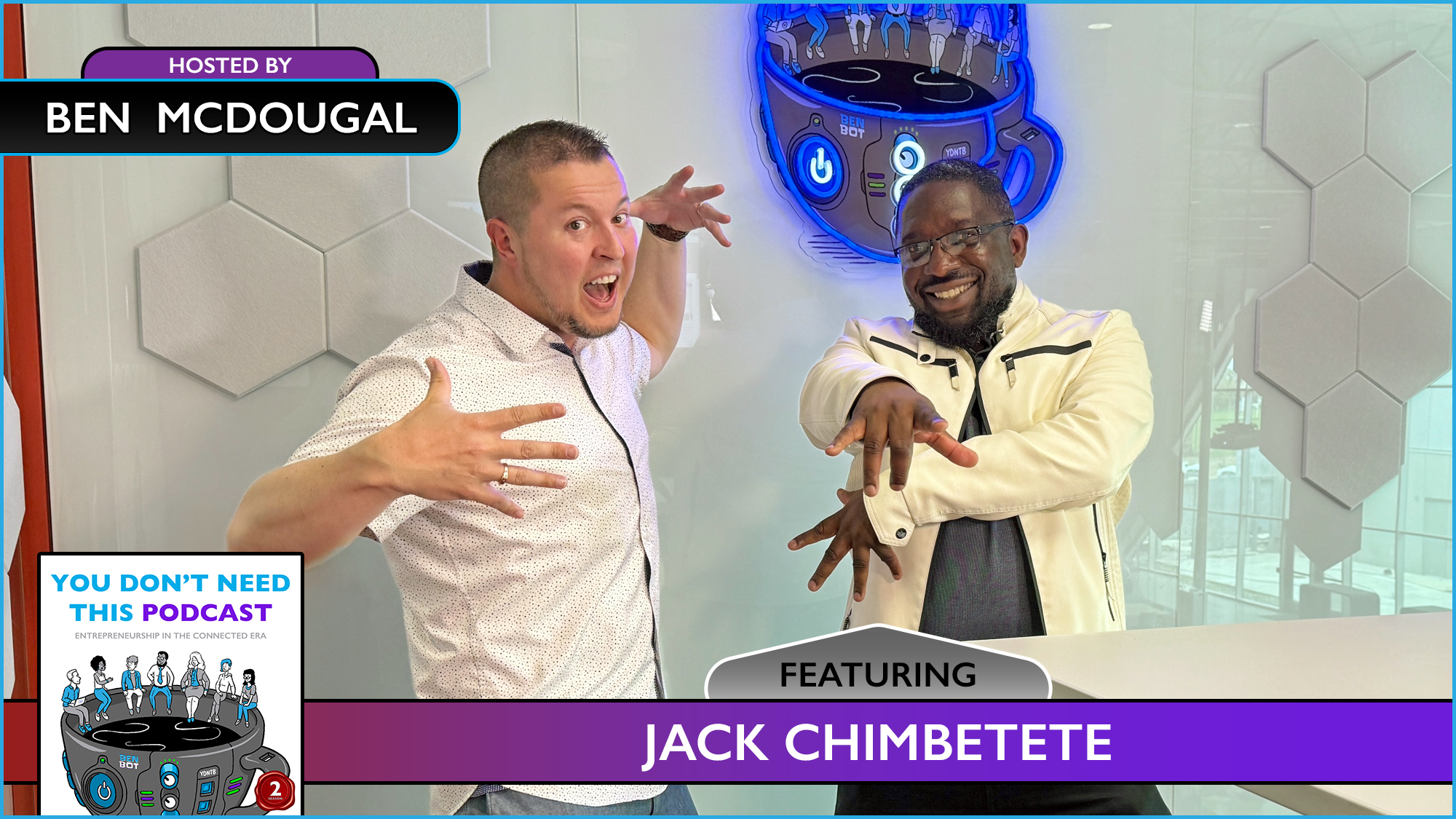
Jack Chimbetete learned to make others feel charismatic as a young leader in Zimbabwe. After this film maker experienced the Mandela Washington Fellowship, he forged a new path by moving to Iowa. We chat about growing up in Africa, producing content for TV, the African Live Network, tips for migration, and how to sequence storytelling to enhance any adventure.

After a euphoric break, Jack and Ben talk about what’s easy to do, but hard to maintain. They discuss being optimistic, while staying realistic and finish with ideas to help anyone build a network when you’re new to town.

LISTEN on APPLE PODCASTS
LISTEN on SPOTIFY

BONUS MATERIALS

https://jacksshackint.com

https://africalivenetwork.tv

https://onevoicedsm.org

https://cultureall.org

Roasted Reflections Break: Career Nirvana

http://Inverse-Charisma.YouDontNeedThisPodcast.com

EP37 – Power of Purpose 🎙️ Dwana Bradley

EP63 – Trapping Time 🎙️ Chris Lo

EP67 – Kups From Kenya 🎙️ Laban Njuguna

https://MandelaWashingtonFellowship.org

http://YouDontNeedThisPodcast.com

https://BenMcDougal.com/show-up

https://BenMcDougal.com/echos

Tiësto 🪩 New York City

https://BrianTracy.com

YDNTP on YouTube

http://BENBOT.ai

By Ben McDougal, ago

DSM USA

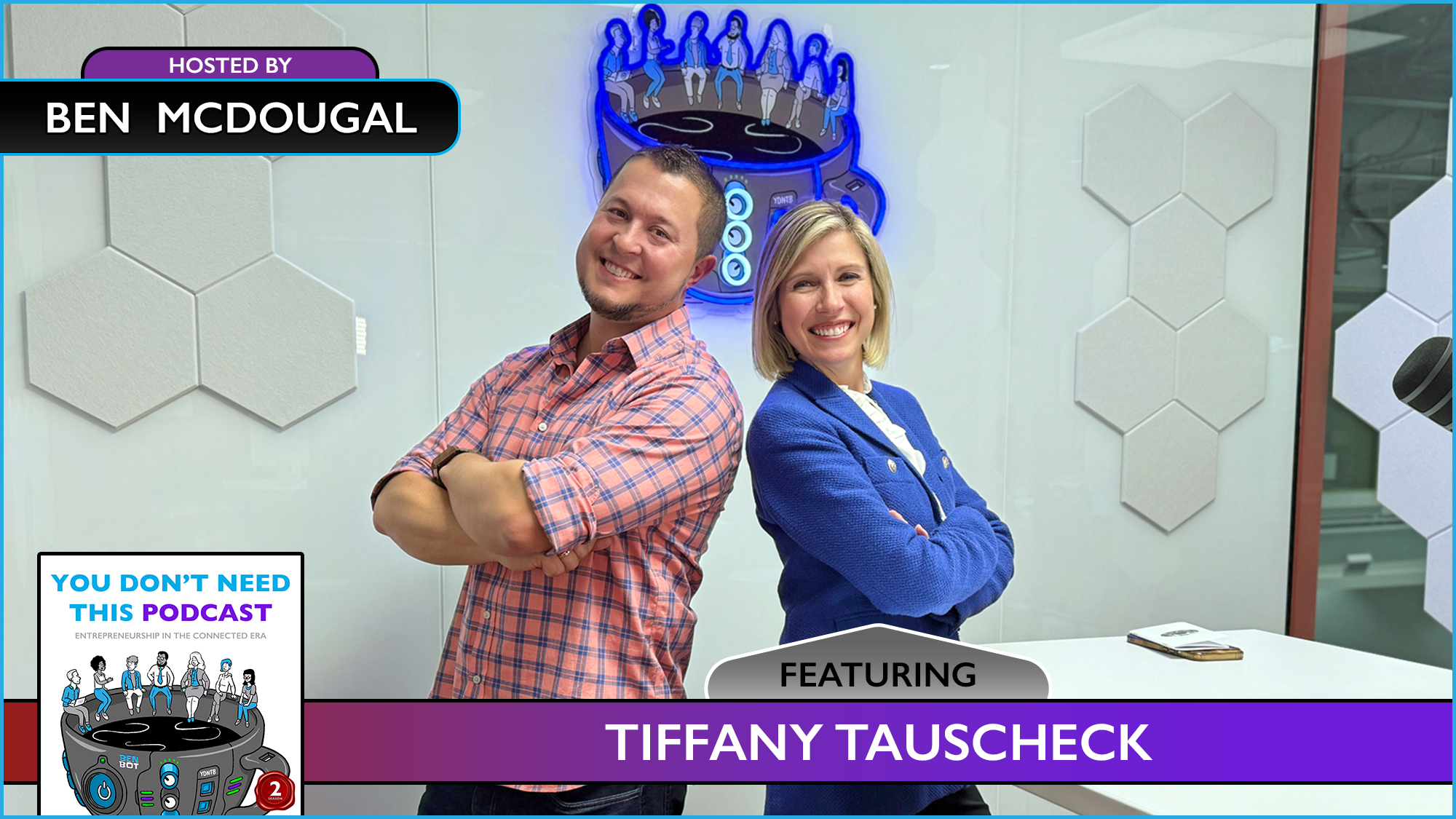
Tiffany Tauscheck is the President & CEO of Greater Des Moines Partnership! This special episode highlights the results of Tiffany’s recent 11-county listening tour with 23 different chambers of commerces and how different communities can collaborate even when environmental factors are different. We then shift gears to discuss leadership within transitional times, data-driven storytelling, and the future of the Des Moines metro.

After you refill your mug, Ben and Tiffany talk about evolving startup communities and entreprenierual ecosystem building. As a cool connection to EP72 of YDNTP, listen as we discuss innovative ideas for member-supported organizations, such as chambers of commerce, non-profits, and industry associations. We review the economic and talent development showcased in the DSM Partnership’s 2024 Annual Report, then go flying with ecosystem allies before an invitation to get in the arena.

LISTEN on APPLE PODCASTS
LISTEN on SPOTIFY

BONUS MATERIALS

Tiffany Tauscheck Bio

Living in Des Moines

Spark DSM + Scale DSM

DSM Partnership’s Entrepreneurship Resources

http://DSM-USA.YouDontNeedThisPodcast.com

EP5 – Jam with Jay 🎙️ Jay Byers

EP13 – Growing the Garden 🎙️ Diana Wright

http://CollectorHardbackEdition.com

http://RoastedReflections.com

http://BENBOT.ai

By Ben McDougal, ago