Online Event Management

Live event management is a handful. Virtual events should also be well thought out. How can we create a memorable experience when everyone is participating online? Let’s teleport into this topic together.

First, consider what must be accomplished. What cannot be achieved without this time together? Determine how long the virtual experience should last. It’s usually less than you think. Next, line up the right technologies to ensure it fits the needs of your virtual experience. As tech is selected, use security tactics to avoid unwanted distractions. With objectives and logistics in place, it’s time to flesh out the experience.

While our connected era has unlocked the next level of efficiency with these virtual interactions, a drawback to online gatherings is the lack of time before and after a meeting. This means there’s less serendipitous interplay. Stay efficient, but it may be wise to weave in random value through manufactured moments that still feel natural for participants.

As attendees arrive, use your opening remarks to set the tone. Generate cohesion with jolts of genuine energy as any rules of engagement are quickly confirmed. If there’s a meeting agenda, run through that and connect it with meeting goals so attendees know what to expect.

After a welcoming attendees with a concise, energizing, and clarifying introduction, have fun unpacking the primary discussion. Stay on task and try to avoid distractions, but leave time for interactive dialogue. With less open dialogue due to the limitations of a virtual experience, this is one way to create space for those manufactured moments of serendipity. These conversational buffers help to avoid having the loudest voice be the only one that’s heard and invites an inclusive environment with deliberate space for everyone to participate.

Extra Shot

The term “hybrid” is hard to define. There’s value in weaving tech into in-person events so that others are able to virtually feel the experience. There’s also value in keeping things simple so the focus remains on your attendee’s engagement. Experiment with what works for you, but one interesting combination is to go all-in with live events, and then add strategic online events into the mix. This avoids fragmented coordination, eliminates the hollowness of virtual content within an in-person experience, and creates ease for organizers who benefit from both types of environments.

As you bring your online events together, you want interactivity so it’s not talking heads with attendees pretending to listen. Do this by including icebreakers, musical moments, pop-up polls, breakout discussions, scavenger hunts, doodling exercises, physical activities, and scheduled breaks. Encourage note taking and grab screenshots as artifacts to share later. Leave time for questions before wrapping things up.

As you bring things to a close, it’s important everyone feels a sense of accomplishment. If ramblings drag on before the meeting abruptly cuts off, people will leave feeling empty. Keep the virtual energy juicy, review key takeaways, and encourage action to tie a bow on the efficiency of all your online events.

By Ben McDougal, ago

13.8 Billion

Based on the latest scientific estimate, our universe is 13.8 billion years old.

I don’t know about you, but over the past decade, I’ve been especially fascinated by the cosmos. If you’re over 30 years old, it’s almost like cosmic curiosity didn’t exists when we grew up. Perhaps I was a bit sheltered by a religious upbringing, but in high school, the narrative around space only focused on our own solar system. I don’t even remember talking about our place within the Milky Way galaxy.

This now feels like such a myopic perspective based on what we’ve learned. As scientific understandings expand, I can’t help but to wonder…

✨ How is our evolving understanding of the universe objectively taught to kids?

🏫 What are educational paths to astrophysics?

☯ Can cosmology and religion co-exist?

⚖️ At what point does arguing become a waste of time?

🧬 Can biotech pause, protect, or extend humans for space travel?

⚫️ How long would it take to arrive at the closest black hole? Who’s going in first?

🧠 How might the field of psychology better prepare us for the neon future?

🤖 Does digitized consciousness unlock time travel by leaving the limitations of a human body behind?

🧮 Where does quantum computing fit into the landscape of cosmic exploration?

👽 It seems statistically impossible that extraterrestrial life does not exist.

⏳ If life on earth has only existed ~25% of the total time our universe has existed, that sure leaves a lot of time for distant civilizations to evolve.

🪐 Considering the universe is expanding at an ever-increasing rate, do we know how fast our solar system is moving and in what direction?

⚡️ Unless it’s to find a more sustainable source, it feels careless to fuel energy using resources that won’t last.

🔬 Can nanotechnology alter the input of an energy source at a subatomic level to dramatically transform the output?

🧪 Will material science support deeper exploration?

🌌 Visiting, even colonizing Mars feels like an important exercise, but somehow starts to feel trivial.

🔭 Does seeing deeper fuel urgency?

🚀 Action may require sacrifice, so how can we encourage and celebrate those who lead the way?

These are extraordinary things to think about, but such concentration can quickly feel overly theoretical. In practice, perpetual learning, comfort within complexity, and a willingness to think again feels essential. Through such a curious lens, perhaps the most significant opportunity we have, is to aspire toward an existence which exceeds our imagination.

I talk often about collaboration in business and within entrepreneurial ecosystems, but when we put our delicate existence into perspective, it’s hard to think that anything besides collaboration allows us to survive.

By Ben McDougal, ago

Neon Future

I’ve always been fascinated by technology and how humanity interacts with what’s next.

Whether it’s artificial intelligence (AI), space travel, computer vision, machine learning, biotech, transformative energy, quantum computing, cerebral transcendence, or synthetic materials, math, or physics we have yet to discover, the deep future is one of my favorite day dreams. I don’t often get to talk with others about these questions we can not answer, but TV shows, movies, books, and music provide fun ways to personalize each paradox.

Extra Shot
Year Million, Cosmos, Altered Carbon, Foundation, and NOVA are a few TV shows that lean into what our neon future may look like. The Matrix, Ghost In the Shell, Finch, Transcendence, Dune, Ready Player Two, Interstellar, The Martian, Lucy, and Ex Machina are a few of my favorite sci-fi movies in this realm. I can’t say I’ve read many books that connect on this front, but when it comes to music, a lot of EDM feels futuristic. In fact, the inspiration for my title comes from Steve Aoki’s latest odyssey and I’ll close with lyrics to maintain this state of trance.

As I think about the future and what technology may allow humanity to achieve, my mind drifts through an eternal field of abundance. Our destiny will naturally change the future of work. My hope is that instead of stealing jobs, the heightened infrastructure will advance our kind and provide more humans the chance to scrutinize their own creativity. Instead of worrying about turning a knob all day, society can focus more on what the turning knob accomplishes.

It’s hard to reflect on such vast unknowns. It’s even harder to find closure. This doesn’t do the trick, but one interesting question that I’ve asked many people, is “does everyone have an entrepreneurial spirit?” I’ve been surprised with how many people say no, but one of my favorite responses included a thoughtful caveat. Perhaps everyone has a creative spirit, but those who are able/willing to tolerate risk, unlock the opportunity to decipher their entrepreneurial spirit.

That said, when it comes to this discourse, I’m interested less about business, and more about the enjoyment of deep thoughts, interesting conversation, and pure wonder.

There’s light years more to unpack here and this was never meant to be a scientific summary. Think of this flickering spark as more of an invitation to cut loose for the neon future is entirely unpredictable, expect for one thing: that before you know it, the neon future, will be the past. Stay wild my friends!

Life has limitless variety
But today, because of aging, it does not have limitless scope
In the neon future life will have opportunity to explore its limitless diversity
Life will have no boundaries

By Ben McDougal, ago

Slide Deck Design

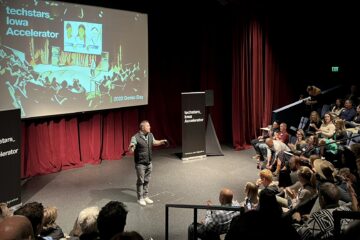
Ready to inspire the audience at pitch competitions? Perhaps you’re presenting a business at an event? Maybe you’re simply looking to host a meaningful meeting this week? Let’s explore translating your transmission with sharp slide deck design.

Before we dive in, why are slides even needed? Building a slide deck supports your key points while also establishing the tone and cadence of your performance. One development approach is to plan what will be said, and then wrap slides around that narrative. An alternate approach is to build the slide deck, which helps synthesize your storytelling. I personally find that the process of building a slide deck helps me lock in the story.

No matter how you find your flow, allow clean visuals to support your verbal queues and learn how to share your story in a natural way. The goal is to deliver the most lasting impact in the least amount of time. Honest passion, transparent vulnerability, and concise simplicity are great ways to accomplish this.

Extra Shot

Pitches are built to impress. Presentations are mean to share.

No matter the environment, a clean slide deck is always a good place to start. This is the visualization of your story. Slide decks should create flow while supporting your verbal presentation. They must concisely highlight key aspects of your business. Slides also help address any specific criteria of the environment it’s being used at, such as pitch competitions or other business presentations. Slides should not include full sentences or bullet points for you to read aloud. If the audience is asked to read the slide, they’re unable to pay attention to what you’re actually saying. Titles or short phrases may help guide the audience, but great slide decks use very few words.

With a foundation of strong imagery, make your presentation stand out. This does not mean a bunch of distracting transitions. Keep transitions between each slide simple, but consider how content comes and goes on each slide. Subtle animations and thoughtful hints of movement on each slide will keep your audience captivated. With a striking slide deck in place, practice what you plan to say and sync the narrative to the timing of each slide.

Extra Shot

Think deeply about the specific environment, your audience, and various objectives to craft the most compelling experience. When a message resonates, attendees express interest through questions, introductions, and future engagement.

Being prepared is obviously important when all eyes are on you. Whether you use animated content or not, it’s best to have a single click to move between each slide. As you speak, your attention should be on connecting with the audience, not the slide deck or the handheld clicker. My suggestion is to memorize the flow and order of your slides, but not exactly what you plan to say. The sentiment of your pitch should remain consistent, but it won’t sound the same each time. Memorizing a talk word-for-word is safe for some, but a more genuine tone comes from the heart.

Are questions allowed? If so, include supportive back slides. Back slides live behind the final slide. They are used to highlight material not included in the main presentation. Handy back slides include detailed pricing, competitive analysis, marketing strategies, research data, and intricate financial information. The optional, but available coverage back slides provide make them well worth the time to prepare. People who understand what they’re talking about can use fewer words, and back slides allow you to deliver a strategically simplified presentation. For the audience, this reduces the numbing effect of information overload. With back slides in place, you can indulge in clarifying conciseness. This makes for a more impactful tone. It can even be good to purposefully leave out a curious topic from the main presentation. When the inevitable question pops, you can use the sneaky back slide to share a more focused response. Memorize the order of your back slides and you’ll soon be leading a smooth, more authoritative exchange. In short, back slides prove you’re a pro.

To complete a slide deck build, export all the slides into one PDF and include a JPG image for each slide. The richest presentation will always come from the software (Apple Keynote, Microsoft Powerpoint, Google Slides, etc.) a slide deck was built from, but the PDF and JPG formats can be used as marketing materials. More important, they are quick substitutes to counter any sort of last minute technical issues. Deliver the digital assets on time and drop everything on a flash drive, just in case.

As you tell your story, take feedback seriously. Feedback from people you don’t know will sharpen the business, your slide deck design, and your presentation overall.

Extra Shot
Happy Thanksgiving!  2021 has been remarkable and I’m grateful for so many things. Along with treasured time with family and work I’ll always remember, the ability to consistently deliver these Roasted Reflections every single week is definitely an achievement I’m thankful for. I hope you’ve enjoyed these weekly ruminations and I can’t wait to hear what you think of the YDNTB audiobook this holiday season!

By Ben McDougal, ago

Content Creation: Organization

Think of the last time you moved into a new home. A clean slate is easy to work with, but can quickly become cluttered as you make it your own. As entrepreneurs develop more creative content, organization is a habit that helps you scale.

The best way to do this is on the front end. Take the time to name and organize your growing collection of files in a way that’s easy to navigate. This sounds simple, but cluttered folders with unrelated files form fast. Need proof? Take a look at your recent downloads or the mess that is a “My Documents” folder.

To boost efficiency, be quick to start new folders and subfolders. Such organizational diligence adds value now and later. You’ll build faster with quick access to what you need. You’ll also be able to more effectively return to past projects. Organization is hard on your own computer. It’s much harder with more people adding all their own materials into a library of files. If the team uses the same library, establish naming conventions and organizational standards.

Extra Shot

Thanks to all who made this YDNTB audiobook release party so special!

Another good organizational habit is to maintain external storage. This supports unlimited growth and ensures everything you build is backed up. It takes a bit of time, but storage space has become basically free. Throw that external hard drive in your bag and treat it like it’s part of your computer. Cloud storage is another good backup method, but online connectivity may be required. For added security, store one more external hard drive outside your home or office. A safety deposit box is a good off-site option. Don’t let data lose spark interest in a better backup plan.

Data management is important, but organization plays a role in other areas as well. Nobody likes working with people who miss deadlines or go silent without reason. Stay organized with your calendar, email, phone, social media landscape, and workspace. This reduces the distraction of clutter and creates a healthy space to do your best work.

Extra Shot

This concludes our 6-week skill building series. To see how everything fits into the broader marketing discussion, pop over and snag You Don’t Need This Book.

As your multimedia marketing skills evolve, merge them to generate all the feels. Learn how to write so it’s easy to read. Snap photos that tell stories. Shoot contrasting collections of video that are enjoyable to watch. Bring narratives to life with captivating graphic design. Get creative and stitch it together with sharp organization. This concoction of multimedia marketing skills is a potent formula for endless stories that sell.

By Ben McDougal, ago