Prismatic

There are endless early moves to help avoid pushing your idea toward someday. For instance, creative wireframing requires only a pencil. With a little visualized clarity in place, a couple exploratory conversations can also help.

First, meet with a mentor. This should feel like a supportive space but avoid rainbows and butterflies. Be realistic with exciting aspects of the idea, but also the challenges. As we learned in YDNTB, an early no is much better than a long, wrong yes. That said, playing it safe is easier than activating initiative, so don’t let early doubt slow you down. Instead, welcome it. Let curiosity uncover new understandings. Pivots are inevitable, and this exploration adds confidence as the original idea is tweaked toward product-market fit.

After transparently talking with that trusted mentor, the next meeting is with a potential customer. This will feel too early, but it’s not. You’re actually protecting your personal bandwidth by not swinging at a bad pitch too many times.

To optimize early innings, arrive prepared to ask good questions. Take notes and speak less so you can actively listen to how this potential early adopter is responding.

Are you building a pain killer or vitamin? Remember, feedback is data, and this is only one data point, but let this conversation infuse reality into the idea. Show up, stand out, follow up, stay connected, find a thoughtful way to accelerate their work, and then keep building.


The business model canvas is a tool to do so. While it’s impossible to predict the future, business model canvases help us continue to explore while curating a story that sells.

Most early business ideas don’t have a clear story. This can make it hard to know where to start within the business model canvas. While you can use this tool in endless ways, consider an approach that is less about the entire business and more about one story at a time. Instead of trying to boil the ocean, organizing a complete story for each customer segment creates a combination of more actionable insights.
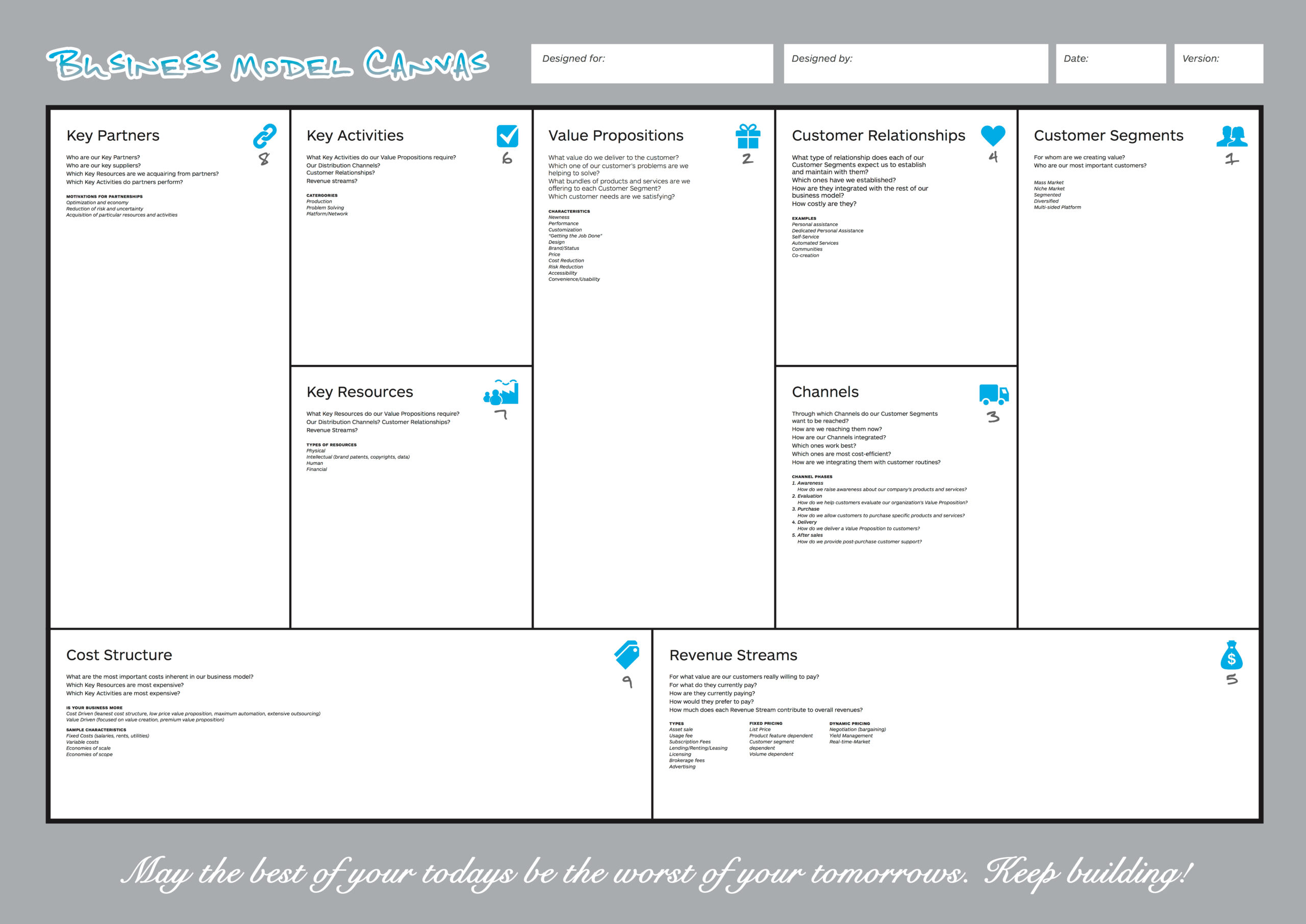
To give it a try, use this special business model canvas. The areas are numbered to curate canvases that each highlight a customer story:

  1. Customer Segments – Start with the details of a particular type of customer. The goal isn’t to complete the Customer Segments box. It’s starting a story to follow through the rest of the canvas. Now lean into the pain as you move from box to box and watch as your solution transforms into a story.
  2. Value Propositions – What benefit(s) can you deliver?
  3. Channels – Where can you connect with this customer?
  4. Customer Relationships – Who are you working with and how will you make this customer feel?
  5. Revenue Streams – Will financial income flow? How?
  6. Key Activities – What actions make the customer care?
  7. Key Resources – What is needed to keep building, and how might needs change to maintain momentum?
  8. Key Partners – Who helps to make this sustainable?
  9. Cost Structure – What costs go into activating this customer segment? How is pricing organized to support realistic profit margins that align with a financial model?

                By telling the story of created value for one customer segment, hypotheses can be connected with context. Next, using a separate business model canvas, visualize more stories based on different customer segments.

                With separate business model canvases for each customer segment, merge everything into one business model canvas. To stay organized, select different colors to use for each customer segment. As everything blends together, the prismatic rainbow maps roads to reality.

                By Ben McDougal, ago

                Voices

                the streets are restless
                voices low,
                rumbling of those
                who feel forgotten
                who feel the die was cast
                before they were even born.

                they hunger for the chance
                to make something their own
                to etch their mark in the wall of the world.

                and in the shadows,
                small fires are being lit
                not by kings or queens
                but by ordinary hands
                with ordinary dreams.

                it begins like a forest rising
                out of swamp and tangle
                messy, alive, unpredictable—
                where strangers meet
                where trust grows in broken soil
                where one seed
                can seed a thousand.

                it says:
                no one will save us
                except us.

                it says:
                the right to begin
                is the right to belong.

                and if enough of us answer,
                if enough of us care,
                then out of the discontent
                out of the silence of the left behind
                will rise
                a chorus of builders
                a rainforest of possibility
                a people remaking the world
                with extraordinary love.

                Extra Shot

                This poem is from Victor W. Hwang.

                By Ben McDougal, ago

                Down Under

                It’s easy to think the perfect investor pitch exists.

                The inspired business idea, sharp slide deck design, magical lines within a concise pitch, and formulas to make everything click. Study fundraising all you want, but the art form can be seen when understanding adds space for storytelling that shows instincts.

                EXTRA SHOT

                This contribution was written by Saba Karim. This Australian technologist is a perpetual builder who has heard more business pitches than anyone you know.

                During my time at Techstars, we listened to hundreds of founder pitches. Different industries, backgrounds, and levels of experience. On paper, many of the companies looked nearly identical. Similar markets, similar traction, similar slides. Yet the outcomes were rarely the same. Some conversations created momentum immediately. Others stalled, even when the numbers looked better.

                The difference was almost never the product. It lived in the story. The strongest founders were not reciting information. They were explaining how they saw the world. Their judgment was heard in the way they framed problems and talked through decisions. Their pitch was not something memorized. It was something the founder(s) understood. That distinction matters, because investors are not betting on slides. They are betting on decision makers. A deck can show intelligence. A story reveals instinct.

                Many founders treat pitching like a checklist. Hit these slides. Answer these questions. Say the right words. But when either side approaches an early interaction that way, the conversation usually falls flat. No deck is ever complete enough to replace connection.

                When founders realize alignment matters more than perfection, the dynamic changes. The meeting stops feeling like a performance and starts feeling like a conversation. That shift alone creates momentum.

                Momentum is not mysterious. It is human. Founders who walk into meetings with clarity tend to leave with more doors open. Not because everything is perfect, but because belief compounds quickly. You can feel when someone has their right foot forward. 

                They are not rushing.
                They are not over-explaining.
                They speak in present tense.
                This is what exists today.
                This is what we’ve learned.
                This is what we are doing next.

                Reality builds more trust than ambition ever will.

                Another common mistake is trying to sell the product instead of the opportunity. Features matter, but they rarely carry the conversation. What resonates is why the problem matters, why the timing makes sense, and why this founder cannot walk away from it.

                The best meetings barely felt like pitches at all. They are calm, low pressure conversations. Sometimes there was a deck. Sometimes there was just a demo. The tone shifted from here is what I want to build to here is what I have already built. That shift changes everything.

                As founders, we tend to overthink the wrong details. Being slightly late. A noisy background. A moment of nerves. Those things rarely matter. What does matter is presence. Listening instead of talking. Answering the question that was asked. Slowing down enough to think clearly.

                Extra Shot

                Confidence is not volume. It is calm.

                Over time, storytelling stops being a fundraising skill and becomes a life skill. Entrepreneurship demands it constantly. With investors, teammates, customers, and yourself. Every difficult decision needs a narrative strong enough to carry uncertainty.

                Early on, those stories are mostly aspiration. Later, experience reshapes them. Obsession sharpens them. Failure humbles them. You stop trying to sound impressive and start trying to sound honest.

                Eventually, you care less about winning every room and more about finding rooms where you belong. Fundraising becomes relational. You are no longer trying to convince someone to believe in you. You are discovering whether you already believe the same things.

                People do not want to feel processed, optimized, or pitched. Success, whether in business or in life, is rarely about winning someone over. It is about how people feel when they leave your presence. The energy you bring into a room. The care you show when no outcome is attached.

                In the end, the perfect pitch never existed. What existed was clarity, presence, and the courage to speak from experience instead of expectation. There is no finish line. Only better questions, deeper alignment, and the quiet understanding that the best relationships are all built the same. With intention, kindness, and a genuine desire to be remembered for how you made people feel.

                By Ben McDougal, ago

                Líneas Invisibles

                Están por todos lados. Este barrio contra el otro. Nuestra comunidad contra la de ellos. Mi estado contra tu estado. Este país contra aquel país. Las líneas invisibles crean lealtades. Crean un sentido de pertenencia. Ayudan a estructurar los recursos. Pero con el tiempo, también pueden crear barreras, divisiones y frenar la colaboración.

                DOSIS EXTRA

                Esta enriquecedora contribución fue escrita por Jorge Sánchez. Este generoso traductor une a líderes angloparlantes e hispanohablantes de todo el mundo.

                Los buenos líderes reconocen la importancia de pertenecer, pero también comprenden que el futuro se construye sobre puentes, no con muros. La innovación no se limita a nuestro lugar de residencia, lo que nos invita a celebrar la singularidad de cada ciudad, región, estado y país, mientras abrimos la puerta a la colaboración entre diferentes culturas. Esto se ve desafiado por el contexto histórico compartido entre dos lugares. Cuando las personas de una comunidad tienen opiniones preconcebidas sobre otra, estas suposiciones pueden limitar el interés en la colaboración futura. En lugar de repetir quejas del pasado o lamentarse por lo que le falta a la propia comunidad, reconozcamos lo que sí tenemos. Celebremos la singularidad que aporta una diversidad enriquecedora y avancemos gracias a la colaboración con nuestros vecinos.

                Además de la colaboración comunitaria, se requiere un esfuerzo adicional para desarrollar negocios a través de fronteras invisibles. Siempre habrá factores específicos a considerar, pero aquí presentamos algunas actividades clave para construir puentes entre diferentes lugares.

                • Participa y comparte experiencias en ambos entornos.
                • Encuentra un aliado honesto que comprenda las diferencias culturales.
                • Crea una red de contactos en ambos lugares y únelas.
                • Estructura legalmente un negocio para ambos entornos.
                • Mantén al día licencias, permisos, obligaciones fiscales, impuestos aplicables y auditorías.

                El lugar de origen aporta valor cultural a cualquier situación, pero esto no tiene por qué convertirse en una limitación. Aprender a desenvolverse en múltiples entornos permite acceder a mejores recursos y ayuda a que las zonas vecinas prosperen sin perder su propia identidad. Respetar las fronteras invisibles es necesario, pero la verdadera oportunidad, los recursos y la armonía esperan a quienes construyen juntos.


                ENGLISH VERSION

                They exist all around us. This side of town versus that side. Our community versus that other community. My state versus your state. This country versus that country. Invisible lines create loyalties. They create a sense of belonging. They help structure resources. Over time, they can also create silos, divisions, and limit collaboration.

                EXTRA SHOT
                This contribution was written by Jorge Sanchez. This translator unites English and Spanish-speaking leaders worldwide.

                Leaders recognize the importance of belonging, but also understand that the future is built on bridges, not walls. Innovation is not restricted to where we live, which calls us to celebrate the uniqueness of individual cities, regions, states, and countries, while also inviting collaboration between different cultures. This is challenged by the historical context shared between two locations. When people in one community have opinions of another community, assumptions can limit interest in future collaboration. Instead of relaying ongoing complaints stuck in the past or dwelling on what your own community lacks, recognize what you do have. Celebrate the uniqueness that adds healthy diversity and go further thanks to a neighbor who can extend progress.

                Along with collaboration at a community level, extra work is required for individuals building a business through invisible lines. There will always be specific environmental factors to consider, but here are key activities to build on any border.

                • Show up and share stories in both environments.
                • Find an honest ally to understand cultural distinctions
                • Build a network in both locations, then unite them
                • Legally structure a business to span both environments
                • Maintain required licenses, permits, financial variations, applicable taxes, and ongoing auditing

                Where you’re from adds cultural value to any situation, but this does not need to become a limitation. Learning to inhabit multiple environments enables people to access better resources and helps neighboring areas thrive without losing their own identity. Respecting invisible lines is necessary, but authentic opportunity, resources, and harmony awaits those who build together.

                By Ben McDougal, ago

                Diplomacy Disrupted

                The world stands at a crossroads where traditional diplomacy has ceded ground to a more dynamic force.

                Entrepreneurs have emerged as the new diplomats of our era, boldly leading where established institutions falter and distrust prevails. For centuries, diplomacy belonged exclusively to statesmen and ambassadors, their negotiations cloaked in formality and protocol. Today, that order is being profoundly reshaped by visionaries who reach across divides not through treaties, but through the universal language of solving, building, creating, and sharing. In a fractious world marked by de-globalization and nationalism, entrepreneurship has become the great common denominator—a calling that transcends borders and unites disparate communities around shared purpose.​

                EXTRA SHOT

                This contribution was written by Jonathan Ortmans. Jonathan has visited 150+ countries around the world and leads the Global Entrepreneurship Network.

                National boundaries, once formidable barriers to commerce and culture, have become remarkably porous to innovation and startup culture. The seamless flow of talent, capital, and ideas continues to define entrepreneurial ecosystems that connect and outperform those that isolate. This porosity represents more than economic opportunity; it embodies a fundamental shift in how value is created and distributed across the globe. Entrepreneurs operate comfortably in this fluid environment, recognizing that the greatest innovations emerge when diverse perspectives collide and collaborate. From rural villages to capital cities, startup culture spreads with viral intensity, carried by digital platforms and sustained by communities that refuse to accept geographic limitations on their ambitions.​

                Yet disruption—the defining characteristic of our age—carries a paradox that demands understanding. Disruption is not destruction; rather, it is the alchemy that turns uncertainty into opportunity. This transformation requires both courage and vision, qualities entrepreneurs possess in abundance. They are fearless and bold, thriving precisely where others see only chaos, spotting cracks where new possibilities emerge as governments and societies shift the rules. Just as storms clear the air and renew the land, moments of disruption force examination of old assumptions, breaking free from complacency to push the boundaries of what is possible. The danger lies not in disruption itself, but in our response to it—whether we view upheaval as an ending or a beginning.​

                Entrepreneurs understand that constructive rebellion is not just healthy but essential in keeping ecosystems vibrant and societies progressing. Without these acts of creative rebellion, without founders willing to risk failure for better solutions, stagnation becomes inevitable.

                This willingness to occasionally stir up turbulence reflects an entrepreneurial mindset that questions the status quo, challenges outdated models, and refuses to accept that the way things have always been is the way they must remain.

                Bold global leadership—rooted in vision, grit, and collaboration—transforms disruption from chaos into the spark that ignites progress. The rebels among us deserve celebration, for in entrepreneurship as in democracy, the bold change the world.

                By Ben McDougal, ago