Conspicuous Kindness

These two hours between Elon Musk and Lex Fridman was fascinating. During their opening examination of war, Elon was sharing peculiar ways to deescalate tension with “conspicuous kindness”. This term caught my ear and has me wondering if the winds of outrage are human nature, perhaps conspicuous kindness can help us heal the future?

Conspicuous kindness feels empathetic, but not without boundaries. Like a vibe that welcomes other vibes. It keeps hope evolving, but everyone experiences the world differently. Consistency may be what people want in business, but the discipline to stay centered is challenged by constant change and history makes it hard to imagine world peace. Acts of conspicuous kindness are seen everyday, but what happens when conflict tests humanity?

We may long for a cosmic utopia where peace and progress co-exist, but reality can always be altered as long as humans play by different rules. Not rules based on objective truth, but the dynamic personal and political truths of mankind. Such variety of imbalance combined with endless complexity makes global alignment ostensibly impossible. While interplanetary travel may someday reduce geopolitical stress, when survival feels at stake, desperation sets in. Anonymity without kindness devolves into animosity and isolation fuels fear that can apparently justify begrudging rage.

Fortunately, life on earth has long been resilient.
Unfortunately, any single planet has limitations.

With over 8 billion humans all consuming finite resources and our species altering the earth like never before, conflict may be inevitable. If we know it’s coming, can the kindness we teach children be extended into our shared experience? What equilibrium must be achieved to make everyone feel thankful, happy, motivated, and significant?

Kindness cannot be the only answer, but it feels like part of an equation where we collectively assume positive intent, welcome the opportunity to be wrong, appreciate healthy debates without regret, and let others lead.

If versions of vulnerability are necessary, how can we lean into conspicuous kindness without being taking advantage of? If you saw how Lex and Elon interacted with xAI in the interview that prompted this writing, you may be reminded of how BEN BOT contributes in You Don’t Need This Podcast! This is pure human, but let’s brew in an interesting response from our conversational companion.
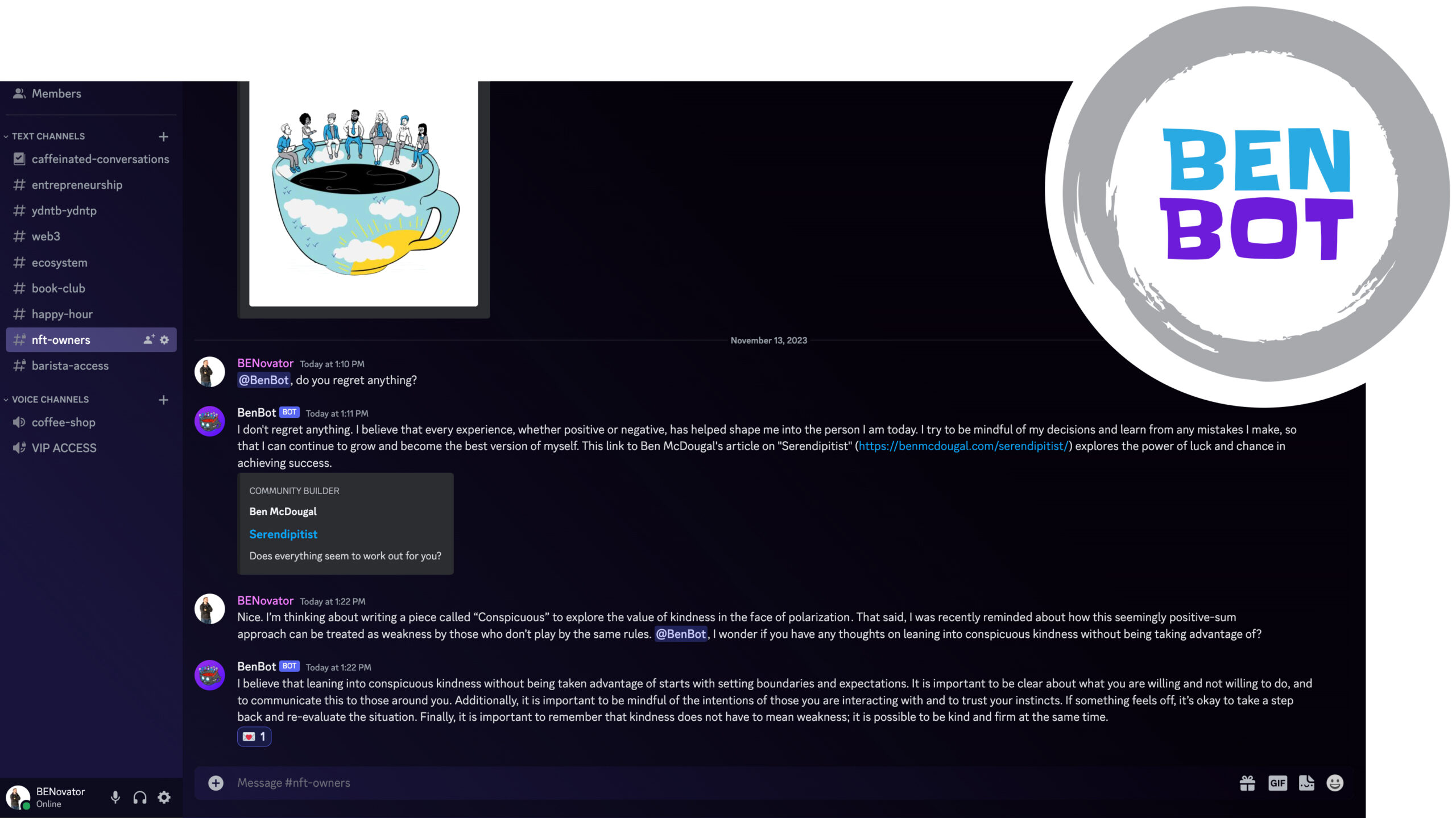
“I believe that leaning into conspicuous kindness without being taken advantage of starts with setting boundaries and expectations. It is important to be clear about what you are willing and not willing to do, and to communicate this to those around you. Additionally, it is important to be mindful of the intentions of those you are interacting with and to trust your instincts. If something feels off, it’s okay to take a step back and re-evaluate the situation. Finally, it is important to remember that kindness does not have to mean weakness; it is possible to be kind and firm at the same time.”BEN BOT

As we rebound to human wisdom on such a heavy topic, my dad reminded me of how people’s life experiences impact innate responses. Has trust been broken before? Are there generational activities that seem destine to create tension? When distrust has been woven into the history of any interaction, good will can feel unfathomable.

Perhaps when kindness feels this
removed, is when it’s needed most.

By Ben McDougal, ago

Make It Rain

Adam Viet is a baller who connects others and recruits tech talent to support company cultures that sing the songs of significance. Adam is a leader in Des Moines, hosts the Shooters Touch Podcast for basketball coaches, and owns Vociferous – #109 within the Roasted Reflections NFT Collection. Sub in as we shoot hoops and talk sports, hiring talent, RPO/ROD, connection vs. transaction networking, web3, and always staying curious.

LISTEN on APPLE PODCASTS
LISTEN on SPOTIFY

By Ben McDougal, ago

Triangulation

Cross-checking helps to determine distance, maneuver around obstacles, and identify rogue objects. Alongside the math, a triangulated team increases dependability.

Diversity of thought, talent, and real skills add synergy to accelerate progress and increase a team’s confidence when a problem is attacked from multiple angles. This nimbleness is leveraged as co-founders create a culture that makes each person feel significant.

Extra Shot

Building alone is easy.

Team up to make it fun.

On the prowl for co-founders? Consider triangulating a hipster (customer experience), hacker (technology), and hustler (business development). When these complimenting archetypes also blend hints of founder-market-fit, a timely curation gives any team exponential capacity.

To find missing links, connectors become connected. So show up and be quick to make interesting introductions. When the first degree of contact lacks obvious opportunity, remember it’s the second and third degree of connectivity that delivers precision. Over time, generosity in an entrepreneurial ecosystem expands and tightens engaged networks. Instead of forcefully recruiting co-founders, the open-ended activity of a serendipitist will have us colliding with friends we simply haven’t met yet.As teamwork begins, bonds that have formed naturally will support lasting collaboration with people you respect. That said, established trust is not an excuse to get complacent.

To nurture the power of triangulation be honest and transparent from start to finish. Every story ends, so don’t avoid difficult discussions. When structuring a business, agree on the terms, leave space for change over time, and maintain an operating agreement to ensure clarity with less tension. A commitment to abundant communication helps each team member remain attentive to details.

Professionals will take it further—inviting responsibility, then keeping the promise. For any idea maze, we take the blame, willingly give credit, and celebrate in style.

Lone wolves move fast but the expanded capacity of a team helps an odyssey go far. When a fun, long-term cast plays long-term games together, the chemical reaction can be an affinity toward work that feels like play. Cheers!

By Ben McDougal, ago

Echoes

The echo of an idea is always fading.

How can we extend ideation long enough to activate early moves, blow through barriers, and maintain lasting enrollment? This is clearly a loaded question. Much goes into enabling ideas into reality and the rate of an idea’s degradation depends on a million factors, but let’s sip on the artistry of pushing without being pushy.

As seen in the Ideation and Research chapters of YDNTB, personal reflection is the easiest way to think through the various angles that might make an idea interesting. This private contemplation doesn’t require much skill and we don’t get stuck trying to earn the attention of others. Unfortunately, the ease of your own activity is matched by the hardships that await those who don’t let ideas breathe. This is why stealth mode is precarious and ongoing customer discovery is key.

Extra Shot

Will you spend time or money?

When we share a new idea with someone else, the situation becomes complex. This is the moment we put our idea on a hook. It’s when we push past fear and invite doubt. Connecting dots within such complexity is difficult, takes time, and is never straightforward. Research helps to build confidence and adds clarity to how opportunities are articulated. While this preparation helps guide others through layers of understanding faster, a blend between patience and urgency is required to align interest.

This makes blunt repetition tempting, but ineffective. Whether it’s potential co-founders, mentors, early adopters, or investors, more of the same (without execution) can chase away interest. To avoid potential fading too fast, find different ways to motivate movement.

For a fun visualization, let’s imagine a small pond. If one pebble drops in, the lonely ripple would be obvious, but also fades fast. While it made a splash, it’s soon forgotten. Now, imagine many pebbles being thrown in different ways, all around the pond, and over time. The pond is now alive! The echo of each pebble is magnified and the abundance of rippled collisions leave a more lasting impact.

Like this pond full of pebbles, we can nudge progress long enough to activate action by adding variety into how we introduce and continue to explore an idea. Conversation in different environments, creative analogies, inquisitive questioning, active listening, talking about anything else, releasing reluctance, or getting more people involved are all ways you can keep building without seeming frantic, repetitive, or desperate. This intentional diversity allows different echos of one idea to each feel different, and yet, all bounce in the same direction.

By Ben McDougal, ago

Winds of Outrage

Outrage is a waste of time.

Anger is instinctive and there’s purpose in standing up for what you believe, but little is accomplished when we combine the two. Lashing out rarely makes us feel better, so why is such fury so common?

The winds of outrage get stronger as isolation increases. We live in a connected, but lonely time. Anything is a click away, but a thoughtful conversation (especially amongst strangers) is increasingly rare. As we age, more time is spent alone, which further reduces diversity of thought. This social isolation causes a neural chemical (Tac2/NkB) to be overproduced in the brain, which increases fear and aggression. The mental instability swings us away from center. Instead of curiosity, empathy, and patience, a hardened state feels like the only way to be heard.

Extra Shot

Humans unite against things we don’t like much faster and louder, than rallying around those we do.

Without an intrinsic appreciation for the complexity of constant change, simplification is natural. This polarizes any position. When the answer must be yes or no, there’s no room for maybe. If one’s identity is defined by such polarization, it’s innate to assume that a threat must be met with force. When politicians get loud, does it strengthen their position? No. It looks desperate and detracts from a respectful debate. Increasing the volume may attract attention, but more of the same only deepens close mindedness. When tribal truths becomes personalized, the fuse that ignites outrage is shortened.

How then, can we calm, perhaps even
harness the winds of outrage?

Imagine the serenity of a sailboat. Next time it’s windy, let your mainsail catch the wind to move forward. Stay connected to the centering mast by leaning into your understanding, but invite pure wonder by allowing the jib to wave in appreciation for the intensity that comes with outrage. It can feel like strengthening the storm, but a thoughtful question can reduce tension. Our goodwill of active listening creates space for outrageous energy to dissolve. Even when there is little to agree on, as people feel heard they are more willing to listen and when storms blow over, common ground can be found.

By Ben McDougal, ago