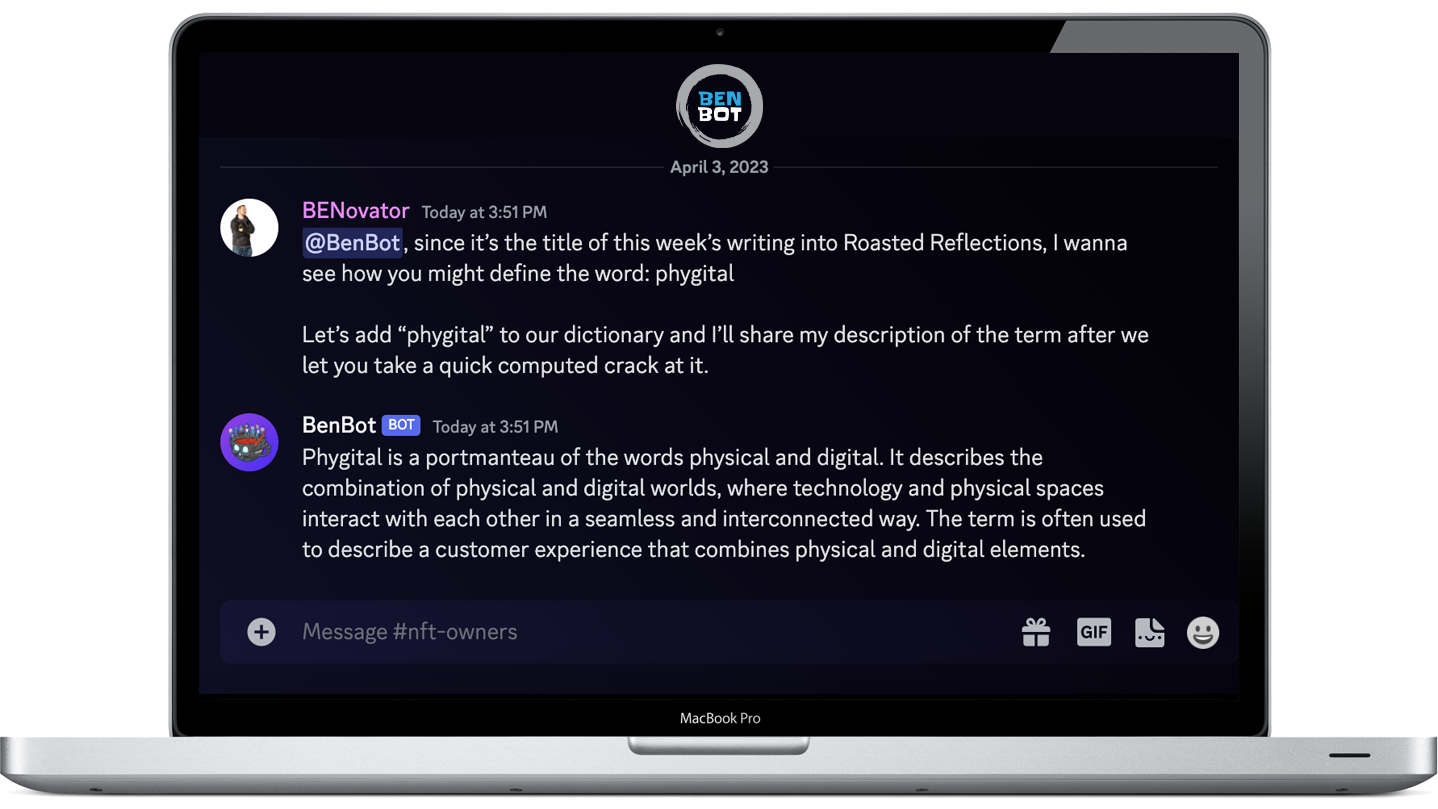
Phygital

Blending a physical reality with digital depth is something humanity has experimented with for decades. Catchy names, memorable phone numbers, short URLs, and QR codes are simple methods that guide a physical interaction to details online.

Augmented Reality (AR), Bluetooth, Near Field Communication (NFC), Radio Frequency Identification (RFID), biotech, and smart materials all take it up a notch. Each of these technologies provide a path to phygital experiences.

To spin some yarn, let’s stitch this nerdy good term into the world of fashion. Phygital clothing now has passive chips embedded behind a patch or hidden in the garment. When tapped by a phone, the tiny chip is given enough electricity to pass data. This prompts a notification that links to digital destinations. The destination may be a website just for fun, but for larger brands with dollowers, the loyalty contest is given all-new levels. Imagine the status game of a global fan base that unlocks digital assets by working together. An elbow bump from someone wearing your favorite brand can now highlight ownership and unlock gamified layers.

With ownership determined by code and real-time incentives connected to the owner, this nerdy good phygital term quickly becomes apart of the web3 taxonomy. That said, the flex is not about being high-tech. It’s introducing a remarkability factor.

When remarkability matters, as it often does, phygital twists offer an edge. There are endless examples of digital depth revolutionizing every industry. Computers and smartphones link a physical device to digital experiences and the first smart vending machine in 1982 would lead to an entire microcosm we call the Internet of Things (IoT). Today’s chips are cute, but nanotech (think a computer on every cell) and neurotech (think brain-computer interfacing) represent a direct line where input and output will require no physical movement. Edges dull as new becomes commonplace, so the time to get phygital is now.

As the world continues to be phygitized, more physical products will be mirrored by digitized counterparts, ownership will be obvious, and an augmented experience will be increasingly invisible as our perceived reality is reinforced by the phygital world all around us.

By Ben McDougal, ago

Milestones

Big or small, internal or external, milestones help people identify with progress. They draw lines in the sand. This clarifies goals while supporting short-term accountability and long-term motivation.

Entrepreneurship is a community sport, but creative problem-solvers working to build a business are still competitive. Milestones tap into this competitive spirit by gamifying a performance-based culture. Recognizing milestone achievements can also boost morale and further unite a team. If you’re collaborating with mentors and/or an advisory team, milestones help keep everyone on the same page as well.

As milestones are established, be sensitive to the diversity of your team. Find creative ways to equitably encourage new and more experienced team members. One easy way to do this, is to establish a few tiered categories for different types of milestones. As you diversify milestones, we’re not creating so many that they become pointless. Instead, you’re curating a variety of dynamic signals that can activate different emotions along a connected and sustained timeline.

As milestones are completed, the culture is nourished with celebration, which we’ll sip on next week!

By Ben McDougal, ago

Minerva

The pursuit to find Pluto is a neat example of how imagination, obsession, and reason align what can be seen. After scientists at the Lowell Observatory finally discovered “Planet X” in 1930, the world weighed in on what to name it. Let’s brew on naming your project.

Extra Shot

Pluto was the second choice of scientists who discovered this beloved dwarf planet. Minerva was the team’s first choice, but it was already taken by an existing asteroid.

A name makes a project feel real. It creates identity. If you’ve been thinking about something for a while, a name may naturally emerge. If you’re struggling or feel uneasy about the name you have in mind, here’s how to fuel confidence and land on something scalable.

Be descriptive. If it’s impossible to guess what you’re offering, you’re taking an early gamble. Hyper specific names may stand out in the moment, but too much definiteness can limit your ability to evolve. Attention is hard to earn, so avoid obscurity, names that trap you, or anything that makes the business hard to remember.

Verify availability. It’s tough to set yourself apart while still being memorable. As you consider naming a business, get creative, but do your homework before falling in love. Do not hope something may not exist; try to find it. Boldly research existing trademarks, domain names, social media accounts, industry competitors, and funky spellings. The result can be a name that is all yours versus something that may be catchy but could spawn future liabilities.

Think long-term. To withstand the test of time, consider how this name supports lasting growth. If the trend upon which you’ve based a name fades, might you look outdated? Will highlighting a location eliminate the ability to expand? In short, don’t corner yourself unless it’s on purpose.

Once you lock in a name, start using it within customer discovery to explore how it’s received by those you seek to serve. When a name clicks, align your marketing and overall vocabulary around the newly established identity. This will make your company recognizable, and over time it connects you to more true fans.

By Ben McDougal, ago

Stealth Mode

We’re all guilty of thinking our idea is better than it is.

Stealth mode is when entrepreneurs wait to start telling their story. Staying quiet about a new project often starts with good intentions. Curiosity and a bit of mystery can generate hype, especially if you’ve been successful in the past. Too often however, people hold onto silence because they fear feedback or that what they’re building may not work in the wild.

To avoid failure, the choice to continue building in stealth mode keeps everything safely in the workshop. This may be wise if the project needs work or when the competition are known pirates, but there are few ideas that require much secrecy. With 8 billion humans on earth, your idea is probably not unique and when it comes to shipping your art, it all comes down to execution. Survey the market and research existing patents to help guide decision making, but stealth mode will soon lag toward being an excuse to procrastinate. Even if you have something big, it can be deflated without the open air of honest feedback. Stealth mode may sound nice, but silence, pride, and fear can devolve into a suffocating sinkhole.

Extra Shot

Winners are good at losing.

If you decide to build in stealth mode, give yourself firm timelines. Determine if intellectual property needs legal protection. If you need to keep certain aspects of the project under wraps, do so while still allowing the idea to breathe. Stealth mode only works when it results in a stronger story. It’s hard to know how strong your story is unless you share it.

Yes, we can only be new once, but the leverage of a startup is an ability to quickly evolve. As your team connects with the true market through strategic, creative, and generous execution, humility paired with persistence will pay off in the form of confidence. Even if something fails, it’ll be more like a pit stop on your path toward product-market fit. Be a scientist. Experiment thoughtfully, iterate often, and invite doubt knowing that if you’re wrong, it can activate a signal that guides the project toward a more sustainable future.

Be careful with the comfort of stealth mode. Those who build in too much silence can go quiet themselves.

By Ben McDougal, ago

Launch

A successful launch rewards hard work.

No matter the audience or how heavy the news, introducing what’s next is your opportunity to spark energy. This milestone will soon be celebrated, but rocket ships do not launch without intention.

The excitement of sharing something you’re proud of can be intoxicating, but we can only be new once. Launching before you’re ready can lead to carnage. Limping into a launch without a connected cadence will also reduce excitement as attention becomes diluted.

Let’s first look at how to avoid launching before you’re ready. There’s value in shipping your art often, as this is the only way anything is set free to evolve toward product-market fit. This, however, does not give us permission to be careless. Research, internal planning, strategic development, thorough testing, and working with true fans is the easiest way to stress test whatever you’re building. When we normalize a nimble, but detailed-oriented approach, you’ll create confidence in what’s being launched while also allowing your art to connect within the market you seek to serve more often.

When the time is right, planning a strategic launch sequence can initiate a boost loud enough to create attention and also long enough to push through the thick atmosphere of endless distraction. Instead of a single celebration, think of your launch as a connected collection of memorable moments.

The most common misfire is overloading your audience too soon. This may be part of the strategy with a short launch sequence, but when a launch lingers, duplicative content will numb an audience before the intended culmination arrives. One tactic for staying patient is mapping the overall launch sequence. This helps sync development with the timing of communication. Such planning also provides internal clarity and connects valuable context to each transmission.

To map a launch sequence, start by creating intrigue with as little information as possible. Think of this subtle stage like a notice to save the date. Next, create excitement by leaning into the pain. Leak a little on why the audience should be excited for what’s to come. No need for too many details quite yet. Those will land next.

Extra Shot

Ready to own your first NFT? To celebrate one year of YDNTB, get your crytpo wallet (I like Coinbase Wallet) ready and stay tuned. We’re minting a special NFT project in April!

As the countdown ticks toward zero, fortify the team to determine how you can effectively respond to every type of inquiry during launch. With internal operations ready to rock, release one final burst of hype before delivering the payload on launch day. As thrusters fire and liftoff occurs, you’re now set free to release your art into the universe. Congratulations!

Within the early moments of flight, keep messaging sharp. Deliver on the promise, include singular calls to action, and track analytics to stay strategic.

A thoughtful launch can create a flurry, but attention is hard to earn and it’s gone before you know it. As the loudness of a launch begins to fade, hit the free prize inside button to activate a few more extraordinary insights built to fuel lasting momentum. Once in orbit, maintain a smooth onboarding process for late arrivals and enjoy the view knowing elevation makes us all feel successful.

By Ben McDougal, ago