Early Moves

The term early moves is abstract on purpose. It can mean so many different things in entrepreneurship. Early moves are actions that brew progress. Initiative is rewarded with positive energy infused into moments that help us climb the mountain toward momentum.

The term early moves is used throughout this book. To get thinking, sharpen the sword with these tactical examples of early moves that keep leaders building:

listen
be honest
read a book
explore current markets
attend local community events
participate at hackathons
connect others
practice the pitch
discover resources
form the company
organize accounting
compete in pitch events
seek accountability
travel to learn
mentorship
create
do

Early moves are exhilarating, but there’s value in being efficient as you decide if something is going to work. When we say yes to something, we say no to something else. It’s tempting to say, “Let’s gooo,” but this is opportunity cost. Be strategic with early moves. As you build, collect feedback like a scientist. Use feedback as data, because an early and proper no is much better than a long, wrong yes.

To avoid swinging at a bad pitch, take time alone. Along with your experience and honest thoughts, the internet is too powerful not to research online. Don’t hope something doesn’t exist; try to find it. Run some numbers. Talk with people to begin customer discovery. Think about ways to prototype something worth testing. Practice storytelling and see if you can snag a pre-order. Will strangers buy in?

If enthusiasm remains genuine, talk with others who may be interested in collaborating. Think about your own real skills to identify where you’ll need help. Attend related events to further qualify early concepts. Even if you’re not ready to share details, the readiness to show up often links to new allies who can connect dots. Stay organized and see how it feels to create and post content online as you continue working through the early stages of any idea maze.

Before you go much further, take a pit stop with your future self. Is this a quest and environment you want to work in for the foreseeable future? Perhaps this should remain a hobby? For instance, if you like pinball, it doesn’t mean you should start a pinball business. The hardships that come with being a business owner can compress, divert, and decrease passion. At first, the allure of new-made things is fun and exciting, but pressures add up. If the dance remains motivating, positive tension is relieved by executing early moves that help sustain a sensation of growth.

Extra Shot

“Inspiration is perishable—act on it immediately.” –Naval Ravikant

Determining which actions to take when is a juggling act, but as early moves are blended and strategically sequenced, they collide to jolt a business idea forward. 

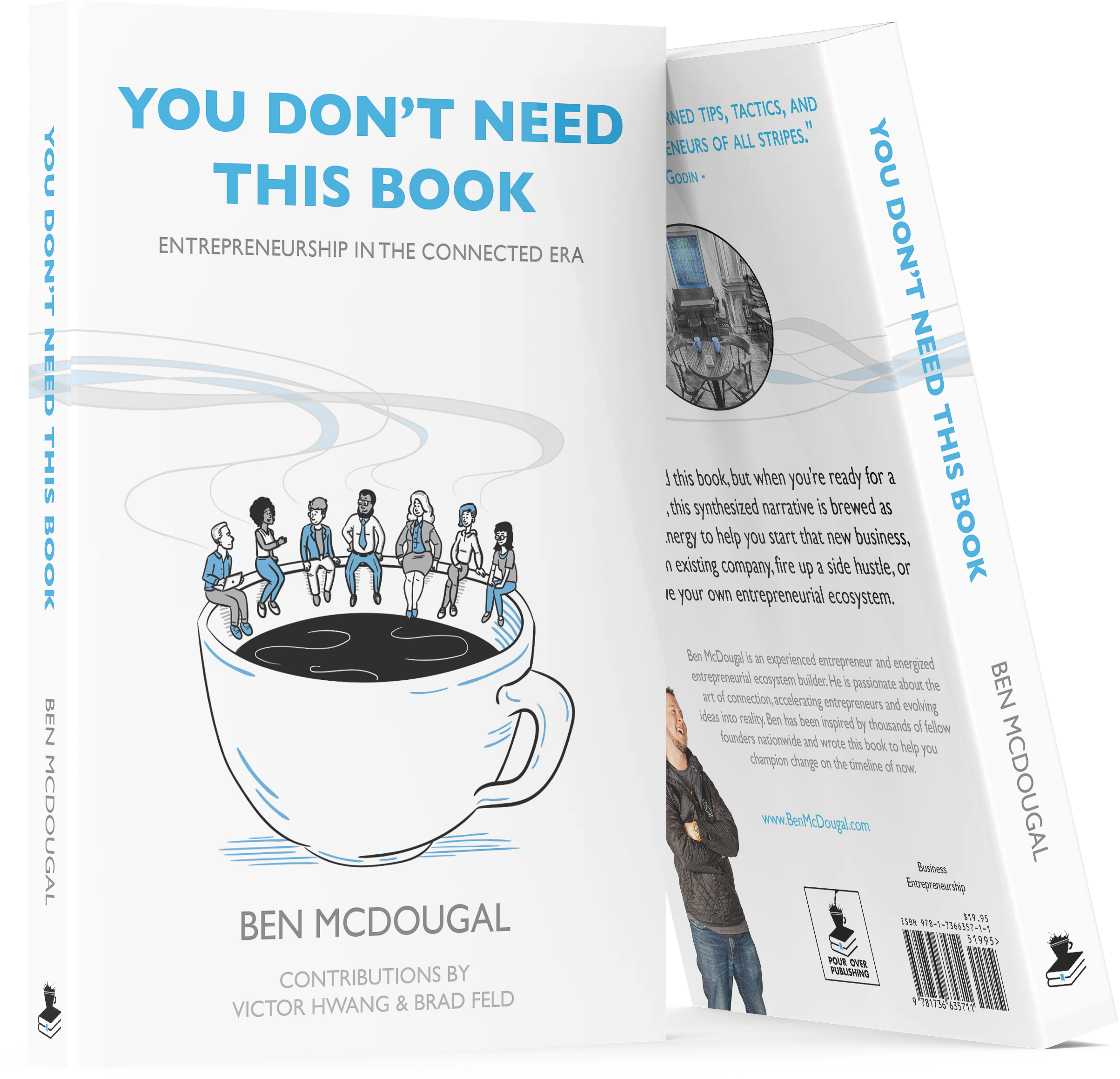
You Don’t Need This Book: Entrepreneurship in the Connected Era prompts diverse types of early moves that guide an idea toward commercialization. Here’s a reminder of that book’s table of contents for readers to revisit.

You Don't Need This Book: Entrepreneurship In The Connected EraChapter 1 – Ideation
Chapter 2 – Community
Chapter 3 – Team
Chapter 4 – Side Hustles
Chapter 5 – Research
Chapter 6 – Testing
Chapter 7 – Marketing
Chapter 8 – Sales
Chapter 9 – Results
Chapter 10 – Persistence

If this evolving business idea continues to touch your heart after internal and external analysis, you may have something ready to pursue. Yes!

Inspiration is perishable, so when this happens, be ready to take action. It’s not how fast you move; it’s that you find ways to get started and keep moving.

Extra Shot

Things you dedicate time to will grow.

As you make early moves, stay nimble. Agility is one of the best advantages to being small. It often takes many versions to land on something ready for the wild. Remain sustained by timing early moves based on personal bandwidth, the environment, things you do well, and things that make you uncomfortable. Leverage educational support, accelerator programs, and resources. Stay intellectually humble, work with others, and continue executing more early moves.

By Ben McDougal, ago

Pitch Competitions

Pitch competitions create hype within conventions, conferences, and trade shows. Business competitions can also be standalone events. When a founder’s storytelling becomes award winning, pitch competitions can enrich your business. Feedback, awareness, complimentary services, and cold hard cash are all up for grabs.

As you explore business competitions, recognize the commitment required for each event. While application fees are rare, applying for pitch competitions can be time consuming. As you apply for different types of events, repetition makes the process more efficient. Save content before submitting each application for a head start on future submission forms. Along with bettering the application process, consider the competitive environment you’ll be occupying.

How can your initial application solidify a positive first impression? What will be required to participate in a meaningful way? Will the audience respond to a presentation meant to share or a pitch built to impress? How much time will you be given? Who are the judges? How can your narrative be catered to the judges’ scoring criteria? Will there be time for questions? If so, what questions should you be prepared to answer? With these considerations in mind, it’s time to prepare the transmission.

NEXT WEEK: Slide Deck Design

By Ben McDougal, ago

Feedback is Data

Customer discovery paves the path to profitability.

This really is the work for entrepreneurs starting a new business. Customer discovery requires curiosity, patience, humility, hard work, thick skin, an interest in being wrong, discernment, and a willingness to adapt.

For many entrepreneurs, impartial feedback can be scary. Customer discovery puts our ideas on the hook and conversations with strangers may contradict past assumptions, but that’s the point! Interacting with the market you seek to serve allows us to learn from “no” in a way that gets us to “yes.” As you collaborate with those who criticize what you’re building, learn why naysayers disagree with your hypotheses. Be humble and make your concepts more compelling to change their minds.

Collecting such real-world data is human and intellectual capital that will attract more network and financial capital. The more you learn from others, the more you’ll recognize—and be able to meet—true demand. This can be a protracted process, which can make it feel unnecessary, but honest feedback will strengthen your value proposition and allow you to eventually go further in the right direction.

When learning from the perspective of others, remember that feedback is only data. This data should be collected, organized, and examined like a scientist. Inference is more effective with more data, so the more feedback you have, the easier it can be to make decisions.

As you translate feedback into action, you must also find your own way. Even with good intent, people who provide you feedback are doing so based on their own experiences. The experience of others is based on the past and is unlikely to harmonize with your exact situation. There are many ways to build your business, so perpetually gather as much feedback as possible and use diversified data to guide your company toward product-market fit.

Extra Shot

My community visit with 1MC Joplin was sweet, this feature article was a neat chance to celebrate Global Entrepreneurship Week, I’m gathering my own feedback by presenting Pour Over Publishing at 1 Million Cups Des Moines, and the much anticipated YDNTB audiobook is almost done!

By Ben McDougal, ago

Generosity Builds Trust

The art of connection aged in a readiness to consistently Show Up and #GiveFirst, often leads the willing to endless opportunity. Let’s explore the why.

Long story short, generosity builds trust. Such benevolence also instills wonderment from others. When our practice includes perennial actions that accelerate others, the ability to deliver on a promise is proven. This earns credibility and allows curiosity to spark new ways to collaborate, which over time, equates to endless opportunity from/with/for people you trust.

Extra Shot

Delivering on a promise sounds heavy, but passing this test can be as simple as suggesting a strategic introduction and following through, arriving on time, or providing the product/service/value a paying customer expects.

At a community level, when more people assume positive intent, tribes are tightened and become able to support more people with bigger ideas. The vulnerability required may introduce new challenges, but the risk is worth the reward when we’re set free to collectively build at the speed of trust. This can be hard to understand for those who have been hardened by the competitive nature of capitalism, but for those who see through the lens of abundance, when more people find their own definition of success, it translates into fresh ways for everyone to thrive.

By Ben McDougal, ago

Recording an Audiobook

I’m often asked about my journey as a first-time author.

How I Wrote YDNTB is a link I’m quick to share with those curiously navigating the fog of writing their own book. I’ve also began speaking with groups about how Pour Over Publishing was established to support this project.

With the audiobook for You Don’t Need This Book about to hit your ears, a similar rumination on how I planned, recorded, produced, and distributed my own audiobook is in order. Enjoy!

Planning

As Seth Godin mentions in his Advice For Authors, the cadence for an important project starts long before everyone first hears about it. Planning slows down early progress, but vision, preparation, and a willingness to rethink along the way provide value as pieces of a larger puzzle come together over time.

Extra Shot

Audiobooks unlocked my interest reading.

Establishing a strategic cadence for YDNTB was something I’m glad I thought about early on. I wasn’t sure how they were produced, but an audiobook was always going to be part of the YDNTB experience. The sturdy softcover and convenient eBook were launched first, but the time-release effect of a staggered distribution provides a fresh promotional boost, while inviting a wider audience of audiophiles into this exploration of entrepreneurship in the connected era.

Along with a thoughtful timeline, a planned cadence has allowed me to organize each of the individual variables into the overall equation. For example, the ISBN numbers, pricing, and distribution methods are different for each item, but work together at the same time.

Recording

When it was time to hit record, I wish it was as easy as grabbing the book, a cup of coffee, and just reading my heart out. There’s a lot you can do in “post”, which is jargon that describes all the work done to bring original media into a finished state, but quality audio is easier to work with. I thought about renting time in a professional studio. I also considered quiet booths at a local coworking space, but knowing the audiobook recording process was going to take longer than I thought, I decided to craft my own quiet place.

As seen in this YDNTB audiobook preview video, I found solace in the lower layer of my home and with a simple setup, I created a comfortable environment to narrate every word of my book.

Any decent microphone can work, but I used the Zoom H4N Pro Audio Recorder mounted in front of a small isolation shield with sound absorbent foam. A pop filter was then placed in front of the microphone to reduce the peaks as I spoke. To monitor the sound, I used a nice headset from my friends at Astro Gaming. This helped me stay in the zone, but also made sure unwanted noise didn’t sneak into the recording. This attention to detail led to the basement fridge getting unplugged, the HVAC being turned off, clock batteries being removed, and momentary pauses when planes flew overhead. Knowing I wanted to stand to project my voice as I narrated the book, I sat my laptop at eye level and used a silent mouse to scroll through the eBook. The result was a rich sound that listeners will appreciate without distraction.

Extra Shot

Brad Feld read his contribution for the YDNTB audiobook, so you’ll hear his voice within the Entrepreneurial Ecosystems section of the Community chapter!

One big surprise, was how exhausting it was to record an audiobook. I was naive to think I could stand up and read the entire thing in just a few settings. Audiobooks must be read word-for-word for whisper syncing and proper transcription. This meant misread words had to be identified (I clapped to create a spike in the audio waves) and re-read to perfection.

Along with eliminating audio-flavored typos, the inflections from the author are one of the best parts of audiobooks, so I wanted listeners to experience a similar satisfaction with the YDNTB audiobook. This translated the narration into more like an artistic performance! With BENergy poured into every word, a single chapter was usually the longest I’d last before my mind was mushy, my voice became scratchy, and my legs started to tremble. In an effort to make the entire audiobook sound even, I knew I wanted to capture everything within a short window of time, but recording all 37,456 words still took over a month to complete. Even with the extra time this process required, I had a lot of fun narrating my own book.

Production

With hours of recorded audio in place, the real work began.

To provide the most engaging experience for listeners, every sentence received treatment. This was painstaking, but the extra effort allowed me to remove outtakes and the distracting sound of me gasping for air. I also spent time listening to how everything sounded together. This often meant listening to the same sentence many times, which allowed me to optimize the flow felt between each syllable, word, sentence, paragraph, and section.

Attentively starring at audio waves and stitching what felt like endless audio into a polished audiobook was the definition of tedious. I have no idea how many hours were spent and if I have to do it again, I’ll probably hire out this production process. That said, I’m glad I took on the challenge. Like much of the YDNTB story, this was a test of skill, will, and endurance, but resulted in a relic I can be proud of for life.

As each word merged into sentences, paragraphs became sections. Sections connected into chapters and I eventually had the entire audiobook stitched together. I brought every element of the audiobook into a final round of editing to reduce any remaining echoes, peaks, and audible flaws. The complete audiobook clocks in at 5 hours, 30 minutes, and 13 seconds.

Distribution

With a piece of art ready to hear, it was important to make sure my audiobook was easy to find. Along with direct (pre)orders from the YDNTB page, I used the Amazon ACX platform to make sure this audiobook was optimized and available to download on Audible, Amazon, and iTunes.

I love how the audiobook fits into the YDNTB universe and I’m proud of how it turned out. I’d invite you to listen to the audiobook while holding a signed softcover for the ultimate experience. I can’t wait to hear what you think!

By Ben McDougal, ago