Culture is woven; technology is built. One accumulates through memory and shared meaning, shaped over time by many hands. The other is designed and assembled with intention. This distinction matters because what is built can be finished, while what is woven never is.
Through stories, symbols, and artifacts, each generation adds new layers to the tapestry of our world. What once took only physical form is increasingly becoming digital, carried forward by the relentless evolution of technology. Yet, once introduced, technology rarely remains confined to its original purpose. It’s folded into the fabric of our world where it’s interpreted and repurposed, becoming part of our society in ways its creators could not fully anticipate. This process is cumulative, not merely additive. New ideas rarely replace what came before; they intertwine with it. Beliefs and practices become entangled across time itself.
EXTRA SHOT
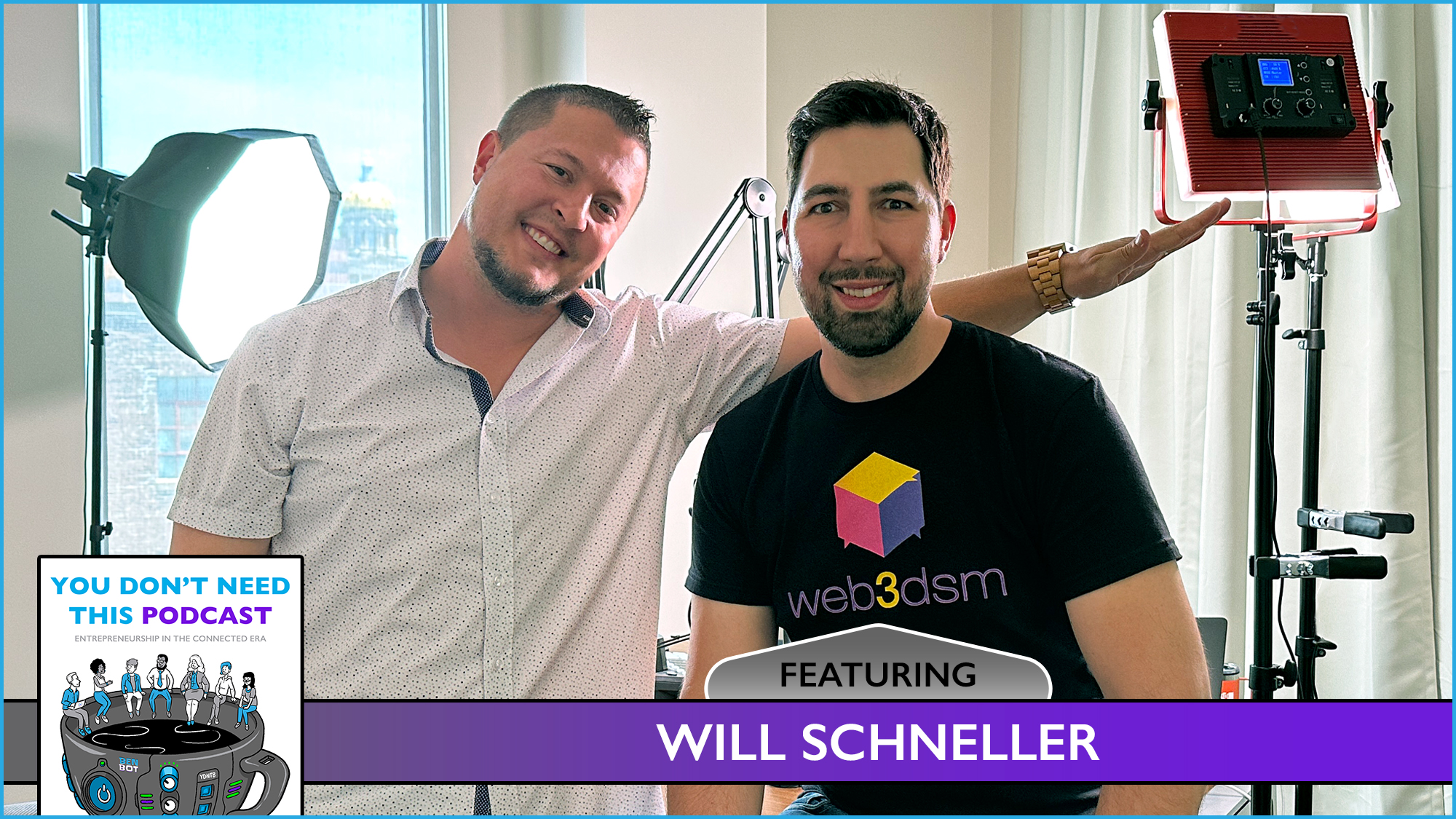
This contribution was written by Will Schneller. This founder is a curious creator who explores how art, technology, and community connect.
At the edge of new frontiers, humans reach for the familiar. We stitch together distancethe gap between the known and unknown with shapes we recognize. Sometimes this instinct serves convenience or efficiency, making new systems easier to adopt. An artwork originating in oil paint is trivial to transfer into a physical print edition, and it’s even easier to make that print digitally available. A ticket to a sporting event that once existed on perforated paper now lives on a handy smartphone app. Your favorite album is no longer confined to the shelf but sits among thousands of other songs on a device in your pocket. Other times, replication is a coping mechanism, a way to translate ideas that feel too abstract, too technical, or difficult to explain.
Even when digital systems begin by imitating familiar physical forms, digital depth quietly emerges beneath the surface. Metadata invisibly flows; hidden traces record not just what something is, but how it came to be, and how it moves through networks. MThe meaning in what we create no longer resides solely in appearance or original intent. It accrues through circulation, reference, and response. As these translations settle into everyday use, they begin to expose possibilities that were never present in their physical counterparts. Constraints loosen and rules get rewritten. Systems that once existed to mirror the familiar start inviting exploration, modification, and play. What follows is not a better copy of the old world, but a space where new behaviors and relationships can unfurl.
While some technological advances are purpose-built to solve specific problems, others become playgrounds. Environments where new primitives can be experimented with and explored. For example, blockchains created the conditions for non-fungible tokens to be born. NFTs (“non-fungible tokens”) are digital assets supported by smart contracts that connect to a blockchain. Each NFT is unique, which allows code to autonomously apply, track, and transfer digital signatures and verifiable ownership. Although each digital artifact may have no exact equivalent, it can still evolve over time. These blockchain-native assets allowed us to apply property rights to digital goods and interact with like-minded individuals without corporate algorithms shaping every connection.
Long before NFTs gained prominence, video games had already been rehearsing some of the same ideas. Virtual worlds established shared rulesets, persistent identities, and digital artifacts whose value emerged through play and social context rather than physical substance. Communities formed around common mechanics, aesthetics, and norms. They assigned meaning to avatars, skins, achievements, and in-game assets that only existed as code yet carried real weight. Traditionally, in-game items are effectively rented, disappearing when servers shut down; blockchain-based ownership proposed permanence, portability, and player-held authority. Once ownership can be represented digitally with credible verification, we give users their own cybernated backpack to store, use, and transfer digital assets. Instead of centralized servers restricting our digital assets, decentralized protocols and web3 layering supports ownership across different platforms. tThe conversation expands beyond art and gaming into everyday artifacts like memberships, credentials, and records that structure daily life.
As these digital-native systems mature, they enable entirely new creative and cultural capabilities. Not merely faster production or broader distribution, but fundamentally different relationships between audiences, creators, and artifacts. One such shift was generative creation. Instead of crafting a single, fixed outcome, creators began defining rule sets; constraints, probabilities, and parameters from which many unique expressions could emerge. Authorship moved upstream from execution to orchestration. One of the earliest and most visible examples was Larva Labs’ CryptoPunks which demonstrated that scarcity and identity could be encoded directly into digital artifacts. Each image was simple, but its meaning was amplified by its inclusion within a fixed set, its history of ownership, and its role as a recognized cultural symbol. Platforms like Art Blocks pushed this idea further by entangling the code powering the generative image algorithms with the cryptographic functions of the blockchain itself to create a symbiotic relationship between process and product. Variation became a feature, not a flaw, and collectors became participants in the moment of creation itself.
Alongside generative art, other projects explored coordination and collective meaning-making through radical simplicity. Jack Butcher’s Checks emerged as social commentary when Twitter (now X) infamously monetized account verification, replacing long-standing signals of notability with a paid badge. More than capturing the cultural moment, Checks leveraged the blockchain architecture itself to create an infinite game of coordination where holders could recombine varying edition sizes to create new outputs, thereby elevating them into collaborators. Another of Butcher’s projects, Opepen, transformed the silhouette of a popular internet-native character, Pepe the Frog, into a gallery-esque system in which constraint became the canvas. Artists across backgrounds and styles imagined thematic sets, each adding a distinct thread to the whole. Through distributed voting, token holders collectively enshrined new works into a permanent collection, shaping the canon set by set. Power did not come from technical complexity or visual detail, but from repetition, shared context, and sustained participation over time. The community drove the narrative.
Taken together, these projects revealed a broader shift. Digital artifacts were no longer static endpoints, but dynamic nodes within living systems. Value emerged not only from aesthetics or novelty, but from process, lineage, and collective engagement. Creation became less about producing objects and more about shaping culture-organizing frameworks within which culture could organize itself. In this way, technology did not replace traditional artistic or cultural practices; it extended them, offering new ways for ideas to propagate, mutate, and endure. But more than offering a new set of tools, technology holds up a mirror, forcing us to confront what we value as our physical and digital lives continue to merge, layer by layer, thread by thread.
When novelty fades and attention moves on, what remains is not spectacle but structure. People return to the tangible, not in rejection of the digital but in search of something that is grounding. Digital slips into quieter roles as infrastructure. This isn’t failure but rhythm, an expression of how new technologies mature over time. Every major technological shift follows the a familiar arc discussed in the upcoming Yin Yang riff. Early breakthroughs ignite curiosity and experimentation, producing rapid growth as possibilities are explored. Along the Often described as an S-curve of a technology’s life cycle, this initial ascent is driven by potential rather than stability. Expectations rise faster than practical understanding. Capital and cultural energy concentrate at the leading edge, amplifying both innovation and excess.
Inevitably, the curve bends and the edges begin to fray. Constraints appear and promises collide with reality. What cannot sustain itself is torn away, giving rise to periods of contraction or disillusionment. These moments are frequently mistaken for failures and become opportunities for skeptics to declare their predictions correct. However, they serve a necessary function. They clear the noise from signals, speculation from utility, and fragile ideas from durable ones. What follows is not a return to obscurity but a slower, steadier climb. The technology re-enters everyday life, quietly embedded into workflows, tools, and habits, often under new branding to shed cultural baggage. It stops demanding attention and begins offering reliability. Value shifts from novelty to usefulness, from expansion to integration. The most enduring systems are no longer those that announce themselves loudly, but those that quietly become indispensable.
Each technology life cycle pulls old threads forward, reweaving the physical and digital into a fabric that grows richer with history. Past experiments inform future structures. Early missteps become knots rather than dead ends, points of tension that strengthen the tapestry. Over time, what once felt disruptive becomes foundational, and the boundary between the new and the familiar dissolves until the cycle begins anew. What remains is not the novelty of the tools themselves, but the patterns of use, meaning, and connection sewn around them. Technologies may be constructed in moments, but their cultural significance is woven slowly through repetition and shared experience. In the long run, progress is measured not by what is built, but by what endures.