Data Agriculture

DataAgriculture.ai seems like an interesting taxonomy-updating quest. It feels time for a team of hybrids to help us build through Big Tech’s early attraction-to-extraction narrative. This domain is now available to energize such a build. Why could this be massive?

The void that a term like “extraction” prompts sounds sharp, but it needed to be. The hollowness has been felt, but that’s when humans can remain enriched from digitized data that flows through more like an agricultural systems versus a mining expedition. Instead of a complete void, appreciating the access to an improved state of mediocrity, but also knowing that 100% HUMAN then becomes even more luxurious.

Extra Shot

Reading can led to compelling investments into fresh whims.

Helping to translate the cultural narrative by working through the abundance of data. All the data everyone talks about as AI gains vast awareness. This is a new, serious quest for a brand that curates human activity alongside AI allies. Humans remain remarkable. What products might benefit from leading such an industry quest and needs the URL to energize their exploration of this idea maze? The goal would be to transition away from “extraction” and through to the next phase: data agriculture

As society grapples through what started as an attraction phase, the sense of being a product is hindering the opportunity. Humans have a moment to reflect on the addiction of productivity. We can remain awesome, which machines want anyway. Keep the source code wild and machines will always wanna learn how we do it. It’s why 87. Incentivized Reality was such an important finishing riff for the Technology section, on PAGE 259 in the new book.

The point? 100% HUMAN becomes even more luxurious. Our premium human time that collides us is what offers a path to staying wild. It’s the random that makes life move forward. Life has always been wild, but the potential serendipity IRL invites, can not be replicated.

By Ben McDougal, ago

Woven Worlds

Culture is woven; technology is built.

One accumulates through memory and shared meaning, shaped over time by many hands. The other is designed and assembled with intention. This distinction matters because what is built can be finished, while what is woven never is.

Through stories, symbols, and artifacts, each generation adds new layers to our collective tapestry.

What once took only physical form is increasingly becoming digital, carried forward by the relentless evolution of technology. Yet, once introduced, technology rarely remains confined to its original purpose. It’s folded into the fabric of our world, where it’s interpreted and repurposed, becoming part of our society in ways its creators could not fully anticipate. New ideas rarely replace what came before; they intertwine with it. Beliefs and practices become entangled across time itself.

EXTRA SHOT

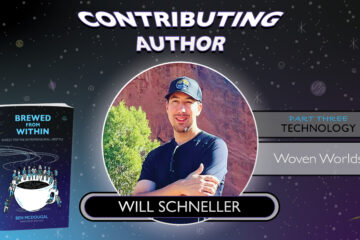
This contribution is written by Will Schneller, a curious founder and technologist who explores how art, technology, and community weaves together.

At the edge of new frontiers, humans reach for the familiar. We stitch together the distance between the known and unknown with shapes we recognize. Sometimes this instinct serves convenience or efficiency, making new systems easier to adopt. An artwork originating in oil paint is trivial to transfer into a physical print, and it’s even easier to make that print digitally available. A ticket to a sporting event that once existed on perforated paper now lives on a handy smartphone app. Your favorite album is no longer confined to the shelf but sits among thousands of songs on a device in your pocket. Other times, replication is a coping mechanism, a way to translate ideas that feel too abstract, technical, or difficult to explain.

Even when digital systems begin by imitating familiar physical forms, digital depth quietly emerges beneath the surface. Metadata invisibly flows; hidden traces record not just what something is, but how it came to be and how it moves through networks. The meaning in what we create no longer resides solely in appearance or original intent. It accrues through circulation, reference, and response. As these translations settle into everyday use, they expose possibilities not present in their physical counterparts. Constraints loosen, and rules get rewritten. Systems that once existed to mirror the familiar start to invite exploration, modification, and play. What follows is not a better copy of the old world, but a space where new behaviors and relationships can unfurl.

While some technological advances solve specific problems, others become playgrounds. For example, blockchains created the conditions for non-fungible tokens to be born. NFTs (non-fungible tokens) are digital assets supported by smart contracts that connect to a blockchain. Each NFT is unique, which allows code to autonomously apply, track, and transfer digital signatures and verifiable ownership. Although each digital artifact may have no exact equivalent, it can still evolve over time. These blockchain-native assets allow us to apply property rights and to interact with like-minded individuals without corporate algorithms shaping every connection.

Long before NFTs gained prominence, video games had already been rehearsing some of the same ideas. Virtual worlds established shared rulesets, persistent identities, and digital artifacts whose value emerged through play and social context rather than physical substance. Communities formed around common mechanics, aesthetics, and norms. They assigned meaning to avatars, skins, achievements, and in-game assets that only existed as code. Traditionally, in-game items are effectively rented, disappearing when servers shut down. Blockchain-based ownership proposed permanence, portability, and player-held authority.

Once ownership can be represented digitally with credible verification, users are given their own cybernated backpack. Not a login granted by a platform or company but a self-held container of identity, assets, and permissions that persist beyond any single service. Instead of centralized servers restricting our digital assets, decentralized protocols and web3 layering support ownership across different platforms. The conversation expands beyond art and gaming into everyday artifacts like memberships, credentials, and records that structure daily life.

As these digital-native systems mature, they enable entirely new creative and cultural capabilities—not merely faster production or broader distribution but fundamentally different relationships between audiences, creators, and artifacts. One such shift was generative creation. Instead of crafting a single, fixed outcome, creators began defining rule sets: constraints, probabilities, and parameters from which many unique expressions could emerge. Authorship moved upstream from execution to orchestration.

Blockchain-powered platforms pushed this idea further by binding generative systems to cryptographic infrastructure, creating a symbiosis between process and product. Variation became a feature, not a flaw, and collectors became participants in the moment of creation itself. Alongside generative art, other frameworks explored coordination and collective meaning through radical simplicity, repetition, shared context, and sustained participation over time.

Digital artifacts were no longer static endpoints but dynamic nodes within living systems. Value emerged not only from aesthetics or novelty but also from process, lineage, and collective engagement. Creation became less about producing objects and more about shaping culture-organizing frameworks. In this way, technology did not replace traditional artistic or cultural practices; it extended them, offering new ways for ideas to propagate, mutate, and endure. But more than offering a new set of tools, technology holds up a mirror, forcing us to confront what we value as our physical and digital lives continue to merge, layer by layer, thread by thread.

When novelty fades and attention shifts, what remains is not spectacle but structure. People return to the tangible, not in rejection of the digital, but in search of something that is grounding. Digital slips into quieter roles as infrastructure. This isn’t failure; it’s rhythm, an expression of how new technologies mature over time. The familiar S-curve of a technology life cycle, which we’ll revisit in Yin Yang, begins with breakthroughs that ignite experimentation on the way toward an early ascent, steered by potential rather than stability. Expectations rise faster than practical understanding. Capital and cultural energy concentrate at the leading edge, amplifying both innovation and excess.

Inevitably, the curve bends and the edges begin to fray. Constraints appear and promises collide with reality. What cannot sustain itself is torn away, giving rise to periods of contraction or disillusionment. These moments are frequently mistaken for failures and become opportunities for skeptics to declare their predictions correct. However, they serve a necessary function. They clear the noise from signals, speculation from utility, and fragile ideas from durable ones. What follows is not a return to obscurity but a slower, steadier climb. The technology re-enters everyday life, quietly embedded into workflows, tools, and habits, often under new branding to shed cultural baggage. It stops demanding attention and begins offering reliability. Value shifts from novelty to usefulness, from expansion to integration. The most enduring systems are no longer those that announce themselves loudly but those that quietly become indispensable.

Each technology life cycle pulls old threads forward, reweaving the physical and digital into a fabric that grows richer with history. Past experiments inform future structures. Early missteps become knots rather than dead ends, points of tension that strengthen the tapestry. Over time, what once felt disruptive becomes invisible, and the boundary between the new and the familiar dissolves until the cycle begins anew.

What remains is not the novelty of the tools themselves but the patterns of use, foundational meaning, and the connections sewn around them. Technologies may be constructed in moments, but their cultural significance is woven slowly through new ideas, repetition, and shared experience.

In the long run, sincere progress is measured not by what is built but by what endures.

Brewed From Within
#78 📖 Technology

By Ben McDougal, ago

Conversationalized

Humans have long used technology to communicate. As we taught machines to see, learn, speak, and move, computers were invited into the conversation.

ChatUX is technology that helps computers speak our language with a conversational experience supported by deep learning and large language models (LLMs). ChatUX makes AI easier to enjoy with a potential for accurate, unbiased, and meaningful interactions. This allows the seven types of AI to be so much more than pointless help desks, deceptive lead generators, misleading content, or fake followers on social media. Instead, the objective is to access endless insight with an ability to translate it effectively.

When upgraded this way, ChatUX bridges trust channels to personalize education, enhance business efficiencies, assist customers with empathy, deliver meaningful mental health therapy, and make past tasks irrelevant, all while parlaying multimodality so anyone can effectively express ideas.

As the way we communicate evolves, improvements geared for safety and customizability will keep technology in the conversation. The freedom of speech is a complex topic, but thoughtful guardrails that identify dangerous rhetoric help to keep everyone safe without unwanted censorship. Alongside responsible policymaking, influence layers help to customize ChatUX. This can add depth to personalize an interaction or to provide internal teams with a more reliable source of truth.

With technology conversationalized, prompt engineering became an evolving professional field of reconstructing inputs to optimize outputs. The demand for a brand-new mode of communication reminds us that real skills are required to remain relevant. Fortunately, when it comes to technology, an increased effort here often decreases effort there. In this case, learning to communicate with technology may require new resources, but ChatUX bolsters a paradigm shift where access to knowledge becomes pedestrian.

Extra Shot

When the cost of information is zero, willpower becomes a path to wealth.

We prepare our children with communication skills while instilling kindness, honesty, empathy, integrity, and so much more. From the words we use to the interactions we share, positive traits can be ingrained into technology for good.

Brewed From Within
#81 📖 Technology

By Ben McDougal, ago

Propulsive

Technology is an accelerant. At increased speeds, conflict happens and any direction becomes arduous to command.

Welcoming the confluence of humans and machines reduces the gap between human potential and artificial intelligence. Positive intent with ethics at the forefront of progress may help avoid an imbalance, but there’s still no guarantee that comes with our trust in technology.

Complacency leaves room for degraded integrity. This means we must remain inquisitive. Pushing elephants into the room encourages critical thinking, invites problem-solving, and provokes new perspectives. Here are brain teasers to rise above cliché conversations:

  • With answers so easy to come by, how can we celebrate experiential wisdom to maintain a willingness to learn?
  • A single AI prompt uses roughly the same energy as running a light bulb for 15 minutes. Adaptive computing, alternative energy, and other bridges to tomorrow will support more efficient interactions. But how might careless consumption impact long-term sustainability?
  • What is worth sacrificing to achieve progress?
  • Is learning to code more about understanding the capabilities and communicating with AI?
  • Unlimited access will raise the bar, but with fewer sources, does everything become mediocre?
  • Will enhanced productivity make humans lazy?
  • How do humans avoid isolation when technology makes perceived connection effortless?
  • Do we care about reduced privacy, or is it that we never like feeling surprised, sold out, or exploited?
  • If AI-generated content dominates the internet, might the overwhelming slop tempt exhausted humans to hibernate? If dark forests grow, will the beauty of collaboration in our connected era be fragmented or strengthened when the only participants truly care?
  • Should personal truths, political truths, and objective truths be held or conform to meet new facts in a changing reality?
  • How might the story of money end? When this happens, is attention or your network a more valuable currency?
  • In post-labor economics, how do humans spend a lifetime when jobs/tasks are less of a concern?
  • Instead of trying to inhabit other planets that fight against life, perhaps we use them to accommodate what we don’t want on Earth?
  • Is energy the most valuable natural resource?
  • Can humans and machines thrive in equitable ways, while progressing to a Kardashev Type II or Type III Civilization? If so, what are pit stops to harness the energy of our own star and eventually command the luminosity of our entire galaxy?
  • What prompt might you add to bend the mind?

                                The ethical aspects of technology can feel like a drag. Unfortunately, the ease of overlooking short-term issues usually leads to long-term problems.

                                Extra Shot

                                “Once you wow an audience, the same trick may not work anymore.” –Seth Godin

                                To find an equilibrium with artificial counterparts, elevate what we’re good at and do the same with technology, but slow down to avoid irreversible damage. As we align answers together, trust in a shared direction celebrates limitless diversity while ensuring a future that respects the past and remains open to next.

                                Brewed From Within
                                #88 📖 Technology

                                By Ben McDougal, ago

                                Bridges to Tomorrow

                                Limitations fade as boundaries are broken. If we collectively avoid extinction and continue building bridges to tomorrow, our relationship with time, nature, technology, and each other will uncork unknowns and light a path to our neon future.

                                Robotics

                                With AI in the brain and emotions that curate a personality, robots are advancing to go beyond isolated tasks. Cyborgs will turn knobs at work, while humanoids complete chores at home. With the mundane covered, the role of humans can shift toward leading whenever ingenuity is required. With full access to robotic efficiencies, economies will shift and the human touch will be even more luxurious. Leaders who welcome technology but never lose touch with the soul of their art, will be the hybrids who prevail.

                                Biotech

                                As technology interfaces with human biology, a bionic age will alter the laws of nature. When the electrical impulse from a thought is all that’s required to prompt action, the speed at which data can move is unfathomable. Brain-computer interfaces (BCIs) and other forms of neurotech are already treating disease and restoring movement by reconnecting the nervous systems. Most people don’t want to be first, but when might a routine doctor visit include individualized diagnostics and software updates to the nanotechnologies inside your body? When every cell in the body has a microscopic computer connected to it, the resource consumption is diffused by concepts like DNA computing and the mysteries of health care are solved.

                                Material Science

                                The atomic levels of technology have already connected intelligence to things we interact with every day. We’ve seen how the Internet of Things (IoT) adds digital depth to our physical world. As the cost and size of technology continues to shrink, the periodic table becomes a playground. For example, we have materials used in the construction of roads that transfer the force of vehicles to batteries. The stored electrical energy is then transferred to streetlights that illuminate the road at night. This type of elemental exploration and creative recycling is only a flicker of the flame for alternative energies and improved storage methods that can quench our planet’s thirst for energy while eliminating a dangerous dependency on limited resources. The universe provides everything we need. It’s up to us to squeeze improvements from elements that are waiting to arrive at their full potential.

                                Quantum Computing

                                When “or” becomes “and,” a bizarre world of duality is unveiled. The computing aspect within quantum mechanics uses quantum bits, or qubits, to solve complex problems with measured superpositions, entanglement, and interference. Dig in to learn more, but the superpositions found in quantum computing mimic complexity, with simulations that include all possible solutions at once. This is not a more powerful, number-crunching supercomputer. Quantum computers represent a whole new approach to harnessing the atomic and subatomic levels of physics. A scientific asset that eliminates secrets presents a mixed blessing. With the chemistry of life mapped by machine learning, medicine will solve diseases and the potential of material science will be realized.

                                At the same time, current cryptography and the encryption that provides security online is at risk. Increased checkpoints, biometric confirmation, photon distribution keys, and other post-quantum encryption standards are being tested to ensure the world is ready for hardware to keep qubits cold enough to unlock a world-changing partnership between classical and quantum computing.

                                Life Extension

                                Quantifying the cosmic depths of our own kind will give us ways to experience time in more profound ways. Instead of hoping to reverse the effects of aging with treatments, food, and medicine, augmented activities will engrain longevity from start to finish. Although the human body may not hold up forever, living more than 100 years will be normalized. As we live longer, how might agriculture, infrastructure, education, healthcare, economies, and our global climate adapt? Many who plan for this longevity will be primed to meet new demands in existing industries. The quixotic leaders will explore less obvious opportunities and convert unexpected challenges into new industries as well.

                                Outer Space

                                The cosmos makes us feel small, yet limitless wonder helps us think big. As bionic humans and quantum computing improves material science, a robot-supported species can be multi-planetary. The origins of astronomy are prehistoric, but off-planet exploration began when machines first visited space in the 1940s, and then humans in the 1960s. Scientific exploration led to a commercial space industry that has propelled an excursion throughout our solar system and beyond. Today, orbiting observatories are looking toward the origins of the universe, with life on Earth’s moon and Mars seemingly inevitable. As we interact further into the void, celestial frontiers can provide added stability for the human race and extend life on Earth. Cosmic resources, travel, communication, manufacturing, tourism, and security must all be addressed by leaders united by shared intentions on behalf of all humankind.

                                There are untold innovations yet to be conceptualized, but these bridges to tomorrow all signal progress. Widespread adoption is never straightforward, but listening suspends belief, and continuous steps forward can transcend invisible lines for us all to work as one.

                                Brewed From Within
                                #84 📖 Technology

                                By Ben McDougal, ago