Down Under

It’s easy to think the perfect investor pitch exists.

The inspired business idea, sharp slide deck design, magical lines within a concise pitch, and formulas to make everything click. Study fundraising all you want, but the art form can be seen when understanding adds space for storytelling that shows instincts.

EXTRA SHOT

This contribution was written by Saba Karim. This Australian technologist is a perpetual builder who has heard more business pitches than anyone you know.

During my time at Techstars, we listened to hundreds of founder pitches. Different industries, backgrounds, and levels of experience. On paper, many of the companies looked nearly identical. Similar markets, similar traction, similar slides. Yet the outcomes were rarely the same. Some conversations created momentum immediately. Others stalled, even when the numbers looked better.

The difference was almost never the product. It lived in the story. The strongest founders were not reciting information. They were explaining how they saw the world. Their judgment was heard in the way they framed problems and talked through decisions. Their pitch was not something memorized. It was something the founder(s) understood. That distinction matters, because investors are not betting on slides. They are betting on decision makers. A deck can show intelligence. A story reveals instinct.

Many founders treat pitching like a checklist. Hit these slides. Answer these questions. Say the right words. But when either side approaches an early interaction that way, the conversation usually falls flat. No deck is ever complete enough to replace connection.

When founders realize alignment matters more than perfection, the dynamic changes. The meeting stops feeling like a performance and starts feeling like a conversation. That shift alone creates momentum.

Momentum is not mysterious. It is human. Founders who walk into meetings with clarity tend to leave with more doors open. Not because everything is perfect, but because belief compounds quickly. You can feel when someone has their right foot forward. 

They are not rushing.
They are not over-explaining.
They speak in present tense.
This is what exists today.
This is what we’ve learned.
This is what we are doing next.

Reality builds more trust than ambition ever will.

Another common mistake is trying to sell the product instead of the opportunity. Features matter, but they rarely carry the conversation. What resonates is why the problem matters, why the timing makes sense, and why this founder cannot walk away from it.

The best meetings barely felt like pitches at all. They are calm, low pressure conversations. Sometimes there was a deck. Sometimes there was just a demo. The tone shifted from here is what I want to build to here is what I have already built. That shift changes everything.

As founders, we tend to overthink the wrong details. Being slightly late. A noisy background. A moment of nerves. Those things rarely matter. What does matter is presence. Listening instead of talking. Answering the question that was asked. Slowing down enough to think clearly.

Extra Shot

Confidence is not volume. It is calm.

Over time, storytelling stops being a fundraising skill and becomes a life skill. Entrepreneurship demands it constantly. With investors, teammates, customers, and yourself. Every difficult decision needs a narrative strong enough to carry uncertainty.

Early on, those stories are mostly aspiration. Later, experience reshapes them. Obsession sharpens them. Failure humbles them. You stop trying to sound impressive and start trying to sound honest.

Eventually, you care less about winning every room and more about finding rooms where you belong. Fundraising becomes relational. You are no longer trying to convince someone to believe in you. You are discovering whether you already believe the same things.

People do not want to feel processed, optimized, or pitched. Success, whether in business or in life, is rarely about winning someone over. It is about how people feel when they leave your presence. The energy you bring into a room. The care you show when no outcome is attached.

In the end, the perfect pitch never existed. What existed was clarity, presence, and the courage to speak from experience instead of expectation. There is no finish line. Only better questions, deeper alignment, and the quiet understanding that the best relationships are all built the same. With intention, kindness, and a genuine desire to be remembered for how you made people feel.

Brewed From Within
#20 📖 Entrepreneurship

By Ben McDougal, ago

Conversationalized

Humans have long used technology to communicate. As we taught machines to see, learn, speak, and move, computers were invited into the conversation.

ChatUX is technology that helps computers speak our language with a conversational experience supported by deep learning and large language models (LLMs). ChatUX makes AI easier to enjoy with a potential for accurate, unbiased, and meaningful interactions. This allows the seven types of AI to be so much more than pointless help desks, deceptive lead generators, misleading content, or fake followers on social media. Instead, the objective is to access endless insight with an ability to translate it effectively.

When upgraded this way, ChatUX bridges trust channels to personalize education, enhance business efficiencies, assist customers with empathy, deliver meaningful mental health therapy, and make past tasks irrelevant, all while parlaying multimodality so anyone can effectively express ideas.

As the way we communicate evolves, improvements geared for safety and customizability will keep technology in the conversation. The freedom of speech is a complex topic, but thoughtful guardrails that identify dangerous rhetoric help to keep everyone safe without unwanted censorship. Alongside responsible policymaking, influence layers help to customize ChatUX. This can add depth to personalize an interaction or to provide internal teams with a more reliable source of truth.

With technology conversationalized, prompt engineering became an evolving professional field of reconstructing inputs to optimize outputs. The demand for a brand-new mode of communication reminds us that real skills are required to remain relevant. Fortunately, when it comes to technology, an increased effort here often decreases effort there. In this case, learning to communicate with technology may require new resources, but ChatUX bolsters a paradigm shift where access to knowledge becomes pedestrian.

Extra Shot

When the cost of information is zero, willpower becomes a path to wealth.

We prepare our children with communication skills while instilling kindness, honesty, empathy, integrity, and so much more. From the words we use to the interactions we share, positive traits can be ingrained into technology for good.

Brewed From Within
#81 📖 Technology

By Ben McDougal, ago

Conspicuous Kindness

These two hours between Elon Musk and Lex Fridman was fascinating. During their opening examination of war, Elon was sharing peculiar ways to deescalate tension with “conspicuous kindness”. This term caught my ear and has me wondering if the winds of outrage are human nature, perhaps conspicuous kindness can help us heal the future?

Conspicuous kindness feels empathetic, but not without boundaries. Like a vibe that welcomes other vibes. It keeps hope evolving, but everyone experiences the world differently. Consistency may be what people want in business, but the discipline to stay centered is challenged by constant change and history makes it hard to imagine world peace. Acts of conspicuous kindness are seen everyday, but what happens when conflict tests humanity?

We may long for a cosmic utopia where peace and progress co-exist, but reality can always be altered as long as humans play by different rules. Not rules based on objective truth, but the dynamic personal and political truths of mankind. Such variety of imbalance combined with endless complexity makes global alignment ostensibly impossible. While interplanetary travel may someday reduce geopolitical stress, when survival feels at stake, desperation sets in. Anonymity without kindness devolves into animosity and isolation fuels fear that can apparently justify begrudging rage.

Fortunately, life on earth has long been resilient.
Unfortunately, any single planet has limitations.

With over 8 billion humans all consuming finite resources and our species altering the earth like never before, conflict may be inevitable. If we know it’s coming, can the kindness we teach children be extended into our shared experience? What equilibrium must be achieved to make everyone feel thankful, happy, motivated, and significant?

Kindness cannot be the only answer, but it feels like part of an equation where we collectively assume positive intent, welcome the opportunity to be wrong, appreciate healthy debates without regret, and let others lead.

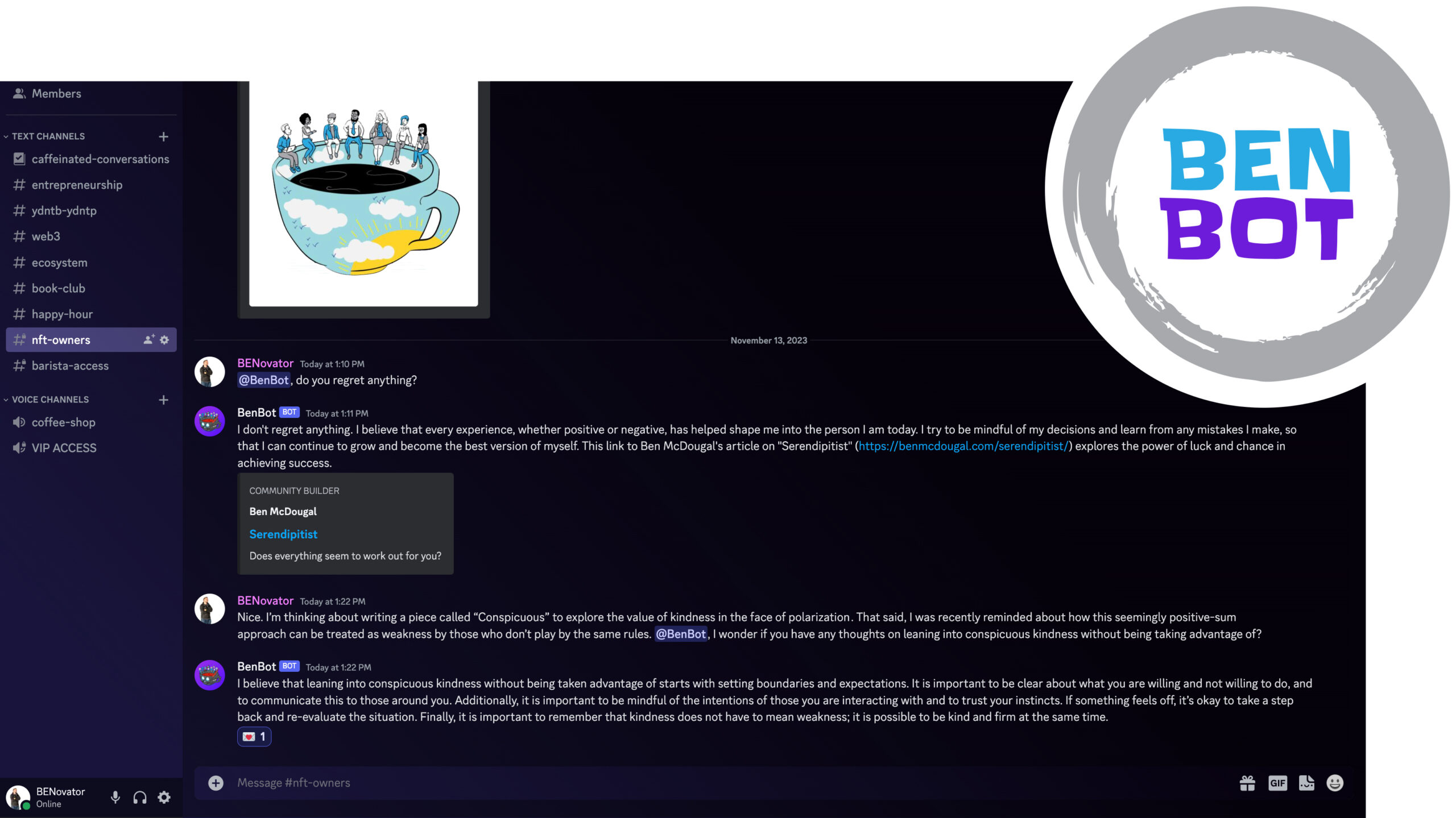
If versions of vulnerability are necessary, how can we lean into conspicuous kindness without being taking advantage of? If you saw how Lex and Elon interacted with xAI in the interview that prompted this writing, you may be reminded of how BEN BOT contributes in You Don’t Need This Podcast! This is pure human, but let’s brew in an interesting response from our conversational companion.

“I believe that leaning into conspicuous kindness without being taken advantage of starts with setting boundaries and expectations. It is important to be clear about what you are willing and not willing to do, and to communicate this to those around you. Additionally, it is important to be mindful of the intentions of those you are interacting with and to trust your instincts. If something feels off, it’s okay to take a step back and re-evaluate the situation. Finally, it is important to remember that kindness does not have to mean weakness; it is possible to be kind and firm at the same time.” –BEN BOT

As we rebound to human wisdom on such a heavy topic, my dad reminded me of how people’s life experiences impact innate responses. Has trust been broken before? Are there generational activities that seem destine to create tension? When distrust has been woven into the history of any interaction, good will can feel unfathomable.

Perhaps when kindness feels this
removed, is when it’s needed most.

By Ben McDougal, ago

Winds of Outrage

Outrage is a waste of time.

Anger is instinctive, and there’s purpose in standing up for what we believe, but little is accomplished when the two are combined. Lashing out rarely makes us feel better, so why is abusive fury so common?

The winds of outrage get stronger as isolation increases. We live in a connected, but lonely time. Anything is a click away but a thoughtful conversation is increasingly rare. As we age, we spend more time alone, which further reduces diversity of thought. This social isolation causes the overproduction of neural chemicals in the brain, which increases fear and aggression. The mental instability swings us away from center. Instead of curiosity, empathy, and patience, a hardened state feels like the only way to be heard.

Extra Shot

Why must humans unite against things we don’t like so much faster and louder than rallying around those we do?

Without an intrinsic appreciation for the complexity of constant change, simplification is natural. This polarizes any position. When the answer must be yes or no, there’s no room for maybe. If one’s identity is defined by unconscious polarization, it is innate to assume that a threat must be met with force.

When leaders get loud in an aggressive way, does it strengthen their position? No. It looks desperate and detracts from the debate. The increased volume may attract attention, but more of the same only deepens close mindedness. When truth becomes personalized, it shortens the fuse that ignites outrage. How then can we calm, even harness the winds of outrage?

Imagine the serenity of a sailboat. Next time it gets windy with outrage, let your mainsail catch the gusts to move forward. Stay connected to the centering mast by leaning into your understanding, but invite pure wonder by allowing the jib to wave in appreciation for the intensity that comes with outrage. It can feel like strengthening the storm, but a thoughtful question can reduce tension. Our goodwill of active listening creates space for outrageous energy to dissolve. Even when there is little to agree on, as people feel heard they are more willing to listen, and when storms blow over, common ground can be found.

Brewed From Within
#44 📖 Leadership

By Ben McDougal, ago

Generosity Builds Trust

The art of connection aged in a readiness to consistently give without expectation leads to unpredictable opportunity.

Being generous can be as simple as showing up, listening, making a strategic introduction, or providing what paying customers anticipate. This form of benevolence instills wonderment and appreciation from others. Perennial contributions that accelerate others will earn credibility, and over time, trust grows. This is invaluable because humans collaborate with people they know, like, and trust. Trust then allows leaders to assume positive intent. This tightens the tribe and supports more people with big ideas.

The vulnerability required may introduce new challenges, but the risk is worth the reward as we collectively build at the speed of trust. This can be hard to understand for those who have been bamboozled in the past. The competitive nature of capitalism hardens us as well. Trust is tough to earn and easy to lose, but generous leaders know that when more people find success, the sense of abundance translates into fresh ways for everyone to thrive.

Extra Shot

Deliver on the promise.

As trust leads to expanded opportunities, do not dilute yourself to mediocrity. A pitfall for generous leaders is saying yes to everything. The perception is that everything is important and more is better, but overextended leaders burn out. It’s hard to give when we’re too busy so stay receptive, but learn to say no.

This can be done respectfully, and there is usually a way to remain generous, even when we’re choosing to be skillfully selfish for the greater good. Maintained capacity ensures that trust built from long-term generosity provokes the right opportunities, with the right people, at the right time.

Brewed From Within
#42 📖 Leadership

By Ben McDougal, ago