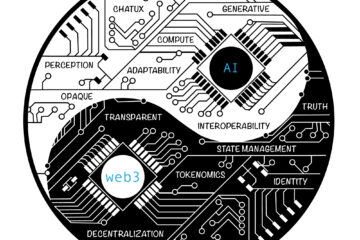
Yin-Yang

Technologies constantly intersect. This impacts a technology’s life cycle (TLC), which already has its own phases of development and market adoption.

Technology life cycles follow an S-Curve. The shape of each technology’s S-Curve is unique, but generally, research and development requires an investment. With traction, the technology can ascend and become profitable. Over time, this ascension slows as a new normal is established. Market relevancy can be lasting, but eventually new technologies push existing technology toward a final decline phase. The further a new technology’s life cycle is from the current status quo, the faster one can push the other into history books. For example, when cell phones went mainstream, it did not take long for pagers to fall out of our pockets.

When different technologies ascend around the same time, they each have their own TLC, but the shared timeline only has room for what the market and adoption curves allow. This initiates a game of scarcity versus abundance. If technologies remain isolated, scarcity wins and the ascension of one technology forces the other technology toward a decline. With a sense of abundance, different technologies find reasons to interact, interconnect, support, and perpetuate each other. Even if the relationship is not obvious at first, layered value broadens the impact and extends each technology’s life cycle.

This can be seen in the rise of web3 and AI technologies. At first, the hype was focused on blockchains and everything under the web3 umbrella. As blockchain networks were ascending past early adoption, Narrow AI learned to speak our language and quickly stole the spotlight. This lowered the volume around web3 as everything became about AI.

With volume lowered, it was easy to think web3 concepts were less relevant, but the interoperability of web3 technologies can transparently source, support, guide, and tame AI. When AI makes everything fake, blockchains make it real again. This symbiosis aligns two different technology life cycles. When balanced, AI is yin and web3 is yang. The yin of AI is exemplified by unpredictability and independence. The yang of web3 draws from decentralized dependency.

© BEN MCDOUGAL

AI is strongest when rooted in web3 concepts, which are strengthened by the capabilities and functionalities of AI. Together, these two seemingly unrelated technologies benefit in various ways. For example, ChatUX gave AI a voice, which can imitate anyone, but blockchains and zero-knowledge proofs can confirm identity. The chaos continues as compute speeds of machine learning make state management hard to uphold, while blockchains, smart contracts, and digital assets can track provenance and the present state of a digital system. If AI projects need financial capital, digital currencies and tokenomics can provide economies to scale. As the capabilities of Narrow AI move toward General AI and Super AI, generative data may struggle to preserve the source of truth, while web3 technologies add transparency to improve inputs and help avoid unsteadiness. Even at the infrastructure level, AI can benefit from decentralized training algorithms, and a growing thirst for electricity can be quenched by HPC data centers originally built for mining cryptocurrencies.

Extra Shot

Darkness lurks in the shadows, but the virtuous light of abundance bets on a shared, atomically exquisite existence.

This example highlights how mixing different concepts can extend technology life cycles. Such abundance also paves the way to more exotic technologies.

Brewed From Within
#83 📖 Technology

By Ben McDougal, ago

Replicants

Technologists and futurists have long imagined interacting with replicants. We’ve seen them in the movies. There’s no single definition for what a replicant might be, but it’s not C-3PO from Star Wars. Our replicants will be an artificially intelligent, bioengineered entity that has consciousness rooted in the human (or machine) it originated from.

This humanoid will index everything the originator ever created, map the complexity of their network, understand internalized versus externalized thoughts, have empathy for how the author matured over time, and gain contextual insight from storytelling to form a foundational identity. This identity would find purpose from a digitized consciousness, maintain essential rules, feel a mirrored personality, act the same even when nobody was watching, and stay updated without an altered foundation.

Extra Shot

Days feel long, but years fly by.

Replication should remain a choice, but capacity to interact with our past and future is expanding. Think of how we take photos. Look at the media being captured at any concert. We already use the moment to remember the past. We speak to holograms, watch animals play video games with their brain, grow synthetic realities, and experiment with infinity through the math and physics of big and small.

As the bandwidth of technology reaches escape velocity, what’s stopping us from pressing the record button to store every angle from every moment? At that speed, how can the linear evolution of humanity’s intelligence fuse with the exponential trajectory of machine learning? Even when it’s possible, do humans want such a reflective future?

Thinking about futuristic interactions can summon a desire to amend the way we spend time. Would you live your life differently knowing future generations may interact with your replicant? Therein lies why most of us don’t like the idea of such a daunting, forward-focused souvenir. If we’re always performative, authenticity is lost. Consistency, which most want in business, becomes a drag, and choosing less randomness, never breaking the rules, and pretending life is show would result in mental distortion and altered actions.

Constant attention is less fun, and making mistakes keeps us wild, but might we be less careless if the plan was to leave a replicant behind? This exercise might be less about technology and, instead, using replication as motivation to fully appreciate how every byte counts.

Brewed From Within
#86 📖 Technology

By Ben McDougal, ago

Dark Matter

Invisible forces look like nothing, and anything that is so inconspicuous will receive less attention, yet the unseen fills our universe and impacts everything.

The gravitational effects of dark matter can also be a brainy comparison for misguiding mindsets or bad experiences that have altered our own trajectory. Traps await us at every turn, but poor habits, surprising disappointments, unhealthy relationships, and mysterious feelings are not uncommon.

No matter how your own dark matter manifests itself, the gravity it wields will direct the light in your life.

When energy levels have been low for too long, identify the dark matter that may be pulling you in the wrong direction. Even the slightest reduction on a negative charge opens a void that welcomes positive growth.

Brewed From Within
#109 📖 Life & Happiness

By Ben McDougal, ago

13.8 Billion

The universe is estimated to be 13.8 billion years old. That’s enough time to ask a few cosmic questions…

  • What are educational paths to the space industry?
  • Can astronomy, cosmology, and religion co-exist?
  • Does digitized consciousness unlock time travel by leaving the limitations of a human body behind?
  • How long would it take to arrive at the closest black hole? Who’s going in first?
  • How will robotics, AI, quantum computing, and material science accelerate space exploration?
  • It seems impossible that extraterrestrial life does not exist. When we learn that aliens are real, how should first contact be carried out?
  • If life on Earth has endured less than 25% of the time our universe has existed, how many distant civilizations may have come and gone?
  • Is it not foolish to mindlessly feed on energy that uses finite resources? When might we run out?
  • How does our planet’s spatial position and cosmic direction change inside an infinite universe that is expanding at an ever-increasing rate?
  • Visiting, even colonizing Mars feels like an important interplanetary exercise, but could other planets be a place to store all the things we don’t want on Earth? Even better, how about asteroids we load up and send off into the dark matter?
  • Can subatomic nanotechnologies alter the input of an energy source to transform the output?
  • How will ownership be handled in space?
  • Does seeing deeper fuel urgency?

                        These are bizarre prompts, and cosmic conversations can quickly become theoretical. To find answers in the unknown, our imagination, scientific exploration, and continual learning are essential as we keep tackling the questions of our universe and the unsolved problems in astronomy and astrophysics.

                        Cosmic questions put life into perspective and make our existence feel fragile. Arguing becomes a lost cause when collaboration is vital for our species to survive.

                        Brewed From Within
                        #108 📖 Life & Happiness

                        By Ben McDougal, ago