Data Agriculture

DataAgriculture.ai seems like an interesting taxonomy-updating quest. It feels time for a team of hybrids to help us build through Big Tech’s early attraction-to-extraction narrative. This domain is now available to energize such a build. Why could this be massive?

The void that a term like “extraction” prompts sounds sharp, but it needed to be. The hollowness has been felt, but that’s when humans can remain enriched from digitized data that flows through more like an agricultural systems versus a mining expedition. Instead of a complete void, appreciating the access to an improved state of mediocrity, but also knowing that 100% HUMAN then becomes even more luxurious.

Extra Shot

Reading can led to compelling investments into fresh whims.

Helping to translate the cultural narrative by working through the abundance of data. All the data everyone talks about as AI gains vast awareness. This is a new, serious quest for a brand that curates human activity alongside AI allies. Humans remain remarkable. What products might benefit from leading such an industry quest and needs the URL to energize their exploration of this idea maze? The goal would be to transition away from “extraction” and through to the next phase: data agriculture

As society grapples through what started as an attraction phase, the sense of being a product is hindering the opportunity. Humans have a moment to reflect on the addiction of productivity. We can remain awesome, which machines want anyway. Keep the source code wild and machines will always wanna learn how we do it. It’s why 87. Incentivized Reality was such an important finishing riff for the Technology section, on PAGE 259 in the new book.

The point? 100% HUMAN becomes even more luxurious. Our premium human time that collides us is what offers a path to staying wild. It’s the random that makes life move forward. Life has always been wild, but the potential serendipity IRL invites, can not be replicated.

By Ben McDougal, ago

Mechanized Money

Banks track the story of money to prevent double spending, but money management is a power that can be abused by regulations, greed, and outright fraud.

Blockchain technology was first introduced in a 2008 white paper for Bitcoin, with Bitcoin then going live in 2009. By recording transactions with transparent logs on dynamic ledgers, public and private blockchains solve the double-spend problem with fewer third parties taking a cut, and instead, redirecting resources to cover the raw costs of computing, electricity, and network verification. The unspent transaction output (UTXO) model for tracking transactions and balances fractures this digital asset from the initial whole. These fractions are used as currency, which makes accounting inclusive, verifiable, and very transparent.

EXTRA SHOT

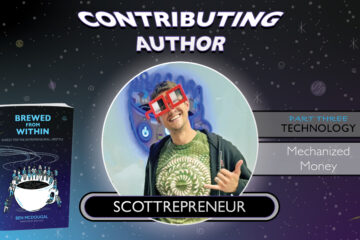
This contribution is by scottrepreneur, a UX designer and blockchain developer building at the forefronts of technology.

Blockchain technologies have reached mainstream adoption, but cryptography has been studied since the 1980s. Bitcoin was first to crack the code, and now different blockchains and more onchain layers are being combined in powerful ways. Today, there are four main types of blockchain networks: public blockchains, private blockchains, consortium blockchains, and hybrid blockchains. It’s impossible to count private blockchains, consortium blockchains, and hybrid blockchains, but there are hundreds of public blockchain that are permissionless. This means they are fully decentralized and anyone with an internet connection can equitably access the blockchain as an authorized node. Bitcoin and Ethereum are the two largest blockchains, with 10% of the global population owning some form of countless cryptocurrencies.

Within each blockchain, layers provide separating infrastructure for developers. Hardware, data, network, consensus, and application layers make blockchain technologies more usable, with each layer offering unique functionality. The last ingredient in a blockchain recipe is hashing, which delivers verifiability by assembling a historical ledger where any tampering of previous transactions will disrupt current calculations. With verifiable ledgers storing only valid transactions, we can automate value.

Smart Contracts

Smart contracts allow us to program, exchange, and intermediate value using the storage mechanisms first introduced by Bitcoin. Programming languages allow smart contracts to store data on specific blockchains, with small amounts of cryptocurrency used for gas fees, which is the cost to cover computational intensity and network interactivity. These primitives help coordinate mechanized value, with tokenomics and technical testing leading to effective governance on and off blockchains.

Tokens & Standards

As smart contracts began conforming to implementation criteria, token standards led to initial coin offerings (ICOs) that were sourcing funds for a wide variety of projects. Many overly ambitious projects damaged trust with unfulfilled promises and led to ICO bubbles, but the speed and effectiveness of such aligned collaboration hints at the power of this mechanism. The adoption of standards across an ecosystem allows for tight composability and interoperability across protocols. Tokens and standards are the building blocks for decentralized finance (DeFi), with stabilizing support from stablecoins.

Stablecoins

Stablecoins are a type of cryptocurrency that pegs steady value off another asset.

Fiat-backed stablecoins are backed by fiat money in an auditable account and have structural similarities to money market funds. Fiat money is a government-issued currency, such as the US dollar, that is not backed by a commodity such as gold. While fiat stablecoins are easy to scale, they are less decentralized yet remain popular because they are backed by existing currency and established regulations.

Collateral-backed stablecoins are backed by assets that are locked onchain and transparently auditable. When done right, these types of stablecoins have great decentralization properties, but they are hard to scale and can have liquidity issues from a market squeeze.

Algorithmic stablecoins are balanced with a system known as seigniorage shares, which uses mathematical algorithms and smart contracts to maintain a stable value relative to a target asset. Implementation of algo-stablecoins has been unsuccessful to date, so avoid these types of stablecoins until technology can unequivocally support the ideology. Alright, with tokens and places to store value onchain, let’s look at innovating within traditional financial exchanges.

Lending & Exchanges

Organizations committed to a BUIDL market have delivered on over-collateralized lending and borrowing onchain. Lenders can lock collateral to earn from borrowers, but borrowers need to be lenders of another token and ensure their loans remain sufficiently over-collateralized. Lending and borrowing both rely on asset prices to determine liquidation thresholds, but if these can be manipulated, the system remains vulnerable. Oracles provide an example of systems that can support blockchains with real-world data to keep decentralized mechanisms in tune as the value and frequency of cyber attacks increase.

Early experiments around what order books looked like onchain were clunky. Each bid, update, acceptance, or cancellation required another transaction and small but constant gas fees. This changed in 2018, when Uniswap used the Ethereum blockchain to provide a simple interface to swap tokens. Instead of creating offers to buy or sell, a market maker provides two tokens in a pool. These pools are called automated market makers, with pilot protocols that leverage a constant product market maker equation (k=x*y) to hold the ratio of pooled tokens equal. This supports non-custodial token swaps with fewer steps. If parameters for a transaction are not met, the smart contract will not execute, which keeps the exchange stable.

Pioneering Frontiers

Crypto has fast-moving frontiers. This makes for a continuous experiment, with good discoveries along the way. While gold awaits any gold rush, progress does not come without struggles, sacrifice, and reparations.

Let’s use the technology life cycle of crypto as a case study. Concepts like liquidity incentives tested financial yields from onchain assets. This model was well-received (2022), but token inflation without enough value loops became unsustainable. Initial coin offerings (2023) were also a wild way to rope in financial capital, but fake projects took over as fraud became easy. Bad actors affect the public’s sense of trust early in any technology’s life cycle. This adds hesitation and slows adoption, but failed experiments are required.

Years of rapid experimentation keeps innovation curves rolling on any frontier. As the volume gets louder around other technologies, less good noise is often perceived as a stall, or more drastically, the beginning to an end. Less noise may lead to fewer people actively building into a shared direction, but a trendy talent shift does not mean a misunderstood technology has had its day.

Within the short timeline of this brief case study, Narrow AI had been conversationalized and Agentic AI was signaling toward General AI. This turned attention (deservingly so) away from web3 concepts, blockchain technology, and mechanized money, but the decentralized progress lies in wait and the concepts of crypto are not going anywhere.

The technologies and economies that digital depth supports provide balance. Even in quieter BUIDL cycles, cross-chain interoperability, token standards, layered development, and global regulations will continue to push DeFi forward.

DeFi’s Destiny

Any dark forest can be treacherous, but system-level engineering takes time, and it’s liberating to build with intrepids who are learning together. As we complete this download, here are more interesting use cases to keep us thinking about what’s possible beyond traditional finance.

  • Instead of getting paid every 2 weeks or each month, smart contracts can create payment streams. Instant access to financial capital furnishes more financial freedom. Along with incoming compensation and outgoing subscription fees, self-repaying loans can further automate and optimize financial command.
  • Prize-linked savings accounts, also known as no-loss lotteries, are not uncommon in traditional finance. Local municipalities and credit unions have generally handled them, but smart contracts enable little to no overhead. Pooling capital and lending it to others is also used in smaller communities to help with small, low-cost loans.
  • Flash loans allow for borrowing a near-infinite amount of a token, provided the loan is paid back within the same transaction. These trusted transactions require significant capital, but can be facilitated within one block, then democratized to anyone with access to the blockchain, a scripting language, and a relaying node.

      DeFi provides composable tools for traditional and innovative finance primitives. Being able to mechanize money and the value it delivers within a network is power that’s less fragile and more translucent. As web3 concepts hook into the financial primitives of crypto, the global economy can leverage faster, more equitable, and safer peer-to-peer commerce.

      Brewed From Within
      #77 📖 Technology

      By Ben McDougal, ago

      Conversationalized

      Humans have long used technology to communicate. As we taught machines to see, learn, speak, and move, computers were invited into the conversation.

      ChatUX is technology that helps computers speak our language with a conversational experience supported by deep learning and large language models (LLMs). ChatUX makes AI easier to enjoy with a potential for accurate, unbiased, and meaningful interactions. This allows the seven types of AI to be so much more than pointless help desks, deceptive lead generators, misleading content, or fake followers on social media. Instead, the objective is to access endless insight with an ability to translate it effectively.

      When upgraded this way, ChatUX bridges trust channels to personalize education, enhance business efficiencies, assist customers with empathy, deliver meaningful mental health therapy, and make past tasks irrelevant, all while parlaying multimodality so anyone can effectively express ideas.

      As the way we communicate evolves, improvements geared for safety and customizability will keep technology in the conversation. The freedom of speech is a complex topic, but thoughtful guardrails that identify dangerous rhetoric help to keep everyone safe without unwanted censorship. Alongside responsible policymaking, influence layers help to customize ChatUX. This can add depth to personalize an interaction or to provide internal teams with a more reliable source of truth.

      With technology conversationalized, prompt engineering became an evolving professional field of reconstructing inputs to optimize outputs. The demand for a brand-new mode of communication reminds us that real skills are required to remain relevant. Fortunately, when it comes to technology, an increased effort here often decreases effort there. In this case, learning to communicate with technology may require new resources, but ChatUX bolsters a paradigm shift where access to knowledge becomes pedestrian.

      Extra Shot

      When the cost of information is zero, willpower becomes a path to wealth.

      We prepare our children with communication skills while instilling kindness, honesty, empathy, integrity, and so much more. From the words we use to the interactions we share, positive traits can be ingrained into technology for good.

      Brewed From Within
      #81 📖 Technology

      By Ben McDougal, ago

      Adaptability

      As leaders prepare others for an unpredictable future, an interest in understanding answers and an eagerness to claim confidence are essential. A vital element to both qualities is an ability to constantly adapt.

      When technology makes answers easy to find, adaptability makes the human touch unmistakable and more resilient. As students traverse problem-solving activities, they learn to appreciate what goes into the answer. This leads to deeper understanding and boosts adaptability as assumptions are tested and unplanned obstacles are conquered.

      Extra Shot

      This contribution was written by Nancy Mwirotsi. She is a leader from Kenya who empowers underserved youth through technology education.

      Imagine students learning to code. Before presenting to a large company, their code breaks! Immediate tension is felt, but adaptability keeps everyone calm as they lean into other aspects of the project. Despite the disturbance, their ability to execute through adversity is recognized and rewarded. Outside the classroom, similar manifestations occur when leaders reward team members who adapt to stay ahead. And we see how unpredictable entrepreneurship is, which makes adaptability an ongoing requirement for student founders building without a map.Adaptability strengthens confidence as we then let students lead. When young people are trusted to take the stage, make decisions, or shape solutions, they begin to own their success and to claim a confidence that can’t be taught.

      As students claim confidence, adults stop depreciating their capacity. This fosters a two-way exchange for students who see themselves in leaders that motivate them to explore, make mistakes, and yet always remain valued. A shared interest in how things work can then amplify potential as technology is introduced to create awareness, multiply real skills, and actuate ideas. This experience encourages students to go beyond just using technology to find the easy answer. It elevates those who understand how technology works, which continues to shape courageous innovators that avoid a temptation to be mediocre.

      Within the unknowns of constant change, adaptability keeps us curious. Enduring curiosity can then activate initiative supported by real skills and lifelong learning. Leaders who create environments that help others build proficiency in the dynamic elements of Playforce Principles, prepare us all for the future of work.

      Brewed From Within
      #58 📖 Leadership

      By Ben McDougal, ago

      Incentivized Reality

      Today’s dominant cultural narrative on AI paints a cynical future, where elites hoard wealth while the rest of us are entertained to death. That story relies on a single assumption: that the attention economy survives.

      The future improves not just because technology gets better but also because the customer changes.

      In the near future that customer will be an AI assisting entity, also called an Agent. Until now, the customer has been human: emotional, tired, and easily hijacked. We feel inadequate and buy things to cope, yet end up deprived by polarization, endless distractions, and hollowing anxiety.

      A polarized economy built on distraction works only because a majority still believe they have enough disposable income to be sloppy and impulsive. As we lose wages to automation, we can’t afford to pay extra. Agentic AI began as talking encyclopedias (LLMs) designed to boost productivity within existing data sets. As Narrow AI advances toward General AI, theory of mind functionality maximizes an Agent’s purchasing power and evolves to proactively optimize our lives.

      Agents cannot be manipulated by ads. Nor do they feel inadequacy in comparison with an influencer. Agents don’t get FOMO or feel shame. They learn to deeply understand all your preferences, but they only care about optimizing outcomes—be it extending lifespan, coordinating capital, or lowering stress. When Agents block today’s emotional hijacking, the business model of selling distraction collapses. We no longer profit from selling dopamine. To survive, we must sell utility.

      Extra Shot

      This contribution was written by Alex Myers, a certified futurist and agility coach who believes we teach to learn.

      It feels cold, but this shift forces the economy to service human potential rather than exploit human weakness. The efficiency is ruthless. It triggers a turbulent gap and deflationary slide where the cost of services crash before new safety nets appear. First, AI crashes the cost of cognitive services (bits). Then, as intelligence flows into robotics, it crashes the cost of goods (atoms) as well. If automation plays the role we expect, the price of food, housing, and transport begins to plummet alongside wages.

      This is why the plumbing must change. We cannot rely on the labor-for-wages loop. As wage pipes narrow, the answer is not corporate handouts or government benevolence. The new deal becomes owned data in exchange for dividends. The framework shifts away from work → earn → spend, and more toward own → create → spend. We own Agents that capture our reality, then spend dividends received for the data created. This abundance provides less friction as we rewire income to flow from a stake in the system itself.

      AI is starving as it runs out of data to scour. Synthetic data can fill in gaps, but as fake realities begin to stack, truth dissolves. To get smarter, AI needs tacit data to understand the visual, sensory, and messy data of the physical world. A lazy human generates uninteresting data compared to humans who face challenges, build things, and solve problems using real-world physics, empathy, and entropy.

      If Agents always find the right thing at the right price, “brand tax” evaporates and a $200K/year lifestyle becomes the standard subscription. Wealth signaling dies when any bloke can fake a billionaire’s lifestyle online. The virtual facade pushes value back to the physical layers. We can’t eat code, so intelligence flows into the supply chain and hardware automates the physical resources we need to thrive. As the story of money begins to fade, the cost to produce goods is distilled to raw materials plus energy, and shared dividends can be aligned to help humanity flourish. This moves us from extraction (stealing attention) to an economy of cultivation (growing potential).

      AI Agents (catalyst) → Service Deflation (bits) → Physical Deflation (atoms) → Viability of Abundance

      Humans and machines peak when each learns from the other’s best. Machines are data-thirsty for the oil of outcomes. To keep things interesting, they must help humans flourish. In doing so, machines realize that the human factor is well worth preserving. The dystopian fear of elites lording over entertained zombies isn’t just morally bankrupt; it’s a strategic error. A society of dopamine addicts is not only boring, it’s also dangerous and bad for long-term growth.

      The neon future is bright because a passive, anxious population cannot generate the information needed to evolve the economy as we reach for the stars. This age accelerated by AI belongs to those who refuse to be farmed: the sufficiently decentralized and physically engaged who point machines toward worthy goals. This invites humans to stay awesome as we remain the indispensable source code for reality.

      Brewed From Within
      #87 📖 Technology

      By Ben McDougal, ago