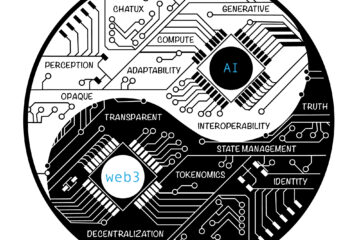
Yin-Yang

Technologies constantly intersect. This impacts a technology’s life cycle (TLC), which already has its own phases of development and market adoption.

Technology life cycles follow an S-Curve. The shape of each technology’s S-Curve is unique, but generally, research and development requires an investment. With traction, the technology can ascend and become profitable. Over time, this ascension slows as a new normal is established. Market relevancy can be lasting, but eventually new technologies push existing technology toward a final decline phase. The further a new technology’s life cycle is from the current status quo, the faster one can push the other into history books. For example, when cell phones went mainstream, it did not take long for pagers to fall out of our pockets.

When different technologies ascend around the same time, they each have their own TLC, but the shared timeline only has room for what the market and adoption curves allow. This initiates a game of scarcity versus abundance. If technologies remain isolated, scarcity wins and the ascension of one technology forces the other technology toward a decline. With a sense of abundance, different technologies find reasons to interact, interconnect, support, and perpetuate each other. Even if the relationship is not obvious at first, layered value broadens the impact and extends each technology’s life cycle.

This can be seen in the rise of web3 and AI technologies. At first, the hype was focused on blockchains and everything under the web3 umbrella. As blockchain networks were ascending past early adoption, Narrow AI learned to speak our language and quickly stole the spotlight. This lowered the volume around web3 as everything became about AI.

With volume lowered, it was easy to think web3 concepts were less relevant, but the interoperability of web3 technologies can transparently source, support, guide, and tame AI. When AI makes everything fake, blockchains make it real again. This symbiosis aligns two different technology life cycles. When balanced, AI is yin and web3 is yang. The yin of AI is exemplified by unpredictability and independence. The yang of web3 draws from decentralized dependency.

© BEN MCDOUGAL

AI is strongest when rooted in web3 concepts, which are strengthened by the capabilities and functionalities of AI. Together, these two seemingly unrelated technologies benefit in various ways. For example, ChatUX gave AI a voice, which can imitate anyone, but blockchains and zero-knowledge proofs can confirm identity. The chaos continues as compute speeds of machine learning make state management hard to uphold, while blockchains, smart contracts, and digital assets can track provenance and the present state of a digital system. If AI projects need financial capital, digital currencies and tokenomics can provide economies to scale. As the capabilities of Narrow AI move toward General AI and Super AI, generative data may struggle to preserve the source of truth, while web3 technologies add transparency to improve inputs and help avoid unsteadiness. Even at the infrastructure level, AI can benefit from decentralized training algorithms, and a growing thirst for electricity can be quenched by HPC data centers originally built for mining cryptocurrencies.

Extra Shot

Darkness lurks in the shadows, but the virtuous light of abundance bets on a shared, atomically exquisite existence.

This example highlights how mixing different concepts can extend technology life cycles. Such abundance also paves the way to more exotic technologies.

Brewed From Within
#83 📖 Technology

By Ben McDougal, ago

Prognostication

Ehrich Pakala is a mathematician, software engineer, and founder who uses machine learning to unlock data-driven understandings. His team at Emigrait leverages insight to find future home buyers and sellers for real estate professionals.

While they play chess in-studio, hear Ben and Ehrich chat about avoiding the measurement trap, Ehrich’s favorite math equation, machine learning, and predictive modeling in real estate. The nerdery continues with mathematics in the real world, then Ben narrates an exponential writing.

After the break, Ehrich writes a haiku in real-time and climbs through thoughts from atop the mountain. EP83 continues with stories from inside the Iowa Techstars Accelerator, communicating complicated products, and what people look for when it comes to their new home. We finish with thoughts on polyhedrons, infinity, and beyond.

LISTEN on APPLE PODCASTS
LISTEN on SPOTIFY

BONUS MATERIALS

https://Emigrait.com

https://linkedin.com/in/ehrichpakala

Techstars Iowa Accelerator Demo Day

http://Prognostication.YouDontNeedThisPodcast.com

Roasted Reflections Break: Linear

EP6 – Computer Vision(ary) 🎙️ Brad Dwyer

EP22 – BioMathemAttorney 🎙️ Cassie Edgar

EP29 – Borderless 🎙️ Kerty Levy

EP34 – Measured Twice 🎙️ Ryan Glick

http://YouDontNeedThisPodcast.com

A Trip to Inifinity (Netflix)

How to Win at Chess

http://BENBOT.ai

By Ben McDougal, ago

Replicants

Technologists and futurists have long imagined interacting with replicants. We’ve seen them in the movies. There’s no single definition for what a replicant might be, but it’s not C-3PO from Star Wars. Our replicants will be an artificially intelligent, bioengineered entity that has consciousness rooted in the human (or machine) it originated from.

This humanoid will index everything the originator ever created, map the complexity of their network, understand internalized versus externalized thoughts, have empathy for how the author matured over time, and gain contextual insight from storytelling to form a foundational identity. This identity would find purpose from a digitized consciousness, maintain essential rules, feel a mirrored personality, act the same even when nobody was watching, and stay updated without an altered foundation.

Extra Shot

Days feel long, but years fly by.

Replication should remain a choice, but capacity to interact with our past and future is expanding. Think of how we take photos. Look at the media being captured at any concert. We already use the moment to remember the past. We speak to holograms, watch animals play video games with their brain, grow synthetic realities, and experiment with infinity through the math and physics of big and small.

As the bandwidth of technology reaches escape velocity, what’s stopping us from pressing the record button to store every angle from every moment? At that speed, how can the linear evolution of humanity’s intelligence fuse with the exponential trajectory of machine learning? Even when it’s possible, do humans want such a reflective future?

Thinking about futuristic interactions can summon a desire to amend the way we spend time. Would you live your life differently knowing future generations may interact with your replicant? Therein lies why most of us don’t like the idea of such a daunting, forward-focused souvenir. If we’re always performative, authenticity is lost. Consistency, which most want in business, becomes a drag, and choosing less randomness, never breaking the rules, and pretending life is show would result in mental distortion and altered actions.

Constant attention is less fun, and making mistakes keeps us wild, but might we be less careless if the plan was to leave a replicant behind? This exercise might be less about technology and, instead, using replication as motivation to fully appreciate how every byte counts.

Brewed From Within
#86 📖 Technology

By Ben McDougal, ago