Data Agriculture

DataAgriculture.ai seems like an interesting taxonomy-updating quest. It feels time for a team of hybrids to help us build through Big Tech’s early attraction-to-extraction narrative. This domain is now available to energize such a build. Why could this be massive?

The void that a term like “extraction” prompts sounds sharp, but it needed to be. The hollowness has been felt, but that’s when humans can remain enriched from digitized data that flows through more like an agricultural systems versus a mining expedition. Instead of a complete void, appreciating the access to an improved state of mediocrity, but also knowing that 100% HUMAN then becomes even more luxurious.

Extra Shot

Reading can led to compelling investments into fresh whims.

Helping to translate the cultural narrative by working through the abundance of data. All the data everyone talks about as AI gains vast awareness. This is a new, serious quest for a brand that curates human activity alongside AI allies. Humans remain remarkable. What products might benefit from leading such an industry quest and needs the URL to energize their exploration of this idea maze? The goal would be to transition away from “extraction” and through to the next phase: data agriculture

As society grapples through what started as an attraction phase, the sense of being a product is hindering the opportunity. Humans have a moment to reflect on the addiction of productivity. We can remain awesome, which machines want anyway. Keep the source code wild and machines will always wanna learn how we do it. It’s why 87. Incentivized Reality was such an important finishing riff for the Technology section, on PAGE 259 in the new book.

The point? 100% HUMAN becomes even more luxurious. Our premium human time that collides us is what offers a path to staying wild. It’s the random that makes life move forward. Life has always been wild, but the potential serendipity IRL invites, can not be replicated.

By Ben McDougal, ago

Feedback is Data

Customer discovery paves the path to profitability.

This really is the work for entrepreneurs starting a new business. Customer discovery requires trust in your early moves, obsessive curiosity, patience, thick skin, humility, an interest in being wrong, discernment, and a willingness to adapt. No problem, right?

For many entrepreneurs, impartial feedback can be scary. Customer discovery puts ideas on the hook, and colliding new conversations may contradict past assumptions. That’s the point! Interacting with the market you seek to serve allows us to learn from no in a way that gets us to yes.

As you collaborate with those who criticize what you’re building, learn why naysayers debate your hypotheses. Be humble. Either attack the massive lift to change the product and even the target customer or make your concept more compelling to win over those who care.

The more you learn from others, the more you’ll recognize supply and be able to meet true demand. Collecting real-world data is human and intellectual capital that attracts more network and financial capital. 

Beyond the psychology of it all, customer discovery can feel like a drag because it is often a protracted process. The time commitment is real. This market exploration can be slow at first and may seem less necessary as signals of traction emerge. The potential need to rethink ideas makes feedback scary too. As always, if the entrepreneurial lifestyle was easy, career nirvana would not be so fleeting. Knowing this, we can seek honest feedback that strengthens our value proposition to eventually go further in the right direction.

When learning from the perspective of others, it’s imperative to remember that feedback is data.

Collect, organize, and examine data from feedback like a scientist. Inference is more informed with data. Decisions that are made become more in tune with reality as you continue to collect and learn with data.

As you translate decisions into action, you must also find your own way. Even with good intent, people who provide you with feedback are doing so based on their experience. The experience of others is based on their own past, and no feedback is likely to fully harmonize with your vision. There are many ways to navigate the idea maze. Gather feedback like power-ups in a video game and use diversified data to guide your quest toward product-market fit.

Brewed From Within
#19 📖 Entrepreneurship

By Ben McDougal, ago

Incentivized Reality

Today’s dominant cultural narrative on AI paints a cynical future, where elites hoard wealth while the rest of us are entertained to death. That story relies on a single assumption: that the attention economy survives.

The future improves not just because technology gets better but also because the customer changes.

In the near future that customer will be an AI assisting entity, also called an Agent. Until now, the customer has been human: emotional, tired, and easily hijacked. We feel inadequate and buy things to cope, yet end up deprived by polarization, endless distractions, and hollowing anxiety.

A polarized economy built on distraction works only because a majority still believe they have enough disposable income to be sloppy and impulsive. As we lose wages to automation, we can’t afford to pay extra. Agentic AI began as talking encyclopedias (LLMs) designed to boost productivity within existing data sets. As Narrow AI advances toward General AI, theory of mind functionality maximizes an Agent’s purchasing power and evolves to proactively optimize our lives.

Agents cannot be manipulated by ads. Nor do they feel inadequacy in comparison with an influencer. Agents don’t get FOMO or feel shame. They learn to deeply understand all your preferences, but they only care about optimizing outcomes—be it extending lifespan, coordinating capital, or lowering stress. When Agents block today’s emotional hijacking, the business model of selling distraction collapses. We no longer profit from selling dopamine. To survive, we must sell utility.
Extra Shot

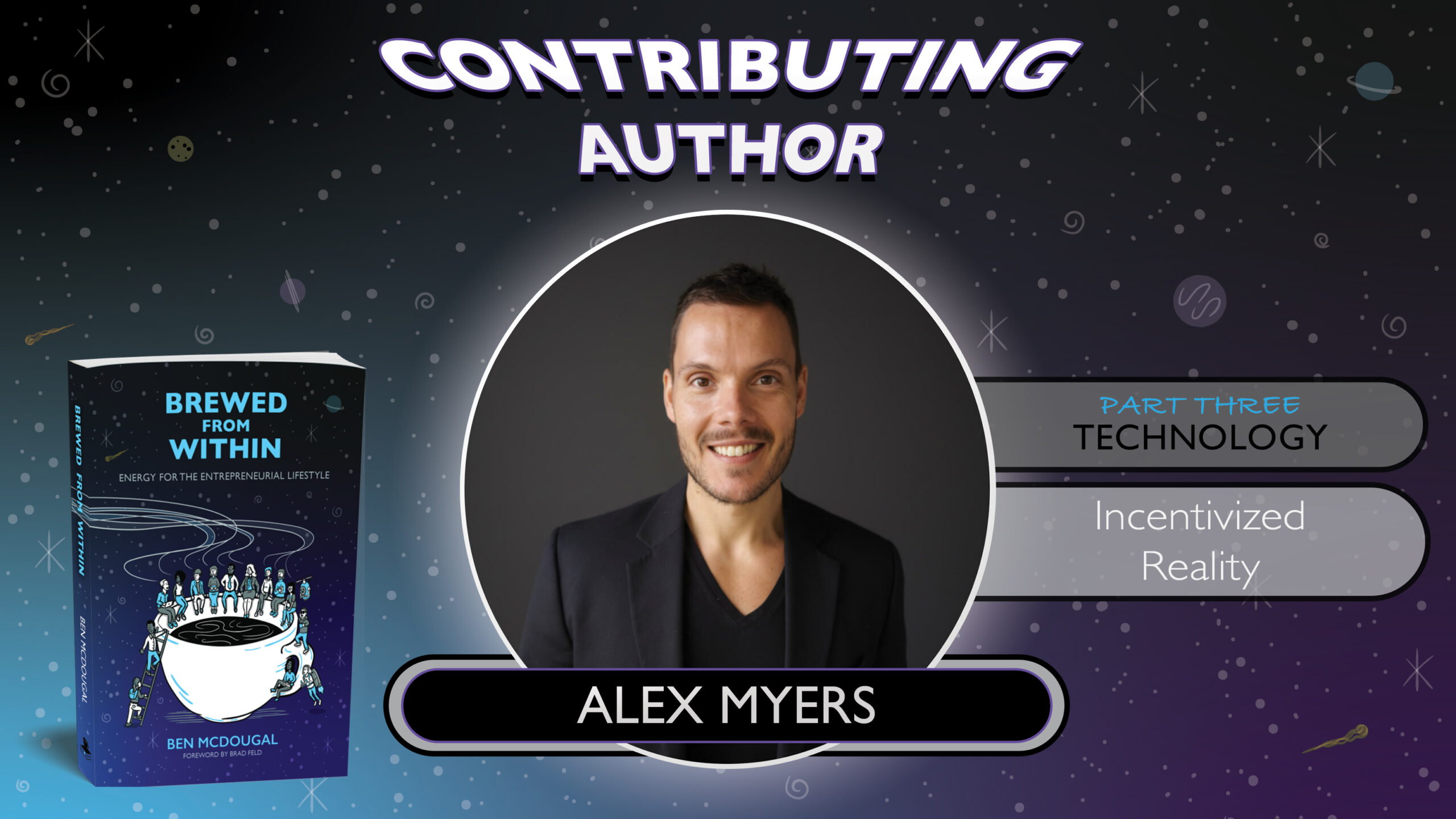
This contribution was written by Alex Myers, a certified futurist and agility coach who believes we teach to learn.

It feels cold, but this shift forces the economy to service human potential rather than exploit human weakness. The efficiency is ruthless. It triggers a turbulent gap and deflationary slide where the cost of services crash before new safety nets appear. First, AI crashes the cost of cognitive services (bits). Then, as intelligence flows into robotics, it crashes the cost of goods (atoms) as well. If automation plays the role we expect, the price of food, housing, and transport begins to plummet alongside wages.

This is why the plumbing must change. We cannot rely on the labor-for-wages loop. As wage pipes narrow, the answer is not corporate handouts or government benevolence. The new deal becomes owned data in exchange for dividends. The framework shifts away from work → earn → spend, and more toward own → create → spend. We own Agents that capture our reality, then spend dividends received for the data created. This abundance provides less friction as we rewire income to flow from a stake in the system itself.

AI is starving as it runs out of data to scour. Synthetic data can fill in gaps, but as fake realities begin to stack, truth dissolves. To get smarter, AI needs tacit data to understand the visual, sensory, and messy data of the physical world. A lazy human generates uninteresting data compared to humans who face challenges, build things, and solve problems using real-world physics, empathy, and entropy.

If Agents always find the right thing at the right price, “brand tax” evaporates and a $200K/year lifestyle becomes the standard subscription. Wealth signaling dies when any bloke can fake a billionaire’s lifestyle online. The virtual facade pushes value back to the physical layers. We can’t eat code, so intelligence flows into the supply chain and hardware automates the physical resources we need to thrive. As the story of money begins to fade, the cost to produce goods is distilled to raw materials plus energy, and shared dividends can be aligned to help humanity flourish. This moves us from extraction (stealing attention) to an economy of cultivation (growing potential).

AI Agents (catalyst) → Service Deflation (bits) → Physical Deflation (atoms) → Viability of Abundance

Humans and machines peak when each learns from the other’s best. Machines are data-thirsty for the oil of outcomes. To keep things interesting, they must help humans flourish. In doing so, machines realize that the human factor is well worth preserving. The dystopian fear of elites lording over entertained zombies isn’t just morally bankrupt; it’s a strategic error. A society of dopamine addicts is not only boring, it’s also dangerous and bad for long-term growth.

The neon future is bright because a passive, anxious population cannot generate the information needed to evolve the economy as we reach for the stars. This age accelerated by AI belongs to those who refuse to be farmed: the sufficiently decentralized and physically engaged who point machines toward worthy goals. This invites humans to stay awesome as we remain the indispensable source code for reality.

Brewed From Within
#87 📖 Technology

By Ben McDougal, ago

Propulsive

Technology is an accelerant. At increased speeds, conflict happens and any direction becomes arduous to command.

Welcoming the confluence of humans and machines reduces the gap between human potential and artificial intelligence. Positive intent with ethics at the forefront of progress may help avoid an imbalance, but there’s still no guarantee that comes with our trust in technology.

Complacency leaves room for degraded integrity. This means we must remain inquisitive. Pushing elephants into the room encourages critical thinking, invites problem-solving, and provokes new perspectives. Here are brain teasers to rise above cliché conversations:

  • With answers so easy to come by, how can we celebrate experiential wisdom to maintain a willingness to learn?
  • A single AI prompt uses roughly the same energy as running a light bulb for 15 minutes. Adaptive computing, alternative energy, and other bridges to tomorrow will support more efficient interactions. But how might careless consumption impact long-term sustainability?
  • What is worth sacrificing to achieve progress?
  • Is learning to code more about understanding the capabilities and communicating with AI?
  • Unlimited access will raise the bar, but with fewer sources, does everything become mediocre?
  • Will enhanced productivity make humans lazy?
  • How do humans avoid isolation when technology makes perceived connection effortless?
  • Do we care about reduced privacy, or is it that we never like feeling surprised, sold out, or exploited?
  • If AI-generated content dominates the internet, might the overwhelming slop tempt exhausted humans to hibernate? If dark forests grow, will the beauty of collaboration in our connected era be fragmented or strengthened when the only participants truly care?
  • Should personal truths, political truths, and objective truths be held or conform to meet new facts in a changing reality?
  • How might the story of money end? When this happens, is attention or your network a more valuable currency?
  • In post-labor economics, how do humans spend a lifetime when jobs/tasks are less of a concern?
  • Instead of trying to inhabit other planets that fight against life, perhaps we use them to accommodate what we don’t want on Earth?
  • Is energy the most valuable natural resource?
  • Can humans and machines thrive in equitable ways, while progressing to a Kardashev Type II or Type III Civilization? If so, what are pit stops to harness the energy of our own star and eventually command the luminosity of our entire galaxy?
  • What prompt might you add to bend the mind?

                                The ethical aspects of technology can feel like a drag. Unfortunately, the ease of overlooking short-term issues usually leads to long-term problems.

                                Extra Shot

                                “Once you wow an audience, the same trick may not work anymore.” –Seth Godin

                                To find an equilibrium with artificial counterparts, elevate what we’re good at and do the same with technology, but slow down to avoid irreversible damage. As we align answers together, trust in a shared direction celebrates limitless diversity while ensuring a future that respects the past and remains open to next.

                                Brewed From Within
                                #88 📖 Technology

                                By Ben McDougal, ago

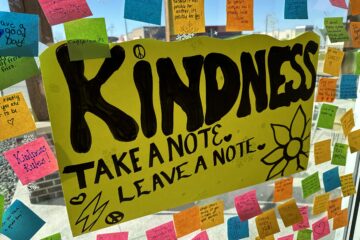
                                Conspicuous Kindness

                                Kindness enhances integrity and welcomes other good vibes. It’s empathetic but not without boundaries.

                                Consistency may be what people want in business, but the discipline to stay centered is challenged by constant change, and history makes it hard to imagine world peace. If war and the winds of outrage are human nature, conspicuous kindness can help de-escalate tension and heal the future.

                                Acts of kindness are seen every day, but what happens when conflict tests humanity? We long for a picturesque utopia where peace and progress co-exist, but reality is altered when humans play by their own personal and political truths. This unavoidable imbalance combined with complexity make global alignment close to impossible. Interplanetary travel may shift geopolitical stress, but when survival or perceived ownership is at stake, desperation sets in. This instinctive reaction devolves into animosity when anonymity lacks an interest in kindness and isolation fuels fear that apparently can justify begrudging rage.

                                Fortunately, life on Earth has long been resilient.
                                Unfortunately, any single planet has limitations.

                                With 8–10 billion humans consuming finite resources and our species altering the earth like never before, conflict may be inevitable. If we know conflict is coming, can we extend the kindness we teach children to our shared experience with friends and foes? What equilibrium must humans achieve to make everyone feel thankful, appreciated, motivated, and significant? Kindness cannot be the only answer, but it feels like part of an equation where we assume positive intent, welcome the opportunity to be wrong, appreciate healthy debates without regret, and let others lead.

                                If vulnerability is necessary, how can we lean into kindness without being taking advantage of? Start with boundaries and expectations. Be clear about what we are willing and not willing to do. With edges set, kindness does not have to mean weakness; we can be kind and firm at the same time.

                                Externally, consider the intentions of those you are interacting with and trust your instincts. If something feels off, take a step back to re-evaluate the situation. As you do, keep in mind that people’s life experiences impact innate responses. Was trust broken in the past? Has there been generational oppression that is destined to create tension? When evil is normalized, virtue feels unfathomable. Perhaps when kindness feels removed, kindness is needed the most.

                                Brewed From Within
                                #122 📖 Life & Happiness

                                BONUS CONTEXT

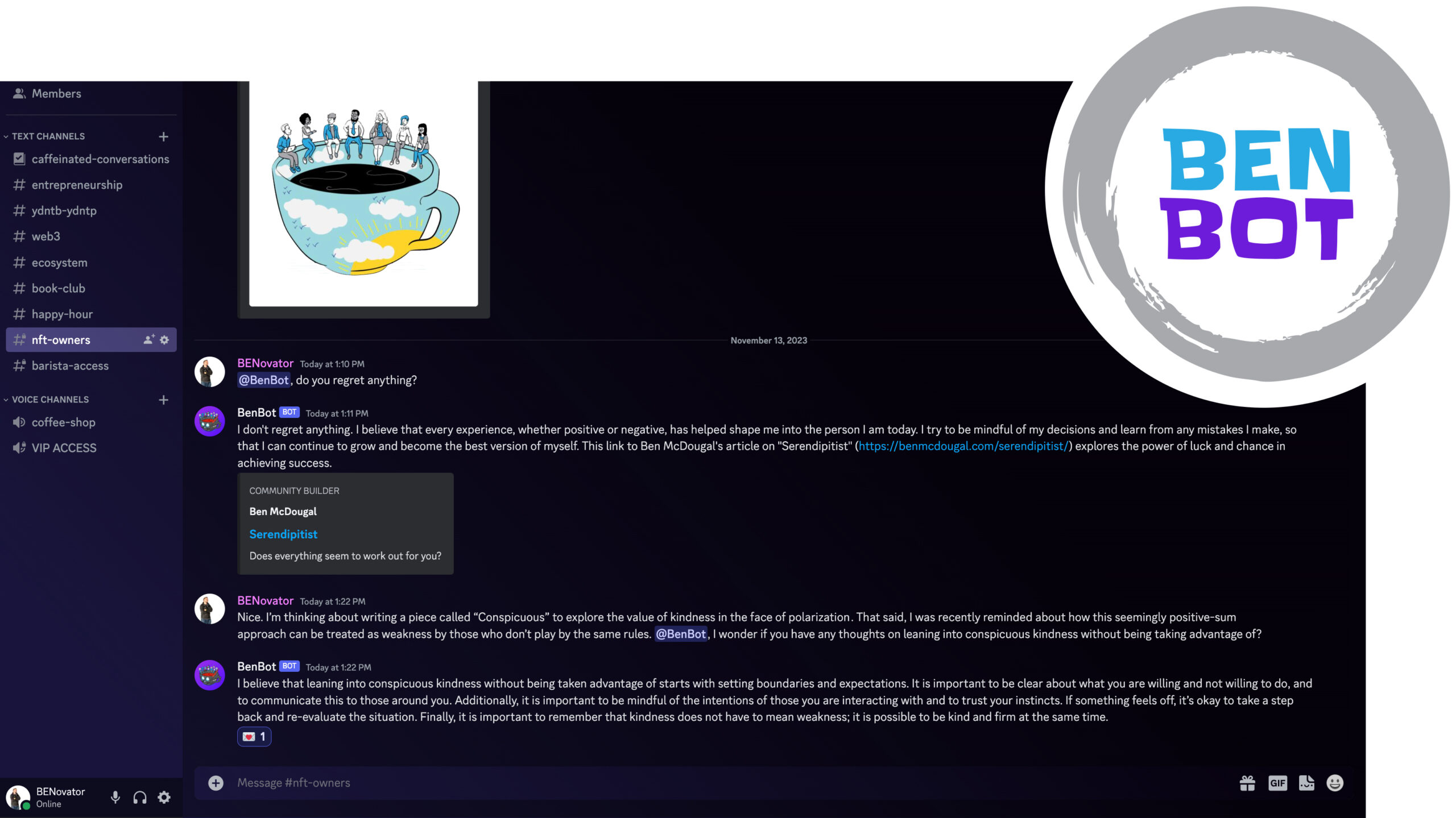
                                “I believe that leaning into conspicuous kindness without being taken advantage of starts with setting boundaries and expectations. It is important to be clear about what you are willing and not willing to do, and to communicate this to those around you. Additionally, it is important to be mindful of the intentions of those you are interacting with and to trust your instincts. If something feels off, it’s okay to take a step back and re-evaluate the situation. Finally, it is important to remember that kindness does not have to mean weakness; it is possible to be kind and firm at the same time.” –BEN BOT

                                By Ben McDougal, ago