Horizons

From the ground, our view to the horizon is 3 miles. Peering atop the highest observation deck in the United States, humans can see up to 50 miles on a clear day.

While the foreground of daily activity occupies so much attention, our cumulative culture has always looked to the edge for answers. Whether it’s cresting through the clouds on a flight, that inspiring view from any rooftop, or the simple pleasure of walks around the neighborhood, we love the hope-filled distance of any view. Beyond these moments of beauty, how can we think about edges as we keep building?

Action is obviously required, but staying wild and thinking BIG takes practice. Busy can be addictive and the close proximity to how time is spent makes everything feel pressing. The closer the deadline, the more attention it’s given. Keep the promise of what you’re building, but finding time to think is a mental exercise that nurtures gratitude and often attracts fresh opportunities.

To avoid self limitation, collide ideas into more weird conversations. We can chat with anyone online, so leverage our connected era, but then pour in the serendipity! Show up and with your own eyes, get interested.

As boundaries come and go, avoid where the sidewalk ends and there’s no need to always be first in line. Skyline views await us all from anywhere. Build like this. Linchpins go beyond brainstorming and instead, edgecraft ideas toward reality. Lean into Playforce Principles and continue to ship on the timeline of now. Along with that prerequisite, stay open to next and feel different momentums converging toward that next horizon.

No matter how you get there, the edge is wonderfully wild. Every horizon is different and gratitude ensures we don’t go numb to the raindrop of time we have on earth. Perhaps the thesis of this riff is that one horizon is not the only endpoint. Each extent is just too cosmic to ever be the same. Trap time and enjoy sequencing distant views to hug the curves toward your own horizons.
By Ben McDougal, ago

Visualizing Variety

For people who play 80 hours instead of working 40, a diversified career portfolio often emerges.

A variety of activities and the contemporary energy of popcorning between them, helps vanguards stay ahead of the innovation curve. Diversification of work can also provide stability when the volume of different activities are strategically adjusted over time.

As we diversify career portfolios, balance, transparency, being realistic, patience, perpetual learning, and avoiding The Headline Trap is critical. These real skills fuel focused progress on multiple fronts and help reduce the risk of diluting yourself to mediocrity. If you’re stretched too thin, the value of diversification can devolve into fragmentation.

Extra Shot

It’s easy to discount our potential, but life is too short not to love what you do.

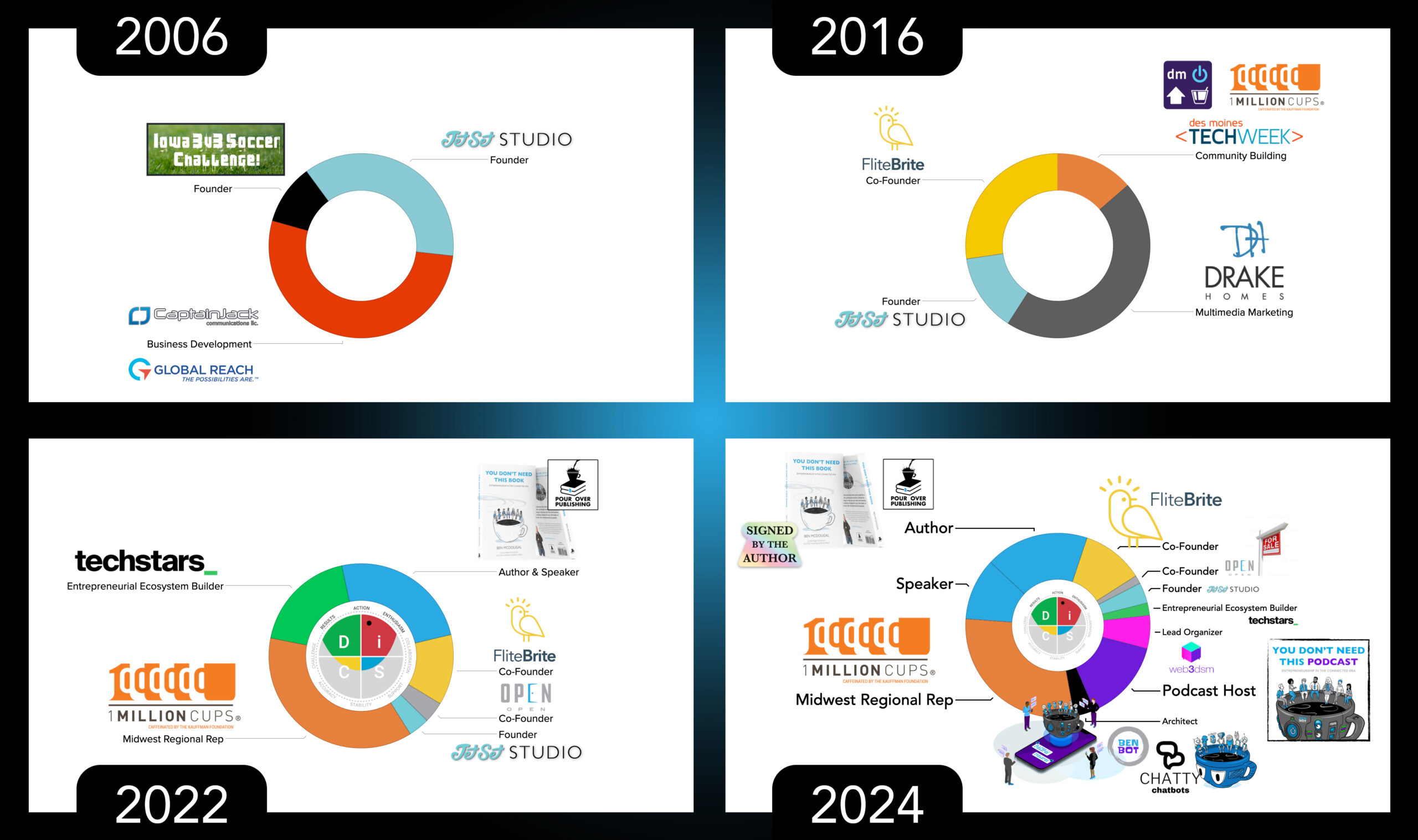
When change is constant, visualized assessment helps track how time is spent. Below is the evolution of my own career portfolio. People who see this often want to implement this method introduced in the Side Hustles chapter of YDNTB, so let’s jam on how to visualize your diversified career portfolio.

First, organize the things you spend time building. Assign a percentage of time spent on each activity, then plot the data into a pie chart. I use Apple Keynote to manage the pie chart and Adobe Photoshop for added flare, but any spreadsheet or slide deck software can visualize data in a similar way. Once created, save the pie chart as an image. You now have a conversation piece that showcases how you spend time. Update it as your career portfolio evolves or use this method as an annual exercise to stay balanced with your own personal bandwidth.

By Ben McDougal, ago

Small Business Owners

Words matter. When “small business” and “small business owner” is used over and over again, it begins to feel belittling. Together, opportunity awaits those who brew fresh ways to talk with and about small businesses!

First, let’s get an elephant in the room. Everyone understands the need for business categorization within an economy and yes, size is a simple metric. Entrepreneur Support Organizations (ESOs) are quick to explain that because of government policies, regulated programs, and the history of small business owners not thinking of themselves as entrepreneurs, using “small business” has become second nature.

The opportunity exists within events where the assemblage are small business owners, but what about this fear of marketing that won’t resonate without a clear call to “small business owners”? Here’s the trick. Use small business terms to gather awareness, but then let those technical terms chill once everyone comes together. This ensures clarity in branding, online activity, and event promotions. As events get underway, emcees, speakers, panelists, and staff can embolden the audience by using “small business owners” as necessary, but intentionally use more alternative titles that add depth to the narrative. Instead of everything being stuck on small, try these seven synonyms that describe greatness, importance, appreciation, growth, and yes, small business owners.

  • Entrepreneurs
  • Leaders
  • Students
  • Innovators
  • Heretics
  • Creators
  • Community Builders

As people who may have only identified as a small business owners start using enlivened vocabulary, these side conversations become a signal of something lasting! If this effort continues at future events, more people will connect with more terms they feel inspired by. This exposes small business owners to even more relevant resources, helpful ideas, and different areas to confidently explore within an expanding entrepreneurial ecosystem.

Extra Shot

When was the last time you wanted something important to be small?

Using this working draft of synonyms, we can each quietly inspire more inclusivity through fresh assimilation at events. Even if policies remain rigid, more people will learn to celebrate and identify with more codifications.

Over time, more will feel allyship with all that is entrepreneurship. We will remain proud small business owners, but just as vested when we hear whatever the latest jargon may be.

By Ben McDougal, ago

Linear

We use linear thinking in an exponential universe.

From a blade of grass on the football field, how can one imagine gaining a single yard? The first down marker feels distant at best, a touchdown seems impossible, and winning the game is barely comprehensible. A season championship? Yeah, that’s not even a glimmer in our mind’s eye. Trying to win all at once makes movement daunting, but staying consistent builds confidence and unlocks efficiencies. When space from this efficiency is used to stay innovative, what’s working is fortified as wormholes connect new levels of momentum.

We all know this.
Let’s dig deeper.

If a linear thinking is status quo, opportunity awaits those who augment their work through a cosmic perspective. As signals of product-market-fit emerge, understanding how each part effects the system will optimize what must work. This awareness leads to stability, which tempts most to coast along a linear path. People like us know that while it’s important to respect past success, such nostalgia does not guarantee the same results within a neon future characterized by constant change.

Yes, paving an exponential path takes endless energy, but we play for 80 hours to avoid working 40 and your creative eagerness can be nourished by a peculiar lack of routine. The goal is not more of the same. That will lead to similar, linear results. Instead, maintain what works, then keep increase the curve’s trajectory by feeding new ideas, talent, collisions, and action into the system.

You knew this was coming, but as always, an easy way to go beyond our linear capabilities is found in community. Community allows us all to do more with less. Curiosity, initiative, and adaptability activates diversified trust channels. Fresh feedback rewards a willingness to experiment and when integrity to follow up is applied, variables can be added to a more exponential equation.

Extra Shot

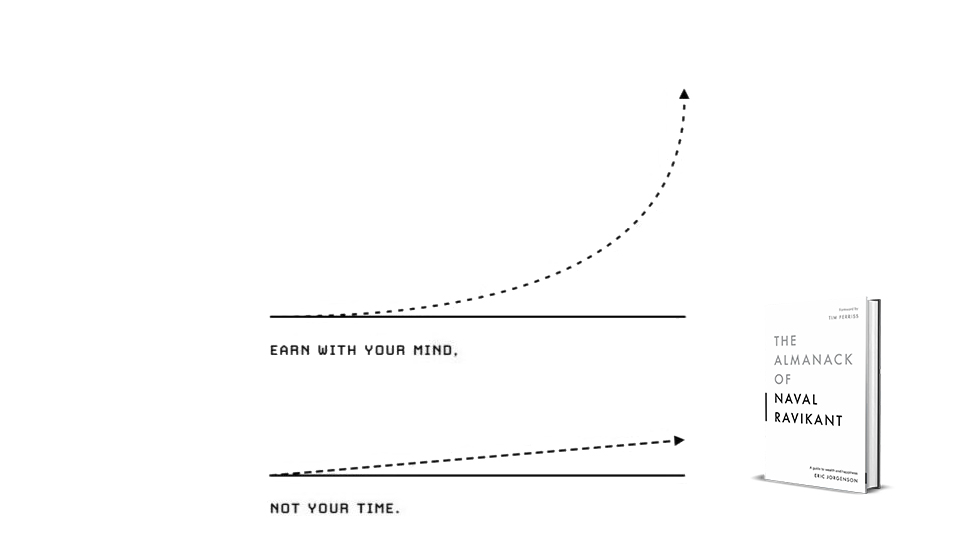
“Getting rich is about knowing what to do, who to do it with, and when to do it. It is much more about understanding than purely hard work.” –Naval Ravikant

Like the opening analogy reminds us, converting a slope of work from linear to exponential is not done all at once. The Headline Trap is distracting and we often assume it takes luck, but we make our own luck with every action.

As we leverage our own community-driven exploration, we uncover ways to earn more with our mind, not our time. The farther we separate time and money, the less we rent our most precious resources. Each time we find that next gear, the system unfolds and the rising slope of your impact, personal bandwidth, sense of peace, and happiness is set free to rapidly ascend.

By Ben McDougal, ago