Bridges to Tomorrow

Limitations fade as boundaries are broken. If we collectively avoid extinction and continue building bridges to tomorrow, our relationship with time, nature, technology, and each other will uncork unknowns and light a path to our neon future.

Robotics

With AI in the brain and emotions that curate a personality, robots are advancing to go beyond isolated tasks. Cyborgs will turn knobs at work, while humanoids complete chores at home. With the mundane covered, the role of humans can shift toward leading whenever ingenuity is required. With full access to robotic efficiencies, economies will shift and the human touch will be even more luxurious. Leaders who welcome technology but never lose touch with the soul of their art, will be the hybrids who prevail.

Biotech

As technology interfaces with human biology, a bionic age will alter the laws of nature. When the electrical impulse from a thought is all that’s required to prompt action, the speed at which data can move is unfathomable. Brain-computer interfaces (BCIs) and other forms of neurotech are already treating disease and restoring movement by reconnecting the nervous systems. Most people don’t want to be first, but when might a routine doctor visit include individualized diagnostics and software updates to the nanotechnologies inside your body? When every cell in the body has a microscopic computer connected to it, the resource consumption is diffused by concepts like DNA computing and the mysteries of health care are solved.

Material Science

The atomic levels of technology have already connected intelligence to things we interact with every day. We’ve seen how the Internet of Things (IoT) adds digital depth to our physical world. As the cost and size of technology continues to shrink, the periodic table becomes a playground. For example, we have materials used in the construction of roads that transfer the force of vehicles to batteries. The stored electrical energy is then transferred to streetlights that illuminate the road at night. This type of elemental exploration and creative recycling is only a flicker of the flame for alternative energies and improved storage methods that can quench our planet’s thirst for energy while eliminating a dangerous dependency on limited resources. The universe provides everything we need. It’s up to us to squeeze improvements from elements that are waiting to arrive at their full potential.

Quantum Computing

When “or” becomes “and,” a bizarre world of duality is unveiled. The computing aspect within quantum mechanics uses quantum bits, or qubits, to solve complex problems with measured superpositions, entanglement, and interference. Dig in to learn more, but the superpositions found in quantum computing mimic complexity, with simulations that include all possible solutions at once. This is not a more powerful, number-crunching supercomputer. Quantum computers represent a whole new approach to harnessing the atomic and subatomic levels of physics. A scientific asset that eliminates secrets presents a mixed blessing. With the chemistry of life mapped by machine learning, medicine will solve diseases and the potential of material science will be realized.

At the same time, current cryptography and the encryption that provides security online is at risk. Increased checkpoints, biometric confirmation, photon distribution keys, and other post-quantum encryption standards are being tested to ensure the world is ready for hardware to keep qubits cold enough to unlock a world-changing partnership between classical and quantum computing.

Life Extension

Quantifying the cosmic depths of our own kind will give us ways to experience time in more profound ways. Instead of hoping to reverse the effects of aging with treatments, food, and medicine, augmented activities will engrain longevity from start to finish. Although the human body may not hold up forever, living more than 100 years will be normalized. As we live longer, how might agriculture, infrastructure, education, healthcare, economies, and our global climate adapt? Many who plan for this longevity will be primed to meet new demands in existing industries. The quixotic leaders will explore less obvious opportunities and convert unexpected challenges into new industries as well.

Outer Space

The cosmos makes us feel small, yet limitless wonder helps us think big. As bionic humans and quantum computing improves material science, a robot-supported species can be multi-planetary. The origins of astronomy are prehistoric, but off-planet exploration began when machines first visited space in the 1940s, and then humans in the 1960s. Scientific exploration led to a commercial space industry that has propelled an excursion throughout our solar system and beyond. Today, orbiting observatories are looking toward the origins of the universe, with life on Earth’s moon and Mars seemingly inevitable. As we interact further into the void, celestial frontiers can provide added stability for the human race and extend life on Earth. Cosmic resources, travel, communication, manufacturing, tourism, and security must all be addressed by leaders united by shared intentions on behalf of all humankind.

There are untold innovations yet to be conceptualized, but these bridges to tomorrow all signal progress. Widespread adoption is never straightforward, but listening suspends belief, and continuous steps forward can transcend invisible lines for us all to work as one.

Brewed From Within
#84 📖 Technology

By Ben McDougal, ago

Technology Soup

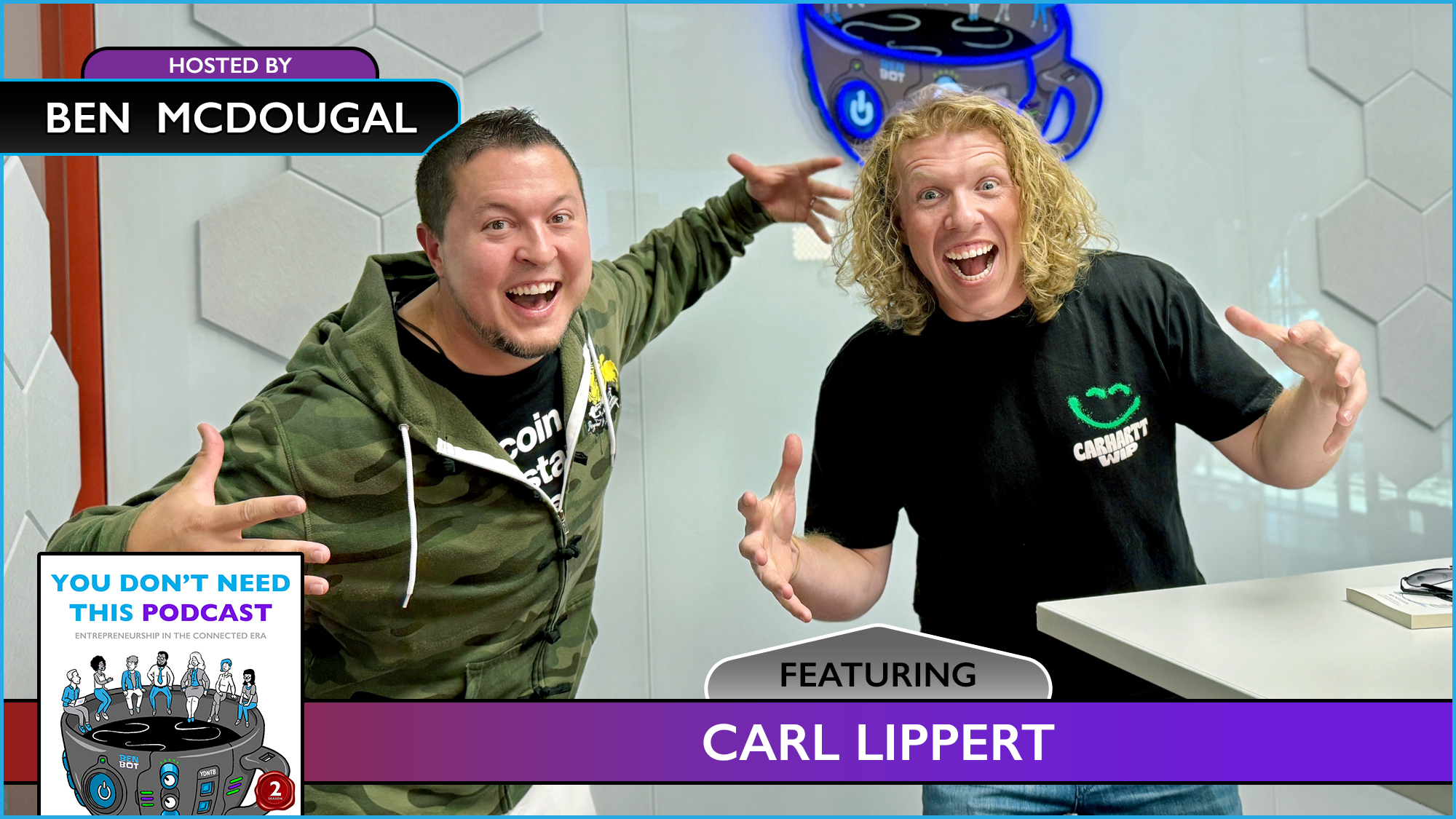
Put your laser eyes on as Carl Lippert swings through the studio to brew some technology soup. Together, we compile Carl’s global hackathon tour to hear how such curiosity paired with initiative helped this small town technologist explore the world.

From farming to AI, to blockchain networks, to prototyping, to nomading, to atoms, cryptography, and truth, EP81 is loaded with tactics and innovative energy to optimize your time and environments.

As Ben and Carl discuss, when technology is inherently money, it’s less about jargon and maybe we get back to atoms. Add to this concoction of thought, a dash of skeuomorphism, how AI can be magically expensive, robotics in daily life, and space! Enjoy this remarkable episode with EDM in the background, stay wild, and as Carl generously invites us to do – try anything.

LISTEN on APPLE PODCASTS
LISTEN on SPOTIFY

BONUS MATERIALS

https://CarlLippert.com

https://CarlLippert.com/blog

https://linkedin.com/in/carllippert

https://x.com/carllippert

http://tryanything.xyz

Roasted Reflections Break: Replicants

http://Technology-Soup.YouDontNeedThisPodcast.com

https://BenMcDougal.com/welcome-to-web3

https://BenMcDougal.com/indexing

http://YouDontNeedThisPodcast.com

EP3 – Blockchain Orgins 🎙️ Jon Woodard

EP6 – Computer Vision(ary) 🎙️ Brad Dwyer

EP8 – Cryptographic Cowboy 🎙️ Kyle Tut

EP39 – Digital Dawn 🎙️ Will Schneller

EP71 – Still United 🎙️ Alex Myers

EP80 – Audacious 🎙️ scottrepreneur

The Anthology of Balaji – The Types of Truth

Carl’s Wardrobe: https://us.carhartt-wip.com

Roasted Reflections on Discord

https://ReadWriteOwn.com

http://BENBOT.ai

By Ben McDougal, ago

Always Growing

“Behind mountains, there are more mountains.”

Well spoken by Chief Farmer of Clayton Farms, Clayton Mooney. This dude runs a kabillion miles by running 20+ ultrarunning, went through Y Combinator, stays stoic with painting, writes, illustrates poetry books, played poker professionally back in the day, enjoys boxing, and has felt the summit of many mountains. Clayton arrived in his Tesla Cybertruck, so we tightened our driving gloves and cruised inside the Pour Over Publishing studio. You’re gonna love this early episode of Season 2 for You Don’t Need This Podcast!

As you’ll see/hear, the team at Clayton Farms have been growing technology on a thesis of providing food that people deserve. They’ve been building with aeroponics for indoor farming, delivered ultra-local greens directly to people’s doors, and are now converting closed restaurants into 24/7/365 farming. You’ve heard of farm-to-table. This is the future of farm-to-window.

LISTEN on APPLE PODCASTS
LISTEN on SPOTIFY

BONUS MATERIALS
https://ClaytonFarms.com
https://substack.com/@openclayton
https://x.com/MooneyMillions
Following October – Poetry Book
http://Always-Growing.YouDontNeedThisPodcast.com
http://YouDontNeedThisKeynote.com

http://CollectorHardbackEdition.com
http://RoastedReflections.com
http://BENBOT.ai

By Ben McDougal, ago

Goodnight Moon

Star parties assemble people who are curious about the cosmos. Let’s set the scene. Imagine a remote place with dark skies and very little light pollution. Each campsite includes 1–3 telescopes. The astronomy equipment ranges from homemade to expensive. There are scopes made for visual observations and others geared for astrophotography.

Extra Shot
Explore my cosmic creations.

Daylight is relaxing, but the heavenly show starts as the sun begins to set and the first observations kickoff an evening of exploration. Tonight, our first stop is our own setting moon. From there, we spin the scopes to target a transitory comet. Planets in our solar system are next, then we go deeper. Globular clusters form dimensional shapes, with distant galaxies that look like eraser marks on black paper. The Milky Way can be seen all night, as constellations help star gazers navigate the rotating sky.

Space is for everyone, and astronomy makes everything feel small. Star parties remind us how we are all weird. Not an alienating type of weird, a wonderful weird that bonds people who care about anything together.

Brewed From Within
#106 📖 Life & Happiness

By Ben McDougal, ago

13.8 Billion

The universe is estimated to be 13.8 billion years old. That’s enough time to ask a few cosmic questions…

  • What are educational paths to the space industry?
  • Can astronomy, cosmology, and religion co-exist?
  • Does digitized consciousness unlock time travel by leaving the limitations of a human body behind?
  • How long would it take to arrive at the closest black hole? Who’s going in first?
  • How will robotics, AI, quantum computing, and material science accelerate space exploration?
  • It seems impossible that extraterrestrial life does not exist. When we learn that aliens are real, how should first contact be carried out?
  • If life on Earth has endured less than 25% of the time our universe has existed, how many distant civilizations may have come and gone?
  • Is it not foolish to mindlessly feed on energy that uses finite resources? When might we run out?
  • How does our planet’s spatial position and cosmic direction change inside an infinite universe that is expanding at an ever-increasing rate?
  • Visiting, even colonizing Mars feels like an important interplanetary exercise, but could other planets be a place to store all the things we don’t want on Earth? Even better, how about asteroids we load up and send off into the dark matter?
  • Can subatomic nanotechnologies alter the input of an energy source to transform the output?
  • How will ownership be handled in space?
  • Does seeing deeper fuel urgency?

                        These are bizarre prompts, and cosmic conversations can quickly become theoretical. To find answers in the unknown, our imagination, scientific exploration, and continual learning are essential as we keep tackling the questions of our universe and the unsolved problems in astronomy and astrophysics.

                        Cosmic questions put life into perspective and make our existence feel fragile. Arguing becomes a lost cause when collaboration is vital for our species to survive.

                        Brewed From Within
                        #108 📖 Life & Happiness

                        By Ben McDougal, ago