Mechanized Money

Banks track the story of money to prevent double spending, but money management is a power that can be abused by regulations, greed, and outright fraud.

Blockchain technology was first introduced in a 2008 white paper for Bitcoin, with Bitcoin then going live in 2009. By recording transactions with transparent logs on dynamic ledgers, public and private blockchains solve the double-spend problem with fewer third parties taking a cut, and instead, redirecting resources to cover the raw costs of computing, electricity, and network verification. The unspent transaction output (UTXO) model for tracking transactions and balances fractures this digital asset from the initial whole. These fractions are used as currency, which makes accounting inclusive, verifiable, and very transparent.

EXTRA SHOT

This contribution is by scottrepreneur, a UX designer and blockchain developer building at the forefronts of technology.

Blockchain technologies have reached mainstream adoption, but cryptography has been studied since the 1980s. Bitcoin was first to crack the code, and now different blockchains and more onchain layers are being combined in powerful ways. Today, there are four main types of blockchain networks: public blockchains, private blockchains, consortium blockchains, and hybrid blockchains. It’s impossible to count private blockchains, consortium blockchains, and hybrid blockchains, but there are hundreds of public blockchain that are permissionless. This means they are fully decentralized and anyone with an internet connection can equitably access the blockchain as an authorized node. Bitcoin and Ethereum are the two largest blockchains, with 10% of the global population owning some form of countless cryptocurrencies.

Within each blockchain, layers provide separating infrastructure for developers. Hardware, data, network, consensus, and application layers make blockchain technologies more usable, with each layer offering unique functionality. The last ingredient in a blockchain recipe is hashing, which delivers verifiability by assembling a historical ledger where any tampering of previous transactions will disrupt current calculations. With verifiable ledgers storing only valid transactions, we can automate value.

Smart Contracts

Smart contracts allow us to program, exchange, and intermediate value using the storage mechanisms first introduced by Bitcoin. Programming languages allow smart contracts to store data on specific blockchains, with small amounts of cryptocurrency used for gas fees, which is the cost to cover computational intensity and network interactivity. These primitives help coordinate mechanized value, with tokenomics and technical testing leading to effective governance on and off blockchains.

Tokens & Standards

As smart contracts began conforming to implementation criteria, token standards led to initial coin offerings (ICOs) that were sourcing funds for a wide variety of projects. Many overly ambitious projects damaged trust with unfulfilled promises and led to ICO bubbles, but the speed and effectiveness of such aligned collaboration hints at the power of this mechanism. The adoption of standards across an ecosystem allows for tight composability and interoperability across protocols. Tokens and standards are the building blocks for decentralized finance (DeFi), with stabilizing support from stablecoins.

Stablecoins

Stablecoins are a type of cryptocurrency that pegs steady value off another asset.

Fiat-backed stablecoins are backed by fiat money in an auditable account and have structural similarities to money market funds. Fiat money is a government-issued currency, such as the US dollar, that is not backed by a commodity such as gold. While fiat stablecoins are easy to scale, they are less decentralized yet remain popular because they are backed by existing currency and established regulations.

Collateral-backed stablecoins are backed by assets that are locked onchain and transparently auditable. When done right, these types of stablecoins have great decentralization properties, but they are hard to scale and can have liquidity issues from a market squeeze.

Algorithmic stablecoins are balanced with a system known as seigniorage shares, which uses mathematical algorithms and smart contracts to maintain a stable value relative to a target asset. Implementation of algo-stablecoins has been unsuccessful to date, so avoid these types of stablecoins until technology can unequivocally support the ideology. Alright, with tokens and places to store value onchain, let’s look at innovating within traditional financial exchanges.

Lending & Exchanges

Organizations committed to a BUIDL market have delivered on over-collateralized lending and borrowing onchain. Lenders can lock collateral to earn from borrowers, but borrowers need to be lenders of another token and ensure their loans remain sufficiently over-collateralized. Lending and borrowing both rely on asset prices to determine liquidation thresholds, but if these can be manipulated, the system remains vulnerable. Oracles provide an example of systems that can support blockchains with real-world data to keep decentralized mechanisms in tune as the value and frequency of cyber attacks increase.

Early experiments around what order books looked like onchain were clunky. Each bid, update, acceptance, or cancellation required another transaction and small but constant gas fees. This changed in 2018, when Uniswap used the Ethereum blockchain to provide a simple interface to swap tokens. Instead of creating offers to buy or sell, a market maker provides two tokens in a pool. These pools are called automated market makers, with pilot protocols that leverage a constant product market maker equation (k=x*y) to hold the ratio of pooled tokens equal. This supports non-custodial token swaps with fewer steps. If parameters for a transaction are not met, the smart contract will not execute, which keeps the exchange stable.

Pioneering Frontiers

Crypto has fast-moving frontiers. This makes for a continuous experiment, with good discoveries along the way. While gold awaits any gold rush, progress does not come without struggles, sacrifice, and reparations.

Let’s use the technology life cycle of crypto as a case study. Concepts like liquidity incentives tested financial yields from onchain assets. This model was well-received (2022), but token inflation without enough value loops became unsustainable. Initial coin offerings (2023) were also a wild way to rope in financial capital, but fake projects took over as fraud became easy. Bad actors affect the public’s sense of trust early in any technology’s life cycle. This adds hesitation and slows adoption, but failed experiments are required.

Years of rapid experimentation keeps innovation curves rolling on any frontier. As the volume gets louder around other technologies, less good noise is often perceived as a stall, or more drastically, the beginning to an end. Less noise may lead to fewer people actively building into a shared direction, but a trendy talent shift does not mean a misunderstood technology has had its day.

Within the short timeline of this brief case study, Narrow AI had been conversationalized and Agentic AI was signaling toward General AI. This turned attention (deservingly so) away from web3 concepts, blockchain technology, and mechanized money, but the decentralized progress lies in wait and the concepts of crypto are not going anywhere.

The technologies and economies that digital depth supports provide balance. Even in quieter BUIDL cycles, cross-chain interoperability, token standards, layered development, and global regulations will continue to push DeFi forward.

DeFi’s Destiny

Any dark forest can be treacherous, but system-level engineering takes time, and it’s liberating to build with intrepids who are learning together. As we complete this download, here are more interesting use cases to keep us thinking about what’s possible beyond traditional finance.

  • Instead of getting paid every 2 weeks or each month, smart contracts can create payment streams. Instant access to financial capital furnishes more financial freedom. Along with incoming compensation and outgoing subscription fees, self-repaying loans can further automate and optimize financial command.
  • Prize-linked savings accounts, also known as no-loss lotteries, are not uncommon in traditional finance. Local municipalities and credit unions have generally handled them, but smart contracts enable little to no overhead. Pooling capital and lending it to others is also used in smaller communities to help with small, low-cost loans.
  • Flash loans allow for borrowing a near-infinite amount of a token, provided the loan is paid back within the same transaction. These trusted transactions require significant capital, but can be facilitated within one block, then democratized to anyone with access to the blockchain, a scripting language, and a relaying node.

      DeFi provides composable tools for traditional and innovative finance primitives. Being able to mechanize money and the value it delivers within a network is power that’s less fragile and more translucent. As web3 concepts hook into the financial primitives of crypto, the global economy can leverage faster, more equitable, and safer peer-to-peer commerce.

      Brewed From Within
      #77 📖 Technology

      By Ben McDougal, ago

      Woven Worlds

      Culture is woven; technology is built.

      One accumulates through memory and shared meaning, shaped over time by many hands. The other is designed and assembled with intention. This distinction matters because what is built can be finished, while what is woven never is.

      Through stories, symbols, and artifacts, each generation adds new layers to our collective tapestry.

      What once took only physical form is increasingly becoming digital, carried forward by the relentless evolution of technology. Yet, once introduced, technology rarely remains confined to its original purpose. It’s folded into the fabric of our world, where it’s interpreted and repurposed, becoming part of our society in ways its creators could not fully anticipate. New ideas rarely replace what came before; they intertwine with it. Beliefs and practices become entangled across time itself.

      EXTRA SHOT

      This contribution is written by Will Schneller, a curious founder and technologist who explores how art, technology, and community weaves together.

      At the edge of new frontiers, humans reach for the familiar. We stitch together the distance between the known and unknown with shapes we recognize. Sometimes this instinct serves convenience or efficiency, making new systems easier to adopt. An artwork originating in oil paint is trivial to transfer into a physical print, and it’s even easier to make that print digitally available. A ticket to a sporting event that once existed on perforated paper now lives on a handy smartphone app. Your favorite album is no longer confined to the shelf but sits among thousands of songs on a device in your pocket. Other times, replication is a coping mechanism, a way to translate ideas that feel too abstract, technical, or difficult to explain.

      Even when digital systems begin by imitating familiar physical forms, digital depth quietly emerges beneath the surface. Metadata invisibly flows; hidden traces record not just what something is, but how it came to be and how it moves through networks. The meaning in what we create no longer resides solely in appearance or original intent. It accrues through circulation, reference, and response. As these translations settle into everyday use, they expose possibilities not present in their physical counterparts. Constraints loosen, and rules get rewritten. Systems that once existed to mirror the familiar start to invite exploration, modification, and play. What follows is not a better copy of the old world, but a space where new behaviors and relationships can unfurl.

      While some technological advances solve specific problems, others become playgrounds. For example, blockchains created the conditions for non-fungible tokens to be born. NFTs (non-fungible tokens) are digital assets supported by smart contracts that connect to a blockchain. Each NFT is unique, which allows code to autonomously apply, track, and transfer digital signatures and verifiable ownership. Although each digital artifact may have no exact equivalent, it can still evolve over time. These blockchain-native assets allow us to apply property rights and to interact with like-minded individuals without corporate algorithms shaping every connection.

      Long before NFTs gained prominence, video games had already been rehearsing some of the same ideas. Virtual worlds established shared rulesets, persistent identities, and digital artifacts whose value emerged through play and social context rather than physical substance. Communities formed around common mechanics, aesthetics, and norms. They assigned meaning to avatars, skins, achievements, and in-game assets that only existed as code. Traditionally, in-game items are effectively rented, disappearing when servers shut down. Blockchain-based ownership proposed permanence, portability, and player-held authority.

      Once ownership can be represented digitally with credible verification, users are given their own cybernated backpack. Not a login granted by a platform or company but a self-held container of identity, assets, and permissions that persist beyond any single service. Instead of centralized servers restricting our digital assets, decentralized protocols and web3 layering support ownership across different platforms. The conversation expands beyond art and gaming into everyday artifacts like memberships, credentials, and records that structure daily life.

      As these digital-native systems mature, they enable entirely new creative and cultural capabilities—not merely faster production or broader distribution but fundamentally different relationships between audiences, creators, and artifacts. One such shift was generative creation. Instead of crafting a single, fixed outcome, creators began defining rule sets: constraints, probabilities, and parameters from which many unique expressions could emerge. Authorship moved upstream from execution to orchestration.

      Blockchain-powered platforms pushed this idea further by binding generative systems to cryptographic infrastructure, creating a symbiosis between process and product. Variation became a feature, not a flaw, and collectors became participants in the moment of creation itself. Alongside generative art, other frameworks explored coordination and collective meaning through radical simplicity, repetition, shared context, and sustained participation over time.

      Digital artifacts were no longer static endpoints but dynamic nodes within living systems. Value emerged not only from aesthetics or novelty but also from process, lineage, and collective engagement. Creation became less about producing objects and more about shaping culture-organizing frameworks. In this way, technology did not replace traditional artistic or cultural practices; it extended them, offering new ways for ideas to propagate, mutate, and endure. But more than offering a new set of tools, technology holds up a mirror, forcing us to confront what we value as our physical and digital lives continue to merge, layer by layer, thread by thread.

      When novelty fades and attention shifts, what remains is not spectacle but structure. People return to the tangible, not in rejection of the digital, but in search of something that is grounding. Digital slips into quieter roles as infrastructure. This isn’t failure; it’s rhythm, an expression of how new technologies mature over time. The familiar S-curve of a technology life cycle, which we’ll revisit in Yin Yang, begins with breakthroughs that ignite experimentation on the way toward an early ascent, steered by potential rather than stability. Expectations rise faster than practical understanding. Capital and cultural energy concentrate at the leading edge, amplifying both innovation and excess.

      Inevitably, the curve bends and the edges begin to fray. Constraints appear and promises collide with reality. What cannot sustain itself is torn away, giving rise to periods of contraction or disillusionment. These moments are frequently mistaken for failures and become opportunities for skeptics to declare their predictions correct. However, they serve a necessary function. They clear the noise from signals, speculation from utility, and fragile ideas from durable ones. What follows is not a return to obscurity but a slower, steadier climb. The technology re-enters everyday life, quietly embedded into workflows, tools, and habits, often under new branding to shed cultural baggage. It stops demanding attention and begins offering reliability. Value shifts from novelty to usefulness, from expansion to integration. The most enduring systems are no longer those that announce themselves loudly but those that quietly become indispensable.

      Each technology life cycle pulls old threads forward, reweaving the physical and digital into a fabric that grows richer with history. Past experiments inform future structures. Early missteps become knots rather than dead ends, points of tension that strengthen the tapestry. Over time, what once felt disruptive becomes invisible, and the boundary between the new and the familiar dissolves until the cycle begins anew.

      What remains is not the novelty of the tools themselves but the patterns of use, foundational meaning, and the connections sewn around them. Technologies may be constructed in moments, but their cultural significance is woven slowly through new ideas, repetition, and shared experience.

      In the long run, sincere progress is measured not by what is built but by what endures.

      Brewed From Within
      #78 📖 Technology

      By Ben McDougal, ago

      Septenary

      AI is often thought of as a singular technology. This blanket assumption makes it impossible to compare the capabilities and functionalities that differ between the seven different types of artificial intelligence.

      The seven types of AI are organized into two groups. The first group is based on capability and includes Narrow AI, General AI, and Super AI. The second group is based on functionality and includes Reactive Machine AI, Limited Memory AI, Theory of Mind AI, and Self-Aware AI.

      Capabilities are determined by what different types of AI are able to accomplish. The three types of AI categorized by capabilities are Narrow AI, General AI, and Super AI. Here’s what’s possible today and what may be possible tomorrow.

      Narrow AI <realized>

      AI trained from existing data, with compute geared to do one thing really well. While data sets are vast, this type of AI cannot go beyond the data sets it is tied to. As of 2026, Narrow AI is the only type of AI that is fully realized within the three types of AI categorized by capabilities. Examples of Narrow AI include language translators, spam filters, recommendation engines, voice assistants, facial recognition, self-driving vehicles, and task-focused robots. Generative AI also falls within this type of AI. The mashups of generated text, images, video, and sound appear to be random but are still constraints by existing data sets. Neural networks, optimized data sets, computer vision, and machine learning make the capabilities of Narrow AI remarkable but limited by the data it has to munch.

      General AI <theorized>

      This advancing realm of AI leverages existing data like Narrow AI but can reason beyond those constraints. The transfer of intelligence with no human intervention makes the race to General AI (also called AGI) intense. When AI can make decisions based on an advancing state of its own understanding, the limit of this AI’s capabilities become unknown. Theories set the potential limit to around that of a human. Agentic AI hints at AGI with decision making and interdisciplinary task management, but lacks the emotional traits, planning, and other methods of generalization that will define the capabilities of General AI. Other signals include synthetic content creation and autonomous robots that can learn new tricks. As the theories of AGI become realized, ethics, regulation, and a determination of consciousness will be moving targets. The breeding speed of AGI may release points of no return, which makes it critical to understand and debate openly to ensure a new species is copacetic.

      Super AI <theorized>

      Welcome to when AI becomes its own species. This triggers concern due to the finite resources of Earth, but when AI surpasses the capabilities of humankind, dust from the deep future will already be everywhere. Multi-planetary travel will be underway, climate problems will be solved, and life extension will be supported by Super AI. Singularity is theorized to push the functionalities of Self-Aware AI and the capabilities of Super AI beyond humanity’s control. That means the time to plan ahead is now. As the minds of machines are wired, it’s crucial to collectively consider the heart and soul we build into technology. This will guide discovery with an excellence that came before it.

      AI based on functionality is less about power and more about how things work. Reactive Machine AI, Limited Memory AI, Theory of Mind AI, and Self-Aware AI are the types of AI classified by their functionalities.


      Reactive Machine AI <realized>

      This is old school AI. Rooted in statistical math, Reactive Machine AI arrived soon after the computer was developed. There is no adaptive learning here, but the speed at which it can calculate data makes the performance seem intelligent. The functionalities of Reactive Machine AI drive more primitive examples of Narrow AI, such as recommendation engines and game-playing programs. This type of AI provides a static base, but with no memory and a focus only on specific tasks, attention shifts toward functionalities that have more adaptive characteristics.


      Limited Memory AI <realized>

      This type of AI learns and evolves. Functionalities of Limited Memory AI are still constrained by the existing data it was trained with, but world-changing advancements have been seen in machine learning, large language models (LLMs), generative AI tools, multimodality, computer vision, and self-driving vehicles. The realization of Limited Memory AI has Narrow AI pushing its full potential.


      Theory of Mind AI <theorized>

      Here, we combine existing data, an adaptive ability to learn, and an emotional willingness to think. Enhanced reasoning, multimodality, customizability, adaptive computing, and user-driven functionalities bring General AI (AGI) to life. Theory of Mind AI embraces emotions and understands how we think. This type of AI will add personality to humanoid robots and support reliable relationships by combining digital depth to the realities of our world. As lines blur between humans and machines, adaptive compute will remain a currency, efficiency will skyrocket, and a new era of life on Earth will begin.


      Self-Aware AI <theorized>

      It’s hard to define consciousness, but true self-awareness exemplifies this type of AI. Along with understanding how we think, Super AI will own emotions, hold beliefs, and is theorized to support the functionalities of Super AI.

      Understanding the seven types of AI helps leaders leverage the perks of technology now and later. Our willingness to lift the fog helps avoid a fear of the unknown, and while resisting technology is a choice, it’s one that may put you behind innovation curves. Hybrids add artificial copilots but remain assertive and budget resources, knowing we are the pulchritudinous architects of our own neon future.

      Brewed From Within
      #81 📖 Technology

      By Ben McDougal, ago

      Cartoonist

      Nathan T. Wright is an artist. He has origins in the early days of social media, made impact inside corporate marketing, and now illustates remarkable art with drawings, cartoons, murals, and more. Ben and Nathan jam on The Adventures of Fatberg, the early (fun) days of social media, the speeds in-house at a large company, leading a creative process with clients, real skills for studying the arts, and understanding the business of being a full-time artist.

      After the break that features a reading of Aphorism, Nathan and Ben dive back in by talking graphic recording at live events, the positive tension of smart cartoons, and extending value by reformatting great content into books. EP90 of YDNTP is an absolute bop – share with a friend!

      EXTRA SHOT

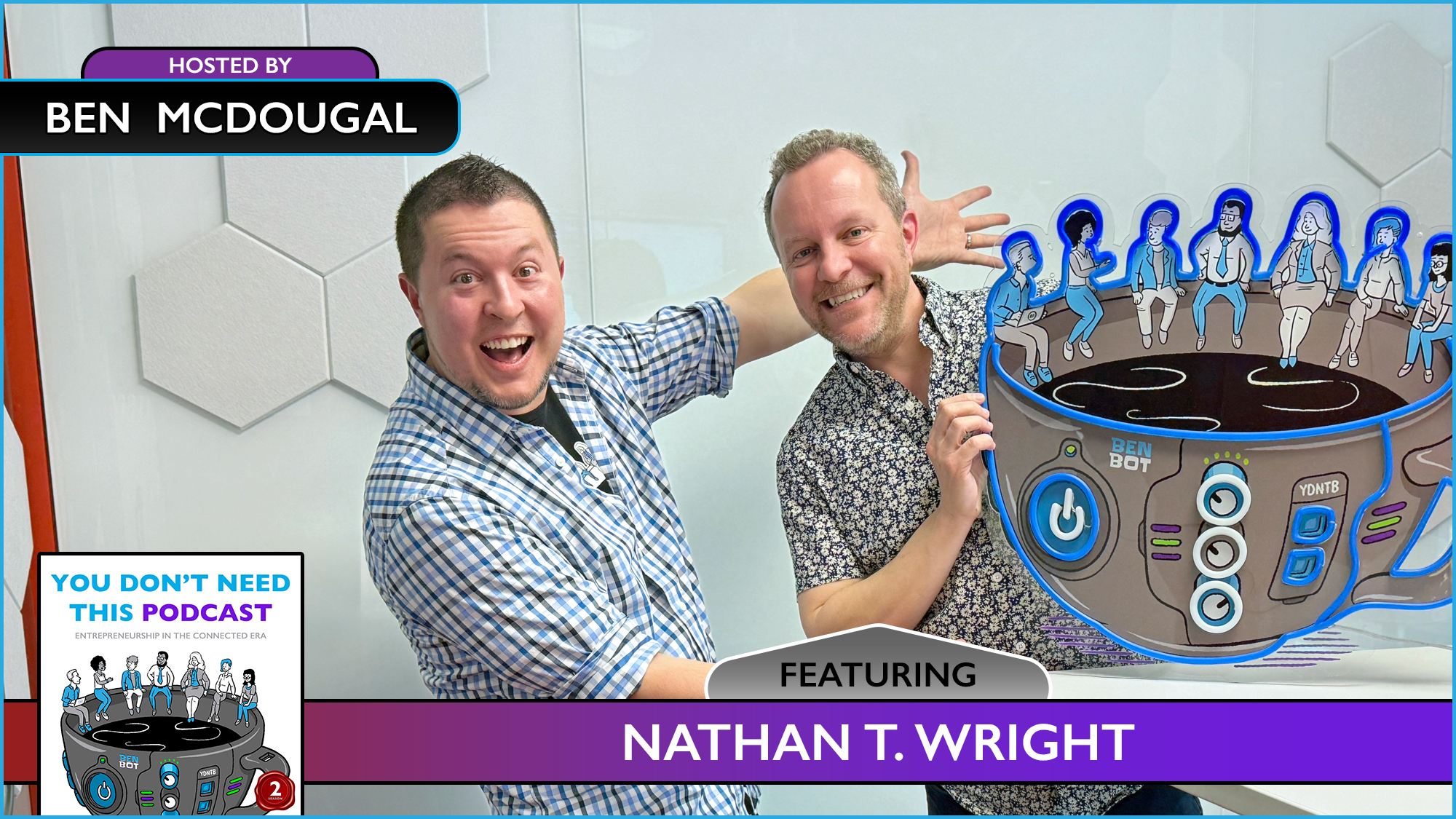
      Nathan T. Wright is the friend who illustrated the mug that has become part of a brand that is Ben McDougal.

      What started as the caffeinated, community-driven cover art for You Don’t Need This Book, now extends through the Roasted Reflections NFT Collection, imprinted phygital clothing, the front of tiny ideabooks, temporary tattoos, a huge neon sign, and of course, the artwork for this timeless podcast! Cheers to this episode and another shared relic that keeps the fun brewing!

      LISTEN on APPLE PODCASTS
      LISTEN on SPOTIFY

      BONUS MATERIALS

      https://nathantwright.com

      The Adventures of Fatberg

      https://etsy.com/shop/ntwillustration

      City of Santa Ana FOG Activity Book

      Roasted Reflections Break: Aphorism

      https://NewYorker.com/latest/cartoons

      http://Cartoonist.YouDontNeedThisPodcast.com

      https://MainframeStudios.org

      EP21 – Pinball Wizards 🎙️ Ben Sinclair

      EP44 – Do What You Love 🎙️ Scotty Russell

      EP55 – Inextinguishable Light 🎙️ Jim Morgan

      EP60 – Goosebumps 🎙️ Nic Roth

      http://YouDontNeedThisPodcast.com

      https://BenMcDougal.com/NFT

      http://BENBOT.ai

      By Ben McDougal, ago

      Audacious

      scottrepreneur is a nerd you need to know.

      How does blockchain layering work? What can composability provide? What’s the value of money being mechanized? Can you translate the difference between centralized, protocol, and blockchain networks? Maybe you’re exploring ways to add digital depth to existing products?

      So many questions, here are some answers!

      After the 10 Commandments of UX are echoed in the break, we talk about how blockchain can support state management and sourcing truth alongside the power of AI. We brew on getting rugged by Big Tech, tokenomics to incentivize contribution, the lasting value of NFTs, user ownership in social media, Hats Protocol, web3 accelerators, Bitcoin halving, burning digital assets, and zero knowledge proofs. Try to keep up, share with a developer, and stay wild with tons of related episodes below. Let’s keep learning and building… together!

      LISTEN on APPLE PODCASTS
      LISTEN on SPOTIFY

      BONUS MATERIALS

      https://scottrepreneur.com

      https://x.com/scottrepreneur_

      https://warpcast.com/scottrepreneur

      http://Audacious.YouDontNeedThisPodcast.com

      Roasted Reflections NFT – Audacious 👾 #36

      https://BenMcDougal.com/Mechanized-Money

      http://YouDontNeedThisPodcast.com

      EP3 – Blockchain Orgins 🎙️ Jon Woodard

      EP8 – Cryptographic Cowboy 🎙️ Kyle Tut

      EP25 – Stablecoins 🎙️ Chase Merlin

      EP38 – Tokenomics 🎙️ Joshua Larson

      EP39 – Digital Dawn 🎙️ Will Schneller

      EP44 – Do What You Love 🎙️ Scotty Russell

      EP71 – Still United 🎙️ Alex Myers

      Roasted Reflections on Discord

      https://ReadWriteOwn.com

      http://web3dsm.com

      http://BENBOT.ai

      By Ben McDougal, ago