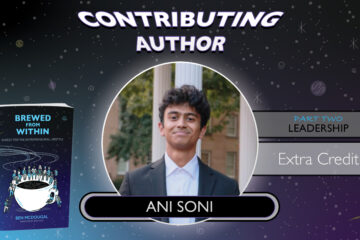
Extra Credit

As a high school student interested in business, extra effort was required to first find and then get involved with the local startup community.

There are business and entrepreneurship classes at any school. Extracurricular programs and student-organized clubs also hint at what an entrepreneurship is about, but too often these insulated activities don’t paint the full picture. For students interested in understanding the realities of an entrepreneurial lifestyle, the assignment is to meet more entrepreneurs.

EXTRA SHOT

This contribution was written by Ani Soni. Ani is a student leader at the University of North Carolina.

Finding entrepreneurial events was easy; showing up for the first time was not. As a student, an environment full of adults can be intimidating. My own ability to contribute felt unlikely, which fed more hesitations. Succumbing to unspoken fears would have been easier, but it was time to leave the training wheels behind.

A willingness to show up paid off quick, as fellow attendees were welcoming and incredibly interesting. The early initiative I showed seemed to make more people eager to help. This made showing up again easy. After a few months, it was clear. Entrepreneurs sure like helping one another.

Listening unlocked new learnings, but I was also able to contribute more than expected. There were opportunities to provide feedback, discuss trends, share a young person’s perspective, and even lend a helping hand. The more I gave, the more I received.

This demonstrated how unconventional action shines bright when chill is status quo. Real-world extra credit was earned by expanding my network before it was needed. Awareness around non-student activities also fed increased curiosity, which can be combined with this type of initiative, more real skills, and vocational knowledge that can caffeinate whatever we care about. Embracing Playforce Principles built confidence to continue my education along with a readiness to make my mark within the realities of our time.

Brewed From Within
#60 📖 Leadership

By Ben McDougal, ago

Training Wheels

As a child, riding a bike was not as easy as it looked. Fortunately, early excitement was bolstered by the comfort of training wheels. These stabilizers provided balance but eventually became self-limiting. Removing training wheels took only a minute, but then fear set in. Staying upright, maintaining speed, avoiding obstacles, and falling without getting hurt felt overwhelming. Even with support from others, success seemed out of reach, until it clicked. Like magic, trepidation transformed into gliding independence.

Training wheels remind us that contentment can lead to complacency. Being content without complacency is a constant battle. One day you’re grateful for all that is, the next you’re feeling oddly stuck. Perhaps this is because the more complacent we become, the more rigid we get. This rigidity then devolves into a stronger fear of change. When the movement of change becomes associated with risk, it’s common to feel stuck, stagnant, or even irrelevant. When training wheels are holding you back, initiative sets you free and persistence keeps us moving. As movement separates from risk, we’re free to shift gears and ride toward next.

Brewed From Within
#100 📖 Life & Happiness

By Ben McDougal, ago

Reluctance

There’s an art to keeping the right people engaged for the right amount of time. When things feel stale, it’s a signal of disinclination. To infuse new energies into a group, create space by releasing the reluctant.

Life happens, so it’s natural for interest and commitment levels to change over time. While engagement may expand, anyone’s ability to contribute can just as easily be reduced as transition occurs, missions evolve, and roles transform.

The spiral of someone’s reluctance will soon create stress between others who are still devoted. The longer this misalignment lingers, the more tension it creates.

Even so, people hold on too long, and most of us choose to avoid confrontation. This extends the pain for everyone. The reluctant feel guilty for not contributing while the zealous begin to resent the perceived lack of integrity. Stakeholders experience obscure toxicity and less dependably, which devolves into reduced trust, enthusiasm, and engagement.

Extra Shot

“Winners quit all the time. They just quit the right stuff at the right time.” –Seth Godin

Keeping an eye on our personal bandwidth adds clarity for what and when to quit. This self-awareness helps leaders stay centered and motivated by the way we spend our time. It also helps maintain good relationships by avoiding the unnecessary roughness of dramatic encounters, even when it’s time to explore a new direction. When bridges don’t get burned, we can make a ruckus, move on, and actually expand our impact while still staying connected.

For leaders dealing with lingering reluctance, let’s finish with a few friendly tactics to keep a group vibrant, while maintaining lasting loyalty from the departed.

Start by respectfully inviting individuals who have written their story to graduate gracefully. Sometimes, good people simply don’t want to quit on the people or program they care about. If time has been committed or someone’s identity as a leader is closely connected to their position, the transitional period takes more time, and the group will need to show proactive initiative to prove they are ready to lead without the departing individual. Rarely is there a perfect time to step down, but when given a polite opportunity to exit with elegance, appreciation leads to smooth transitions.

Another way is to ask everyone to do more. Inviting initiative provokes less committed members to bail. The danger is that you may lose others who may not like being asked to go beyond the original game plan.

Lastly, recognize the end will always come. Be clear with expectations, transparent as things evolve, and keep succession a part of ongoing planning.

Along with being open up front, complement internal clarity with external celebration. Acknowledge individuals who made a difference in the past, and praise those who are being generous now. This nurtures an environment where people are inspired to do their best when they’re involved, without feeling a sense of loss when it’s time to let go.

Brewed From Within
#54 📖 Leadership

By Ben McDougal, ago

Replicants

Technologists and futurists have long imagined interacting with replicants. We’ve seen them in the movies. There’s no single definition for what a replicant might be, but it’s not C-3PO from Star Wars. Our replicants will be an artificially intelligent, bioengineered entity that has consciousness rooted in the human (or machine) it originated from.

This humanoid will index everything the originator ever created, map the complexity of their network, understand internalized versus externalized thoughts, have empathy for how the author matured over time, and gain contextual insight from storytelling to form a foundational identity. This identity would find purpose from a digitized consciousness, maintain essential rules, feel a mirrored personality, act the same even when nobody was watching, and stay updated without an altered foundation.

Extra Shot

Days feel long, but years fly by.

Replication should remain a choice, but capacity to interact with our past and future is expanding. Think of how we take photos. Look at the media being captured at any concert. We already use the moment to remember the past. We speak to holograms, watch animals play video games with their brain, grow synthetic realities, and experiment with infinity through the math and physics of big and small.

As the bandwidth of technology reaches escape velocity, what’s stopping us from pressing the record button to store every angle from every moment? At that speed, how can the linear evolution of humanity’s intelligence fuse with the exponential trajectory of machine learning? Even when it’s possible, do humans want such a reflective future?

Thinking about futuristic interactions can summon a desire to amend the way we spend time. Would you live your life differently knowing future generations may interact with your replicant? Therein lies why most of us don’t like the idea of such a daunting, forward-focused souvenir. If we’re always performative, authenticity is lost. Consistency, which most want in business, becomes a drag, and choosing less randomness, never breaking the rules, and pretending life is show would result in mental distortion and altered actions.

Constant attention is less fun, and making mistakes keeps us wild, but might we be less careless if the plan was to leave a replicant behind? This exercise might be less about technology and, instead, using replication as motivation to fully appreciate how every byte counts.

Brewed From Within
#86 📖 Technology

By Ben McDougal, ago

Breakout Valuation

Breakout valuations are achieved when a business is valued based on how it makes people feel and its future potential, not just on what it’s done in the past.

The nine components of a breakout valuation are confidence, vision, curiosity, people, communications, cash management, financial forecasting, capital strategy, and business design. Whether or not you sell your company, owners who optimize in these areas position themselves for a breakout valuation.

Extra Shot

This is an adaptation of Breakout Valuation by Patrick E. Donohue. Patrick is the Breakout Growth Investor—a founder, valuation expert, and capital strategist who helps us build magnetic vision, unlock financial clarity, and create lasting value.

While you’re running a company, breakout valuations make everything easier. It attracts talented employees and quality customers. This expands your market position, makes financial capital less expensive, and invites vendors to extend better terms based on your surging trajectory.

Knowing what your ownership of the business is worth helps you make important financial decisions and becomes increasingly important as a business matures.

If a business grows to the point where it becomes valuable to acquire, academic and finance professionals attempt to make valuation objective, but the complexity of each transaction makes valuation subjective in the end.

Along with all the objective data, valuation is highly influenced by the environment, relationship, and personal views of the participants in a transaction.

Knowing how investors and lenders use objective valuation tactics is crucial. But understanding the potential value of the business, articulating it to potential partners, and having them buy into the vision will arm you with an advantage to get what  you want: a breakout valuation.


Extra Shot

What are we doing today to support our goals for tomorrow?

Breakout valuations are not aspirational.
They emerge from what you are doing right now.

Be clear with your mission and vision. Know your numbers and how everything comes together through a shared mindset, communication, and workflow. 

The pursuit toward a breakout-valuation compounds, requiring attention today and every day moving forward. This steady focus aggregates a deep level of understanding and builds confidence. When the day comes to part with some or all of your business, the assurance from a breakout valuation will maximize the payout or support the poise to walk away.

Alright, grab the gondola.
Let’s head back up the mountain.

Brewed From Within
#28 📖 Entrepreneurship

By Ben McDougal, ago