Adaptability

As leaders prepare others for an unpredictable future, an interest in understanding answers and an eagerness to claim confidence is essential. A vital element to both qualities is an ability to constantly adapt.

When technology makes answers easy to find, adaptability makes the human touch unmistakable and more resilient. As students traverse problem-solving activities, they learn to appreciate what goes into the answer. This leads to deeper understanding and boosts adaptability as assumptions are tested and unplanned obstacles are conquered.

Extra Shot

This contribution was written by Nancy Mwirotsi. She is a leader from Kenya who empowers underserved youth through technology education.

Imagine a young student, standing in front of a packed room to pitch her first startup idea. Something unexpected is bound to happen. When it does, real-time adaptability keeps her calm and her voice grows stronger as the crowd responds to her ability to execute despite the disturbance. Outside the classroom, similar manifestations occur when leaders reward team members who adapt to stay ahead of innovation curves and we all know how unpredictable entrepreneurship is, which makes adaptability an ongoing requirement for founders building without a map.

Adaptability strengthens confidence as we then let students lead. When young people are trusted to take the stage, make decisions, or shape solutions, they begin to own their success and claim a confidence that can’t be taught.

As students claim confidence, adults stop underestimating their capacity. This fosters a two-way exchange for students that see themselves in leaders who motivate them to explore, make mistakes, and yet, always remain valued. A shared interest in how things work can then amplify potential as technology is introduced to create awareness, multiply real skills, and actuate ideas. This experience encourages students to go beyond just using technology to find the easy answer. It elevates those who understand how technology works, which continues to shape courageous innovators that avoid the temptation to be mediocre.

Within the unknowns of constant change, adaptability keeps us curious. Enduring curiosity can then activate initiative supported by real skills and expanded through lifelong learning. Leaders who create environments that help others build proficiency in the dynamic elements of playforce principles, prepare us all for the future of work.

By Ben McDougal, ago

Everyday Activism

Power from the past keeps us moving, but effectiveness dwindles when fewer voices are heard. Fewer voices help those in power grow, but history reminds us how a lack of diversity is not only dangerous, it’s also boring. This invites the leader inside us all, to design action for change by empowering diverse populations.

EXTRA SHOT
This contribution was written by Andrè Wright. Andrè is a thinker who uses design, fashion, and art to inspire students and community-driven movements.

To thread a topic for discussion, let’s stick a few bars on the global language of fashion. Our voices can be heard, but sometimes the volume makes a message miss. The art we share online is material but can be lost in the sea of content. Efforts add up, but community requires sacrifice. Activate as much energy as possible, but clothing can also speak. What we wear tells a story. This story has many characters, each playing a role in how we feel, think, and act. What we wear either hides or magnifies our mode for that moment. Fashion makes each outfit a creative act.

To thread a topic for discussion, let’s stick a few bars on the global language of fashion. Our voices can be heard, but sometimes the volume makes a message miss. The art we share online is material but can be lost in the sea of content. Efforts add up, but community requires sacrifice. Activate as much energy as possible, but clothing can also speak. What we wear tells a story. This story has many characters, each playing a role in how we feel, think, and act. What we wear either hides or magnifies our mode for that moment. Fashion makes each outfit a creative act.

In America, we dress to impress, to feel the chill, to stand out, to fit in, to perform, to relax, or just to call it good enough. In Tokyo, streetwear is precise, with a quiet confidence, layered intention, and respect for the craft. In Seoul, it’s forward-thinking—experimental silhouettes, fearless self-expression. In Paris, style is posture and effortless rebellion wrapped in restraint. In Milan, heritage meets the edge of luxury with attitude. In Bangkok and Ho Chi Minh City, fashion is adaptive, with heat, movement, and hustle shaping design. In Istanbul, layers tell stories of empire, faith, and modern youth culture colliding. In Mexico City, Lima, and Bogotá, streetwear carries ancestral memory that shines through bold colors and symbolism. In Berlin and Amsterdam, fashion is utilitarian resistance with form following function and identity following truth. Across the Philippines and Sri Lanka, style is resourceful, resilient, and deeply personal.

Streetwear is more than clothing. It’s code. It’s both survival and celebration at the same time. These creative expressions grow stronger when paired with education, lived experience, and collaborative partnerships that invite people in. For any genre, when stories stack alongside real progress, community-driven activism can cook up the ingredients for a movement.

The right audience in the moment (timely) and over time (timeless) sets a direction for these movements. This form of group action involves individuals, organizations, and communities choosing to move together. Together, a vision becomes possible through a compelling narrative. Planning keeps the vision clear. Small, consistent actions—moves that rhyme—are what build trust, assurance, and momentum.

The movements we remember are those that create pathways: opportunities to build leadership, teamwork, and citizenship through creative expression. They don’t just inspire people; they equip them.

We each carry gifts and love people who shape how we show up in the world. That’s what makes our style, our approach to life, entirely our own. This individuality, altered by the environment, also makes us each an accouterment for change.

Everyday activism adds up. The diversity it invites keeps the work honest and interesting. Designed with an open mind and a positive-sum mindset, everyday activists form communities that create conditions where all of us can thrive.

When this happens, we develop more conscious people who can then contribute positively to their families, schools, neighborhoods, and the world—one outfit, one conversation, one shared vision at a time.

By Ben McDougal, ago

Enchanting Events

Leaders bring people together. Thoughtful connections happen every day, but organizing a public event takes a concerted effort. Great events deliver on a promise by consciously colliding a diverse mosaic of stakeholders who share premium human time together.

When an experience unites the right audience, events expand and accelerate progress. Before, during, and after an event, the more value someone receives by committing to attend, the more likely they are to return.

Tactical depth for organizing both live and online events are practical sections within You Don’t Need This Book. Revisit the Community chapter of YDNTB for more on building engagement through shared experiences. With that in place, let’s skip downstream.

Polymorphic Sequencing

Organizing an event combines resourcefulness, content creation, attention to detail, and people who care. It’s planning and executing an experience that offers more value than the time required for attendees to show up.

This sounds straightforward and we see others hosting endless events. This constructs an illusion that leads many to think it’s easy. Yes, anyone can do it, but organizing an event rarely happens without struggle. No experience, a lack of organized resources, or not having the channels to create awareness with enough people who care make any new concept a lift to launch. Fortunately, building into something we care about is work that feels like play and our juice is often worth the squeeze.

Extra Shot

Find a reason to build with others.
Like consistency, it’s worth the sacrifice.

Hosting one event can create powerful effects, but treasure awaits those who keep building into a longer sequence of multiple events over time. As momentum grows, an ability to execute becomes more natural. This allows creativity to expand impact, while people, themes, environments, and other events stay connected. As different experiences begin to rhyme, shared appreciation builds trust that caffeinates whatever you care about. This keeps the supply of events steady, but disconnects occur when the demand changes.

Navigating Demand

Anytime we get good at something, it’s helpful when the requirements to be good stay the same. Sticking with what works is swell, but roles drift and what people need can deviate. Cultural shifts are usually slow, which makes it possible for events to stay in-tune longer, with fresh twists that maintain demand and keep attendance consistent.

When the cultural climate changes more suddenly, organizers can get stuck playing the same song too long. Events that only hold on to what’s worked in the past, may get stagnant and can quietly, but quickly lose relevancy.

Take a global pandemic for instance. As our planet emerged from the COVID-19 pandemic in 2023, public events felt different. Years later, they still do. The world had stayed home for an exorbitant amount of time and when people returned to a new normal, the game had changed.

Online-only communication had been normalized within the pandemic and efficiencies were fun at first, but soon got old. Virtual teleportation grew networks, but the high speed of growth led to fragmentation. While remarkable progress was made, online events began to feel hollow and lacked enrollment without the heart of an experience that transcended an agenda. Virtual meetings had set topics, specific attendees, and only certain people leading the discussion. Inquisitive side conversations diminished, which reduced the serendipity that makes everything awesome.

As impassioned engagement began to fade, the effort to activate events became burdensome. Attention dissolved and leaders lost sight of what their audience needed. The smallest moves felt risky, exhaustion set in, and communities fell apart. This unprecedented time reminded us how relationships can survive at a distance, but struggle to thrive without IRL (in real life) interactions.

As this tragic pandemic subsided, everyone was socially out of shape. It was good to be back together in-person, but a jarring reality remained. People had become addicted to productivity, felt safe in isolation, and a new generation of founders had started successful companies without contact during the pandemic. Showing up for anything felt like an unnecessary task, which led to an aura of optionality.

Enthusiasm to get involved was soon harder to find. Life happens and calibrating how we spend time is worthy, but this ethos can easily devolve into an excuse to do less. To hesitate. To say “no” when a “yes” would have led to more adventure. With altered demand, crowds became harder to curate. Many past events returned to unite attendees through a similar experience, but just as many returned to dwindling congregations that felt stagnant. Failed events led to organizer burnout, which meant less opportunities for good people to collide. Social fracturing on a global scale took time to mend, but as leaders began to explore new ways to bring us together, fresh ideas were collided, formats adapted, new collaboration emerged, and value returned.

A global pandemic is a dramatic example, but when change is constant, how can leaders evolve the supply of events to meet demand for the people in a startup community and the organizations within an entrepreneurial ecosystem?

These cultural crossroads remind us that a beginner’s mindset preserves a willingness to experiment. When the status quo is easy, lean toward what’s hard. Tension can help avoid more dead ends and when challenges are seen as opportunity, adaptive events can meet evolving demand. 

As events transform to fit the moment, remember a why, foster diversity, harmonize with key stakeholders whose needs may have changed, consider the cadence, explore new venues, try new marketing maneuvers, and recommit to local leaders hosting contiguous events.

The lasting promise is that evolving demand does not change the value of serendipity. Unscripted collisions keep us all wild and healthy. Great events spark invaluable intuition and help peers avoid misery. Human ingenuity connects dots, ideas are given space to mingle, progress is seized, and a renewed audience can leverage exponential encounters that are united through a positive-sum mindset.

Parlay Measurements

Systems like the assurance from data and many forms of data can be compiled when it comes to assessing events.

Use traditional metrics that have been helpful, but even small pigeonholes can make good data dirty, so beware of the measurement traps all around you.

If you’re truly interested in enchanting events for those you may never meet, let intuition guide you. Leverage analytics, but don’t let them disguise reality. Instead, parlay good, clean data with feedback from the people who care. Listen to attendees, offer surveys, welcome being wrong, segment attendance trends, find joy with informal check-ins, and don’t limit feedbacks loops to only the loudest in the room.

Attendee feedback, experiential wisdom, and good data supports better understandings. Decisions get easier and there’s less guessing. With success and this state of understanding, program details can evolve in a shared direction and technology can be gamified to support more stakeholders. This level of growth is not for the faint of heart, so don’t be afraid to keep it chill, but if we keep building and handy solutions are made to be easy, user appreciation leads to enrollment. This bolsters good data as fans use it to grow the events they care so much about.

If a decline is clear and nobody cares enough to provide feedback, harder decisions are coming soon. Even if it’s time to graduate gracefully, this type of honest assessment provides confidence that helps us learn, appreciate what was accomplished, and enjoy a closing sunset.

Growth vs. Therapy vs. Entertainment

Developing and attending events is an effective way to add and enhance real skills, but stay cognizant to keep your time and purpose aligned with events and related attendees.

There’s no wrong answers, but there is a difference between events geared for personal growth, versus therapy or entertainment. For example, if you need basic education, but the majority of attendees are there for entertainment, newcomers will feel a sense of fun, but the motionlessness may not have them sticking around. Another example is the welcoming environment that lacks in-depth insight, which will have more experienced people choosing to disengage. These examples remind us that when the messaging does not match the experience or an atmosphere can not support goals of an attendee, less value is felt and impact can fizzle.

To align expectations and the experience, be clear with those you seek to serve. Avoid trying to be everything to everyone, understand the type of people who make your events relevant, and welcome constructive feedback. This intentionality attracts the right attendees, which makes it easier to deliver an experience that resonates. Evolve to meet changing demand, but remain viable by expanding how people feel between numerous events.

Versatility

Expanded viability can be achieved when one event has different flavors or when various leaders host different types of mutually dependent events. Multipurpose events led by one person or organization look better through a short-term lens and often see faster results, but ego, thirst for control, a wrongful sense of ownership, and ulterior motives will always get in the way. A more lasting and sustainable path involves a diverse collection of ecosystem allies who are excited to share an audience between related events. Consistency and variety will keep people coming back, but that’s a heavy lift for one, versus a lighter lift for many. Distribution of events within a startup community adds depth that makes it easier for organizers to be consistent as they focus on what they do best, knowing other events deliver supplementing variety.

As individual attendees experience different types of value in a connected community, engagement grows thanks to versatility that people can get excited about together.

Currency of Attention

There was a time when we didn’t know every option. The Internet and social media changed that. The bombardment of information has literally changed our biology and reduced attention spans with endless options that saturate our lives. When combined with an innate desire for routine, attention becomes currency and is much harder to earn.

When time is precious and attention is scarce, the perceived optionality of events will always keep them on the chopping block. For event organizers trying to fuel awareness, it’s not enough to just open your doors or post an event online.

Leaders must stay ahead of the innovation curves, attend other community events to pave two-way streets, revisit communication tools, keep fresh blood flowing, and make an effort to personally invite the right people at the right time. Even as recognition is earned, don’t be complacent, for the currency of attention never lasts long.

Impermanence

If the message has been received, but people are still not showing up or you’re feeling tired as an attendee, determine if the event is still something to spend time with. If it is, don’t hold back. Host more events until you have enough experiential data to honestly reassess. If you’re participating as an attendee, consider getting more involved.

Hopefully a new level of satisfaction is achieved, but if dots still aren’t connecting, it could be time to move on. This will be emotional, but appreciate the impact that was made and learn from the experience. As we wind something down, personal bandwidth is added, so think about how that can be used to create different types of thickness within your interest in events and their polymorphic sequencing.

As you shift gears, the community and target audience may remain, but time away helps to reexamine reality and find new people to collaborate with. With updated perspectives, and the network effect of more people involved, stay urgent, but remain patient as new opportunities emerge.

Deep-Rooted

What’s long-term in the context of events? It’s not rigid math, but it begins by building one event.  To sequence, have ideas on if/how events may lead to future events.

Consistency over a few events is common and one year is impressive. People and programs that run events a few years provide a healthy jolt, stories that go 5-15+ years are given time to root prolific value. Movements feel like 15-25+ years, which include tons of remarkable events worldwide. Interestingly, religion timelines may be the longest cadence for events in history. Consistency is hard, but adds up quietly when you’re around those you love.

What a cadence to support deep-rooted events? Annual events are massive, bring everyone together, and are so amazing. Quarterly events are less common, but can be absolutely excellent over the years. Series are a cool way to experiment with events, because they allow you to feel success, but avoid the weight of forever. Monthly events are easy and take a good year to grow. A monthly cadence is fantastic and it spawns powerful effects, but it’s the weekly events that have a cadence brewed to connect community.

Extra Shot

What’s the longest you’ve hosted an event?

What event have you attended the longest?

Humans will always crave connection, so whether you’re actively evolving events or looking for the next opportunity, be willing to adapt. Deliver on what’s expected, then delight the right audience with unanticipated value. Even within evolving demand, leaders can eliminate the optionality that looms when the currency of attention is required to show up again and again. Word will spread as people feel heard and the opportunity that events present will forever be optimized with timely purpose and lasting significance.

By Ben McDougal, ago

Executionist

Nobody cares about our great ideas.
They care how we make ideas happen.

This moniker is a tribute to movement. It honors ingenuity by recognizing all who apply consistent action to nudge the world.

Executionists appreciate planning but don’t get stuck in endless brainstorms. They’re not rushing into bad ideas, but they are often the first to tinker. Action-based execution is why the title of my first book, podcast, and keynotes remain true. It even grounds the preface of You Don’t Need This Book, which we will revisit here:

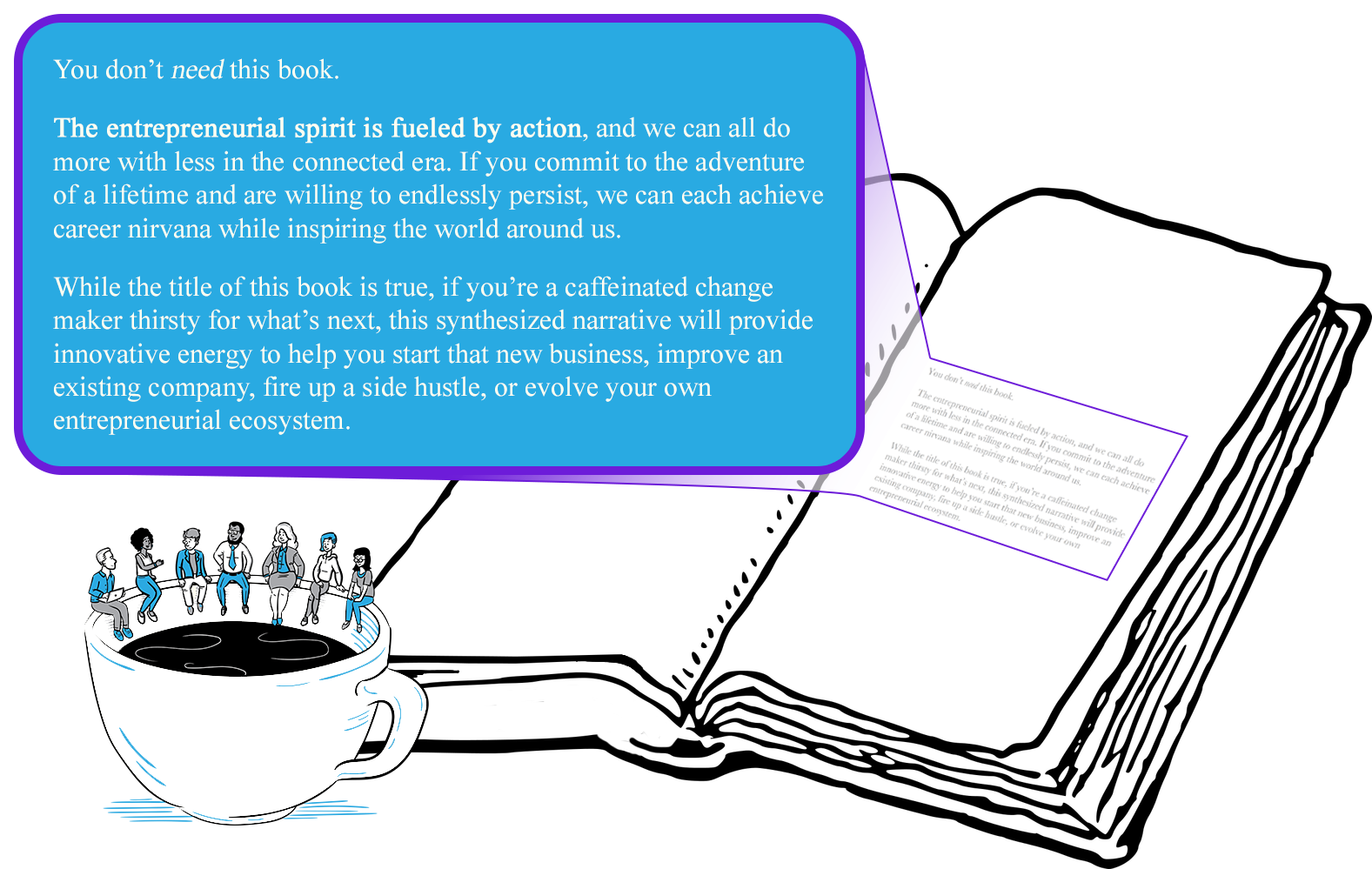
There are good reasons why we have so many clichés about talk being cheap. Movement is required when it’s time to get things done. Cheers to so many who don’t stop at ideas. Heretics who build when others don’t. Leaders who choose to make a ruckus without permission, and in so doing, go beyond the status quo by evolving ideas into reality.

Executionists show up.
Executionists experiment.
Executionists connect dots.
Executionists are consistent.
Executionists learn by doing.
Executionists leverage uncertainty.
Executionists don’t require a roadmap.
Executionists courageously communicate.
Executionists take time to be detailed-oriented.
Executionists are organized to stay efficient.
Executionists know when to shift gears.
Executionists add pieces to a puzzle.
Executionists are Serendipitists.
Executionists choose to care.
Executionists keep promises.
Executionists invite blame.
Executionists give credit.

Brewed From Within
#45 📖 Leadership

By Ben McDougal, ago

Interested Introductions

Leaving a networking event with a pocket full of business cards can feel rewarding, so why do these relics from past interactions quickly feel more like rubble? This can happen when we angle introductory conversations as transactions for immediate progress instead of connections built for consistent progress over time. When the focus is quantity, we tend to set authenticity aside and put on a show in hopes of getting what we want as quickly as possible. Playing this type of networking game may connect the dots that sit on the surface, but it typically won’t convert conversations into a foundation for memorable and sustained connectivity beyond the moment. Flipping this tendency is simple, but it requires shifting the goal from what we want out of the first contact with someone to what both/all parties need to feel a connection. That shift becomes much easier when we make a conscious decision: less of us trying to be interesting, and more genuine interest in who we’re meeting in the moment.

EXTRA SHOT

This contribution was written by Nick O’Brien. Nick is a founder and creative economy strategist who connects people to people, people to place, and people to potential.

When meeting people, what we’re working on doesn’t matter. Ironically, being valuable in a first encounter is about listening and learning rather than presenting ourselves as valuable. It’s about making mental links between them and others in our network. It’s conjuring inverse charisma, leaning into Playforce Principles, and igniting feelings in others that differentiate our first encounters from agenda-focused introductions.

These feelings produce a neurochemical reaction that sparks the brain’s amygdala and hippocampus simultaneously. It’s as if a cup of coffee is being poured into the parts of our brain responsible for creating and storing memories. In short, when introductory conversations unlock the true emotions of connection, the chances for strong memories of the interaction significantly increase. This makes it easier to stay in tune with more variety as our network expands.

After years of observing the ways we approach meeting someone new, a few basic trends emerge based on different types of people. Introverts are careful with what they say. They’ll share experiences, perspectives, and opinions but typically not without being asked. Extroverts are more likely to stand out, as they share their experiences, perspectives, and ideas more openly. A complex conversation is required to fully understand extraversion, introversion, and ambiversion, but let’s zoom in on how introverts and extroverts encounter the first moments of potential connection.

When introverts meet, they typically stay on the surface. The hidden intent is to not stand out, especially if what they say or do might make them seem less interesting. While this reserved approach might lead to an easy, free-flowing conversation, it’s not conducive to getting below the surface, where unique experiences, perspectives, and insights can be exchanged. This safe approach actually decreases the chances they’ll remember each other, because unique feelings were not shared inside the interaction.

When two extroverts collide, they both dive right in. With an intent of being interesting to the other person, they soon begin to subtly one-up each other to earn attention. Both extroverts may be energized, but the feelings of this memory are built on comparisons to the other person. Instead of feeling genuinely intrigued by what’s possible, confident people are left dwelling on their shortcomings, or worse, become driven to clash rather than to connect.

When an introvert and extrovert cross paths, it’s natural for an extrovert to dominate the conversation. Unsurprisingly, both personality types are comfortable during these interactions. The introvert is less worried about standing out when all they must do is listen. The extrovert shares their most interesting attributes, which makes them feel comfortable as well. The introvert learns about and feels a connection with the extrovert, which may help them remember more about the extrovert. Because the extrovert is doing all the talking, they learn little about the introvert, which leaves the extrovert feeling less of a connection with the introvert.

Maintaining an interest in perpetual learning is the key when meeting new people. With practice, you’ll be more knowledgeable and better at recalling what you know about who you know.

What you know about who you know can be a superpower in the form of making introductions. Your introductions can be concise (15–20 seconds), aligned, and engaging enough to not only have sticking power but also to generate immediate interest in taking action as a result of the conversations you help curate. An interested introduction is a compelling story that includes five elements: exposition, rising action, climax, falling action, and resolution.


1. Exposition = Name the Story
The names of who you’re introducing become the title of this story, creating a new folder in the introducees’ minds for the information you’re about to share. Many people struggle to remember names, which correlates with why we struggle to remember what we’ve learned about people. As you evoke unique feelings with your introductions, you’ll find yourself remembering the names and related details of more people. Once names are shared, one go-to detail to include is how you met each introducee, especially if you met through mutual connections, at a place they’re both drawn to, or during an activity they both enjoy. This will create immediate feelings of proximity, while demonstrating that the details of your connection are meaningful enough to remember. The relevant context also helps us tap into the knowledge we’ll need for taking the next step in making unforgettable introductions.

2. Rising Action = Spark Connection
Briefly explaining your knowledge about each person’s purpose can spark early feelings of connection.  Remember, what someone cares the most about is rarely found on their business card. As you notice the introducees’ intrigue in each others’ callings, that is when you’ll align both parties with the shared potential between their respective missions. A connection sparked through what each person cares deeply about welcomes a variety of aligned feelings that deepen memory and sets the intro up perfectly for what comes next.

3. Climax = Celebrate Together
Now we open the door to shared feelings, as the emotions of celebration are useful to tap into at this stage. By sharing a milestone that the people you’re introducing have recently experienced, each can revel in their own interesting journey while also learning about and cheering on who they’re meeting. Ideally, the milestones you’re celebrating are linked to the details you’ve already shared. This can be tricky if you don’t know people well, but get creative with small wins to always have this option. Large or small, professional or personal, mutual celebration is an experience of shared emotion that will make the moment more memorable.

4. Falling Action = Align Focus
With connection established and shared celebration flowing, the introducees will be eager to learn how else they can engage with each other. If possible, highlight an obstacle they’re facing or a potential milestone within a project they’re enthused about. If you don’t have these details, hint at potential intersections between their respective journeys. The context we add here invites the exchange of experiential wisdom and new ideas into the conversation that follows.

5. Resolution = Invite Action
The stars of this story feel less pressure to act interesting because you’ve done it for them. Now finish the intro story and encourage a longer sequel! To do this, mention (types of) people who each may need to meet in the next chapters of their respective stories. Ideally, these are folks the other person knows and can easily make an introduction to. If you don’t have deep knowledge of the introducees’ networks, name people you know are relevant to the connection between them. If the suggestions are genuine, a sense of being in the right place at the right time inspires emotions that fuel action.

    We have now set the stage for a memorable, emotion-based conversation by including relevant information that makes any personality type feel significant. This introduces equitable, level-setting hooks for a conversation to flourish without you as a constant conduit between them.

    When this method sets a virtuous tone between the people you introduce, there’s no need to rush away, but be quick to hand the mic. Enjoy listening, and watch the story you curated take the spotlight. It’s beautiful to see people meet someone they feel a connection with, and the more we do this, the more often our interested introductions lead to a new and lasting node within the startup community. More memories are made; others are strengthened.

    Extra Shot

    Create Your Magic

    Overtime is always nice, but remember we must also keep moving to share time with others, especially when we’re hosting the networking event.

    The art of stepping away in style is an added real skill. As we read about in You Don’t Need This Book, this is handy when one conversation starts to monopolize time. To stand out, bring more people into the circle. Introduce everyone using this same method and watch the value swell. You then have the option to stick around or excuse yourself. Even if you leave the chat, your energy will remain a part of that new conversation as you mingle elsewhere.

    Another approach is to joke that it’s time for everyone to go meet more new people. This lighthearted suggestion is rewarded as connectors become connected and more people build relationships without always needing you in the room.

    As intentional interactions are personified by emotion, mutual memories lay a foundation for true connection. When true connections show up, follow up, and keep adding diversity through a positive-sum mindset, the expansive value of a community can be realized.

    Brewed From Within
    #48 📖 Leadership

    By Ben McDougal, ago