Conversationalized

Humans have long used technology to communicate. As we taught machines to see, learn, speak, and move, computers were invited into the conversation.

ChatUX is technology that helps computers speak our language with a conversational experience supported by deep learning and large language models (LLMs). ChatUX makes AI easier to enjoy with a potential for accurate, unbiased, and meaningful interactions. This allows the seven types of AI to be so much more than pointless help desks, deceptive lead generators, misleading content, or fake followers on social media. Instead, the objective is to access endless insight with an ability to translate it effectively.

When upgraded this way, ChatUX bridges trust channels to personalize education, enhance business efficiencies, assist customers with empathy, deliver meaningful mental health therapy, and make past tasks irrelevant, all while parlaying multimodality so anyone can effectively express ideas.

As the way we communicate evolves, improvements geared for safety and customizability will keep technology in the conversation. The freedom of speech is a complex topic, but thoughtful guardrails that identify dangerous rhetoric help to keep everyone safe without unwanted censorship. Alongside responsible policymaking, influence layers help to customize ChatUX. This can add depth to personalize an interaction or to provide internal teams with a more reliable source of truth.

With technology conversationalized, prompt engineering became an evolving professional field of reconstructing inputs to optimize outputs. The demand for a brand-new mode of communication reminds us that real skills are required to remain relevant. Fortunately, when it comes to technology, an increased effort here often decreases effort there. In this case, learning to communicate with technology may require new resources, but ChatUX bolsters a paradigm shift where access to knowledge becomes pedestrian.

Extra Shot

When the cost of information is zero, willpower becomes a path to wealth.

We prepare our children with communication skills while instilling kindness, honesty, empathy, integrity, and so much more. From the words we use to the interactions we share, positive traits can be ingrained into technology for good.

Brewed From Within
#81 đź“– Technology

By Ben McDougal, ago

Bridges to Tomorrow

Limitations fade as boundaries are broken. If we collectively avoid extinction and continue building bridges to tomorrow, our relationship with time, nature, technology, and each other will uncork unknowns and light a path to our neon future.

Robotics

With AI in the brain and emotions that curate a personality, robots are advancing to go beyond isolated tasks. Cyborgs will turn knobs at work, while humanoids complete chores at home. With the mundane covered, the role of humans can shift toward leading whenever ingenuity is required. With full access to robotic efficiencies, economies will shift and the human touch will be even more luxurious. Leaders who welcome technology but never lose touch with the soul of their art, will be the hybrids who prevail.

Biotech

As technology interfaces with human biology, a bionic age will alter the laws of nature. When the electrical impulse from a thought is all that’s required to prompt action, the speed at which data can move is unfathomable. Brain-computer interfaces (BCIs) and other forms of neurotech are already treating disease and restoring movement by reconnecting the nervous systems. Most people don’t want to be first, but when might a routine doctor visit include individualized diagnostics and software updates to the nanotechnologies inside your body? When every cell in the body has a microscopic computer connected to it, the resource consumption is diffused by concepts like DNA computing and the mysteries of health care are solved.

Material Science

The atomic levels of technology have already connected intelligence to things we interact with every day. We’ve seen how the Internet of Things (IoT) adds digital depth to our physical world. As the cost and size of technology continues to shrink, the periodic table becomes a playground. For example, we have materials used in the construction of roads that transfer the force of vehicles to batteries. The stored electrical energy is then transferred to streetlights that illuminate the road at night. This type of elemental exploration and creative recycling is only a flicker of the flame for alternative energies and improved storage methods that can quench our planet’s thirst for energy while eliminating a dangerous dependency on limited resources. The universe provides everything we need. It’s up to us to squeeze improvements from elements that are waiting to arrive at their full potential.

Quantum Computing

When “or” becomes “and,” a bizarre world of duality is unveiled. The computing aspect within quantum mechanics uses quantum bits, or qubits, to solve complex problems with measured superpositions, entanglement, and interference. Dig in to learn more, but the superpositions found in quantum computing mimic complexity, with simulations that include all possible solutions at once. This is not a more powerful, number-crunching supercomputer. Quantum computers represent a whole new approach to harnessing the atomic and subatomic levels of physics. A scientific asset that eliminates secrets presents a mixed blessing. With the chemistry of life mapped by machine learning, medicine will solve diseases and the potential of material science will be realized.

At the same time, current cryptography and the encryption that provides security online is at risk. Increased checkpoints, biometric confirmation, photon distribution keys, and other post-quantum encryption standards are being tested to ensure the world is ready for hardware to keep qubits cold enough to unlock a world-changing partnership between classical and quantum computing.

Life Extension

Quantifying the cosmic depths of our own kind will give us ways to experience time in more profound ways. Instead of hoping to reverse the effects of aging with treatments, food, and medicine, augmented activities will engrain longevity from start to finish. Although the human body may not hold up forever, living more than 100 years will be normalized. As we live longer, how might agriculture, infrastructure, education, healthcare, economies, and our global climate adapt? Many who plan for this longevity will be primed to meet new demands in existing industries. The quixotic leaders will explore less obvious opportunities and convert unexpected challenges into new industries as well.

Outer Space

The cosmos makes us feel small, yet limitless wonder helps us think big. As bionic humans and quantum computing improves material science, a robot-supported species can be multi-planetary. The origins of astronomy are prehistoric, but off-planet exploration began when machines first visited space in the 1940s, and then humans in the 1960s. Scientific exploration led to a commercial space industry that has propelled an excursion throughout our solar system and beyond. Today, orbiting observatories are looking toward the origins of the universe, with life on Earth’s moon and Mars seemingly inevitable. As we interact further into the void, celestial frontiers can provide added stability for the human race and extend life on Earth. Cosmic resources, travel, communication, manufacturing, tourism, and security must all be addressed by leaders united by shared intentions on behalf of all humankind.

There are untold innovations yet to be conceptualized, but these bridges to tomorrow all signal progress. Widespread adoption is never straightforward, but listening suspends belief, and continuous steps forward can transcend invisible lines for us all to work as one.

Brewed From Within
#84 đź“– Technology

By Ben McDougal, ago

Septenary

AI is often thought of as a singular technology. This blanket assumption makes it impossible to compare the capabilities and functionalities that differ between the seven different types of artificial intelligence.

The seven types of AI are organized into two groups. The first group is based on capability and includes Narrow AI, General AI, and Super AI. The second group is based on functionality and includes Reactive Machine AI, Limited Memory AI, Theory of Mind AI, and Self-Aware AI.

Capabilities are determined by what different types of AI are able to accomplish. The three types of AI categorized by capabilities are Narrow AI, General AI, and Super AI. Here’s what’s possible today and what may be possible tomorrow.

Narrow AI <realized>

AI trained from existing data, with compute geared to do one thing really well. While data sets are vast, this type of AI cannot go beyond the data sets it is tied to. As of 2026, Narrow AI is the only type of AI that is fully realized within the three types of AI categorized by capabilities. Examples of Narrow AI include language translators, spam filters, recommendation engines, voice assistants, facial recognition, self-driving vehicles, and task-focused robots. Generative AI also falls within this type of AI. The mashups of generated text, images, video, and sound appear to be random but are still constraints by existing data sets. Neural networks, optimized data sets, computer vision, and machine learning make the capabilities of Narrow AI remarkable but limited by the data it has to munch.

General AI <theorized>

This advancing realm of AI leverages existing data like Narrow AI but can reason beyond those constraints. The transfer of intelligence with no human intervention makes the race to General AI (also called AGI) intense. When AI can make decisions based on an advancing state of its own understanding, the limit of this AI’s capabilities become unknown. Theories set the potential limit to around that of a human. Agentic AI hints at AGI with decision making and interdisciplinary task management, but lacks the emotional traits, planning, and other methods of generalization that will define the capabilities of General AI. Other signals include synthetic content creation and autonomous robots that can learn new tricks. As the theories of AGI become realized, ethics, regulation, and a determination of consciousness will be moving targets. The breeding speed of AGI may release points of no return, which makes it critical to understand and debate openly to ensure a new species is copacetic.

Super AI <theorized>

Welcome to when AI becomes its own species. This triggers concern due to the finite resources of Earth, but when AI surpasses the capabilities of humankind, dust from the deep future will already be everywhere. Multi-planetary travel will be underway, climate problems will be solved, and life extension will be supported by Super AI. Singularity is theorized to push the functionalities of Self-Aware AI and the capabilities of Super AI beyond humanity’s control. That means the time to plan ahead is now. As the minds of machines are wired, it’s crucial to collectively consider the heart and soul we build into technology. This will guide discovery with an excellence that came before it.

AI based on functionality is less about power and more about how things work. Reactive Machine AI, Limited Memory AI, Theory of Mind AI, and Self-Aware AI are the types of AI classified by their functionalities.


Reactive Machine AI <realized>

This is old school AI. Rooted in statistical math, Reactive Machine AI arrived soon after the computer was developed. There is no adaptive learning here, but the speed at which it can calculate data makes the performance seem intelligent. The functionalities of Reactive Machine AI drive more primitive examples of Narrow AI, such as recommendation engines and game-playing programs. This type of AI provides a static base, but with no memory and a focus only on specific tasks, attention shifts toward functionalities that have more adaptive characteristics.


Limited Memory AI <realized>

This type of AI learns and evolves. Functionalities of Limited Memory AI are still constrained by the existing data it was trained with, but world-changing advancements have been seen in machine learning, large language models (LLMs), generative AI tools, multimodality, computer vision, and self-driving vehicles. The realization of Limited Memory AI has Narrow AI pushing its full potential.


Theory of Mind AI <theorized>

Here, we combine existing data, an adaptive ability to learn, and an emotional willingness to think. Enhanced reasoning, multimodality, customizability, adaptive computing, and user-driven functionalities bring General AI (AGI) to life. Theory of Mind AI embraces emotions and understands how we think. This type of AI will add personality to humanoid robots and support reliable relationships by combining digital depth to the realities of our world. As lines blur between humans and machines, adaptive compute will remain a currency, efficiency will skyrocket, and a new era of life on Earth will begin.


Self-Aware AI <theorized>

It’s hard to define consciousness, but true self-awareness exemplifies this type of AI. Along with understanding how we think, Super AI will own emotions, hold beliefs, and is theorized to support the functionalities of Super AI.

Understanding the seven types of AI helps leaders leverage the perks of technology now and later. Our willingness to lift the fog helps avoid a fear of the unknown, and while resisting technology is a choice, it’s one that may put you behind innovation curves. Hybrids add artificial copilots but remain assertive and budget resources, knowing we are the pulchritudinous architects of our own neon future.

Brewed From Within
#81 đź“– Technology

By Ben McDougal, ago

Technology Soup

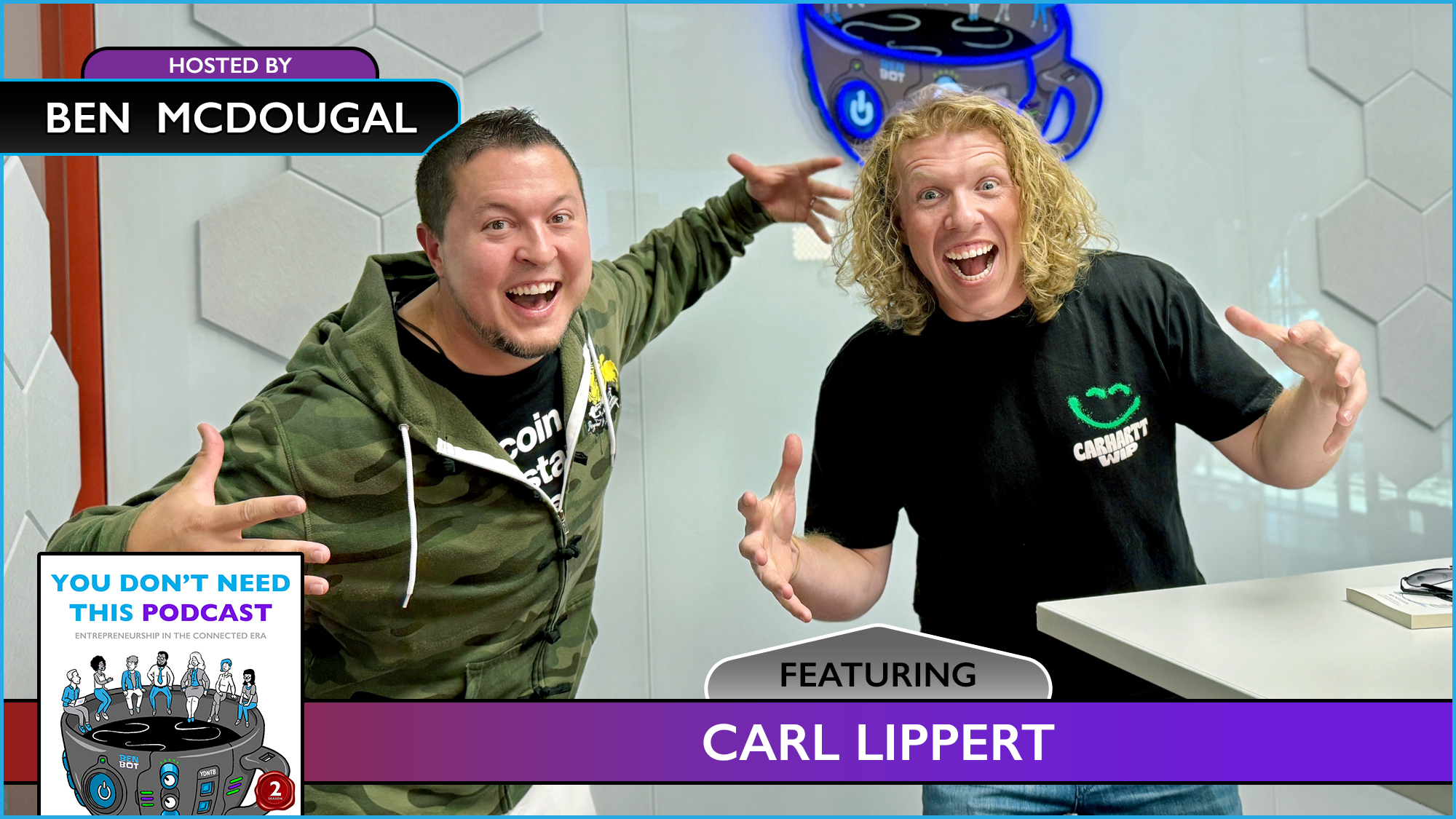
Put your laser eyes on as Carl Lippert swings through the studio to brew some technology soup. Together, we compile Carl’s global hackathon tour to hear how such curiosity paired with initiative helped this small town technologist explore the world.

From farming to AI, to blockchain networks, to prototyping, to nomading, to atoms, cryptography, and truth, EP81 is loaded with tactics and innovative energy to optimize your time and environments.

As Ben and Carl discuss, when technology is inherently money, it’s less about jargon and maybe we get back to atoms. Add to this concoction of thought, a dash of skeuomorphism, how AI can be magically expensive, robotics in daily life, and space! Enjoy this remarkable episode with EDM in the background, stay wild, and as Carl generously invites us to do – try anything.

LISTEN on APPLE PODCASTS
LISTEN on SPOTIFY

BONUS MATERIALS

https://CarlLippert.com

https://CarlLippert.com/blog

https://linkedin.com/in/carllippert

https://x.com/carllippert

http://tryanything.xyz

Roasted Reflections Break: Replicants

http://Technology-Soup.YouDontNeedThisPodcast.com

https://BenMcDougal.com/welcome-to-web3

https://BenMcDougal.com/indexing

http://YouDontNeedThisPodcast.com

EP3 – Blockchain Orgins 🎙️ Jon Woodard

EP6 – Computer Vision(ary) 🎙️ Brad Dwyer

EP8 – Cryptographic Cowboy 🎙️ Kyle Tut

EP39 – Digital Dawn 🎙️ Will Schneller

EP71 – Still United 🎙️ Alex Myers

EP80 – Audacious 🎙️ scottrepreneur

The Anthology of Balaji – The Types of Truth

Carl’s Wardrobe: https://us.carhartt-wip.com

Roasted Reflections on Discord

https://ReadWriteOwn.com

http://BENBOT.ai

By Ben McDougal, ago